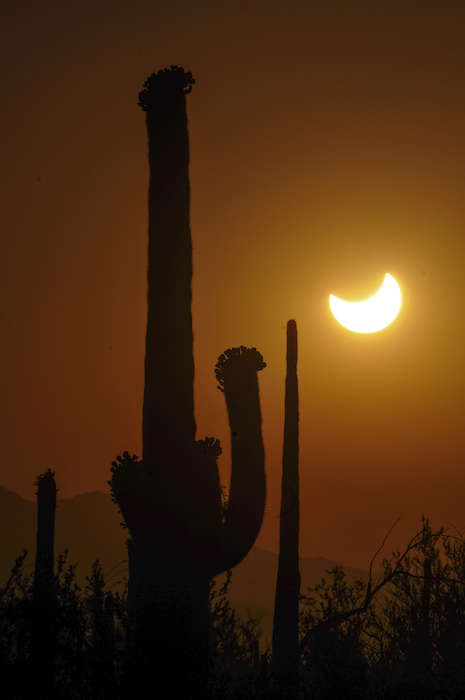
TUCSON SUNSET ECLIPSE ALL ABOUT SAGUAROS, THE RING OF FIRE STRETCHES FROM ASIA TO NEW MEXICO
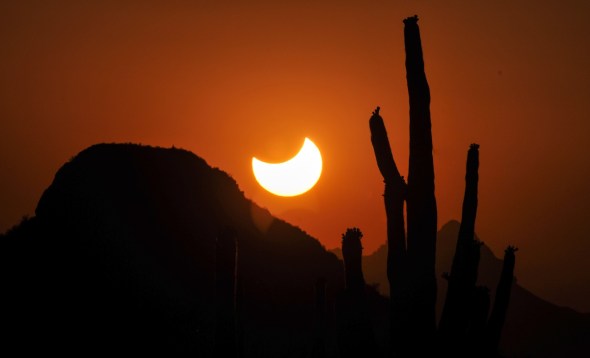
As Sunday’s solar Eclipse drops toward Sunset the Saguaro Cactus invades the view and stamps this a South West view from Tucson, Arizona….
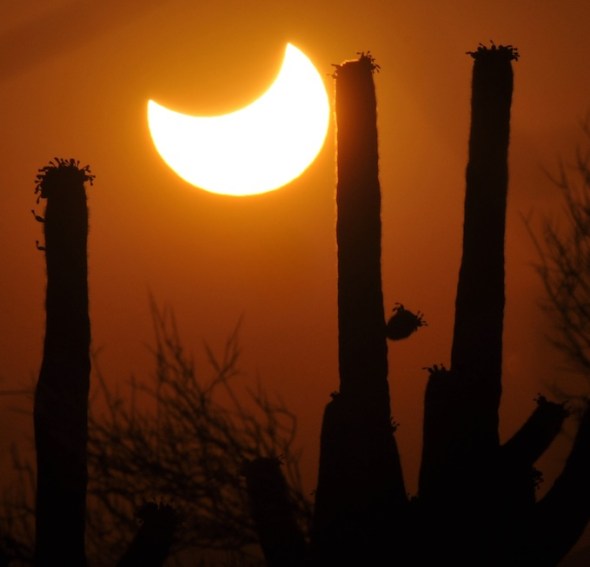

Using a BW filter (25A) I attempted to cut exposure and project a yellow Circle of Fire
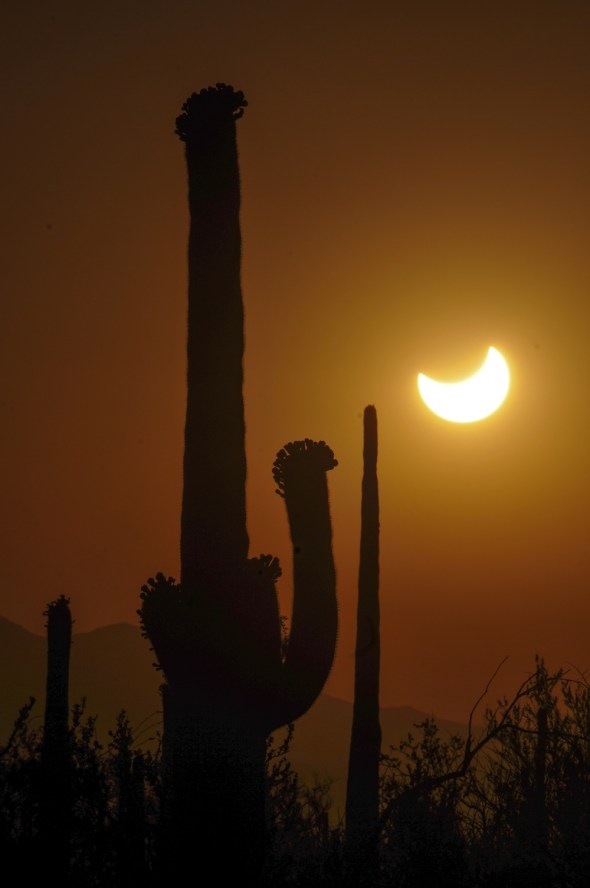
Tucson’s Saguaro National Monument West
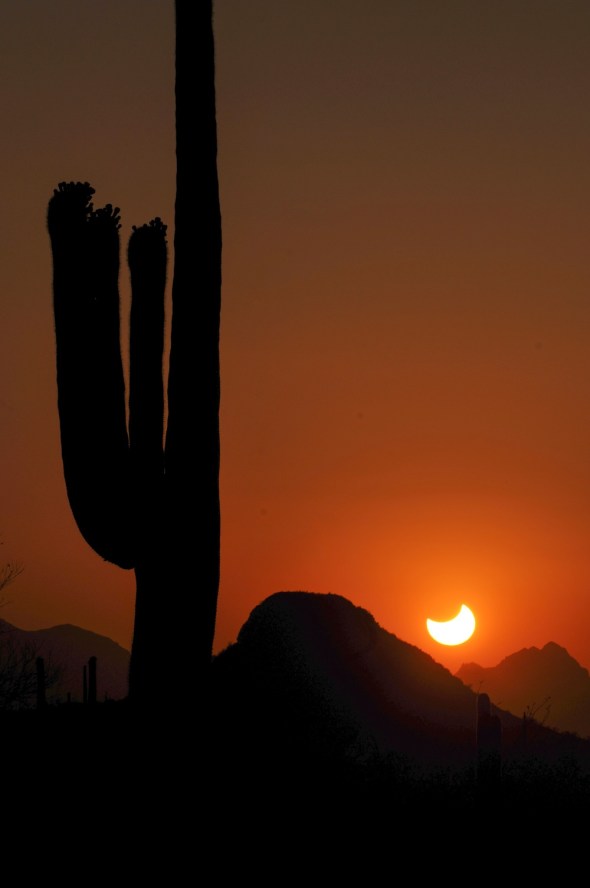
Sunset in the Tucson Mountains west of Tucson, Arizona
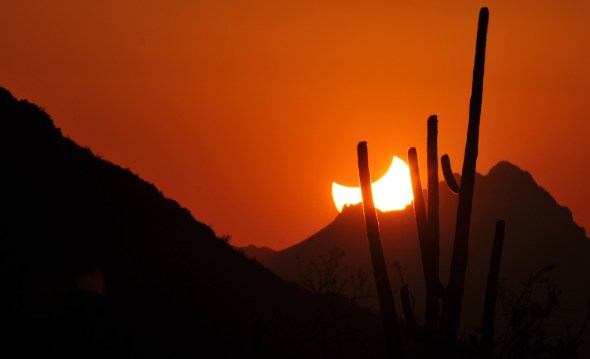
Slipping behind the Tucson Mountains the Solar Eclipse backlights the Saguaro, the largest cactus in the Desert.
FOR MORE SOLAR ECLIPSE PHOTOS CLICK HERE FOR SOUTHWESTPHOTOBANK GALLERY


<a href=" SPANISH TRANSLATIONS:
“TREE TIME” THE SINGLE GREATEST CONTRIBUTION TO AMERICAN ARCHAEOLOGY THE STUDY OF TREE RINGS or THE DAY SOUTH WEST PREHISTORY STOOD STILL …
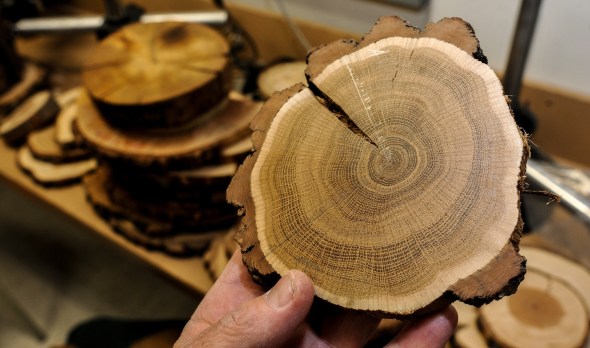
Annual growth rings show years of drought, fire or growth…
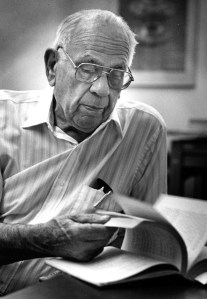
Emil Haury spent his entire adult life at the University of Arizona. He changed the name of the Archaeology Department, to the Anthropology Department at age 33.
THE STUDY OF TREE RINGS or THE ARCHAEOLOGIST’S TIME PIECE…wrote Emil Haury in his “PREHISTORY OF THE AMERICAN SOUTHWEST, in which he illustrates a new world order as seen by a man who spent his whole life piecing together the past. In his book Haury recounts the tale of HH-39, a tree ring sample which caused the most exciting day in his career when south west Prehistory stood still and then changed forever. Before the study of annual tree growth rings, or dendrochronology, archaeologist were unable to assign dates to the ruins of the south west. The discovery of three chunks of coal in a ruin near Show Low, Az in a single afternoon UA scientist Andrew Douglass dated 40 old villages occupied by the Pueblo Indian before the arrival of the Spanish. It was a contentious time in South West Archaeology, the Mogollon Culture controversy was raging through archaeological circles who battled over whether this orange pottery was a variant of the Anasazi or was it a distinct culture! Many archaeologist argued for greater study because they believed the known chronology was too short, others failed to budge and without actual dates, nothing was certain. Carbon 14 dates come in with a plus and minus ten or more years, most dates for the material culture known as Mogollon, had evolved into pit house villages around 1000 AD and later those villages grew into pueblos with connecting room blocks. Many archaeologist believed after 1000 AD there was a mixing of the Anasazi and Mogollon peoples who may have evolved into the Western Pueblo culture occupying large multi-story room blocks from 1200 AD into the post-contact period around 1500 AD. Early dates for the Mogollon were lacking, and without better data, many archaeologist found the Mogollon culture argument flawed.

At the same time tree ring studies were evolving alongside the archaeological scientific inquiry and archaeology student Joe Ben Wheat uncovered an orange pottery site with AD 350 tree ring dates just beneath the Mogollon Rim. No sooner had the skeptics requested tree ring dates, the archaeologist provided them, putting to rest a running battle that had made Haury’s life difficult for decades.

The Sequoia Tree is the largest tree in the world and yields a rich and large record of growth cycles in the California White Mountains. South West tree ring dates do not relate to the White Mountains of California, which has a different tree ring record. The above photo shows the radius of a Sequoia.
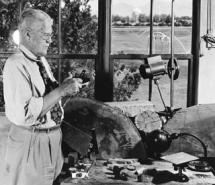
A.E. Douglass, founder of the University of Arizona Laboratory of Tree-Ring Research
Dr. Andrew Elliott Douglass, The Father of Dendrochronology, had developed this chronology for the south west extending from present to almost the time of Christ (AD11). “This record had a two-fold value for archaeologist”, wrote Haury in his Prehistory. “First it held the key for dating countless ruins and ruins yet to be dug, since this record can be consulted anytime. Second, it offers a record of weather, a story with years of drought and years of plenty, which opens up studies along ecological lines.” Douglass the astronomer believed tree rings could carry data concerning sun spots and by exploring that, he learned that tree rings tell much more.
Haury had given much thought to where to dig in order to find tree rings which everyone presumed could fill-in the gap and overlap the two known existing Douglass chronologies. On June 22, 1929 a work crew near Show Low unearthed three pieces of charcoal, HH-39 it was labeled, –it proved to be the bridge between Douglass’s prehistoric and historical-period tree-ring chronologies. Haury remembered the discoveries of that day as the single most dramatic event of his archaeological career; what follows is Emil Haury’s recollection of what was said by Douglass following his assessment of HH-39.
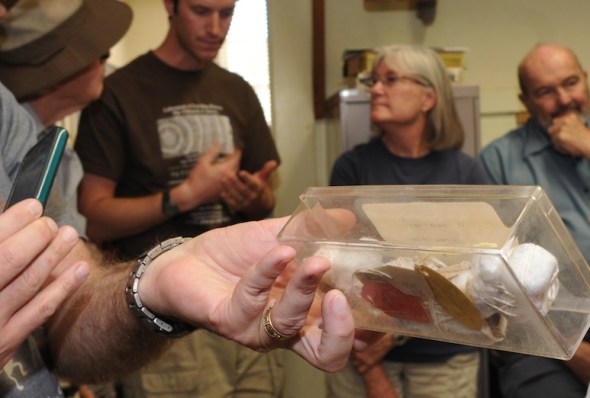
Three pieces of charcoal dug close to the surface at a Mogollon site near Show Low Az. These fragile specimens changed the direction of Archaeology.
“I think we have it. Ring patterns between 1240 and 1300 of the historic sequence correspond in all important respects to the patterns in the youngest part of the prehistoric sequence. This means that there was no gap at all. The overlap of the two chronologies was only 26 years and there was no possible way to join the two on the evidence we had. Beam HH-39 has established a bridge. “This was a moment of great Truth writes J.J. Reid in “Prehistory, Personality, Place” with Stephanie Whittlesey in his overview of Emil Haury’s career, “and at times like this, the truth sinks in slowly. No one spoke”, Reid wrote about the moment of discovery; “Douglass was busy making mental calculations, correcting his relative dates for ruins to the years of the Christian calendar. He broke the silence in his gentle way and told the spellbound archaeologists: “This means that Pueblo Bonito was occupied in the 11th and early 12th centuries and the other large ruins of Chaco Canyon were of the same age. The ruins of Mesa Verde, Betatakin and Keet Seel are mid-13th century.” Delivering at the same time, a new short course in South West Prehistory. The experience was unforgettable, said Haury, who cherished working along side Douglass, the scholar and the astronomer turned archaeologist.
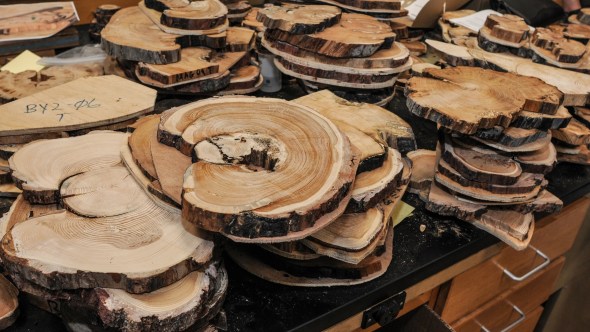
For seventy-five years, The University of Arizona’s Laboratory of Tree-Ring Research has helped multiple-discipline scientists study mysteries in archaeology, ecology, geology and most recently in climate change. In 2007 a “transformational gift” from Agnese N. Haury, the widow of Dr. Emil Haury, who donated $9 million to construct a new building to archive the lab’s collection of millions of samples. The building will be named the Bryant Bannister Tree-Ring Laboratory, the former director of the Tree Ring facility, who still contributes to science.
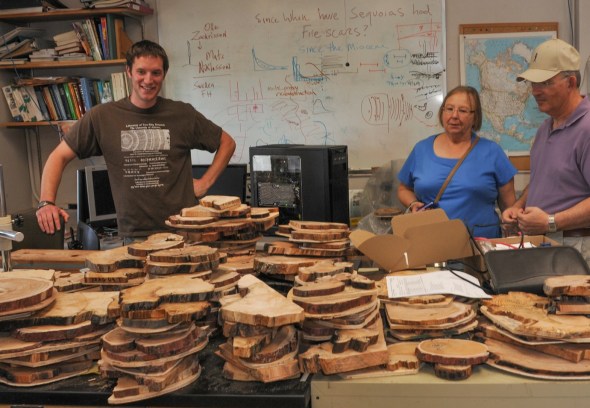
Chris Guiterman with a 700 year old tree ring chronology he collected during a recent Siberia visit.
Guiterman, is one of 19 graduate students in Tree-Ring Studies, he graciously gave us the walking tour of the largest and oldest tree-ring facility in the world. Guiterman’s office lies behind one of the many nondescript doors in the guts of the UA Football’s West Stadium where the tree-ring lab has called home for 75 years. Wood cross-sections are stacked high on his desk. This is Guiterman’s recent tree samples collection from Siberia this summer, where he was able to amass a 700 year chronology which will advance climate studies around the world. “We make sanding a fine art”, he says about the practice of reducing the wood until microscopes reveal the hidden rings. Guiterman says such detail can show growth signatures, showing which side of the mountain this tree had grown or visualizing the new growth each season or fire scars also seen in the ring.
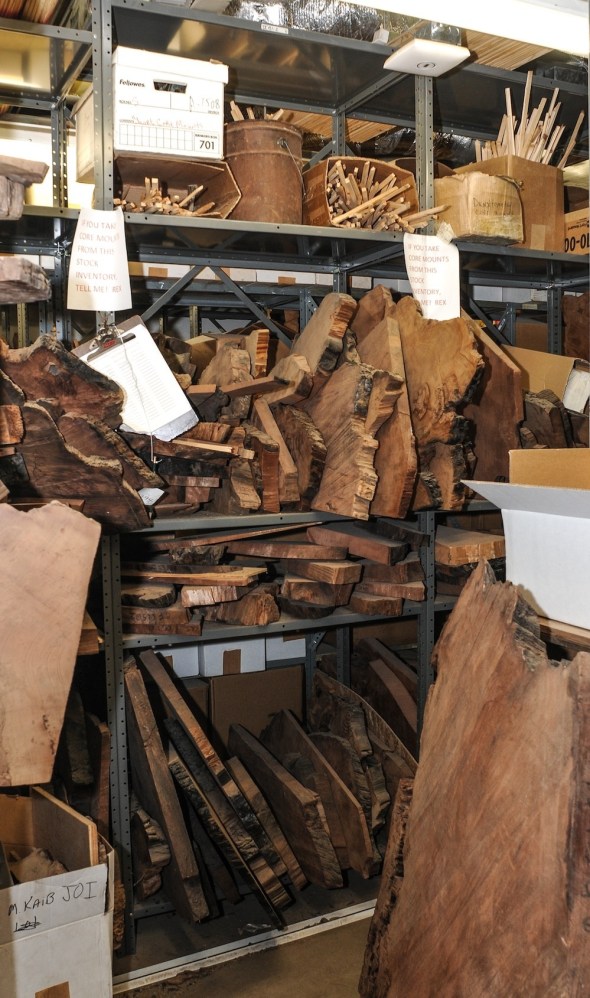
100 years of collecting wood samples
With new resources, more and more of the collection data can be digitized. The Tree Ring Bulletin can inform scientist worldwide on the web.
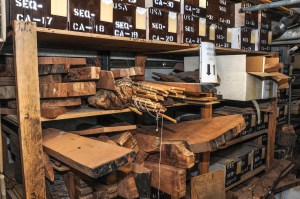
Gladwin’s Gila Pueblo who with Haury started the collection in the cliff dwellings of Cherry Creek
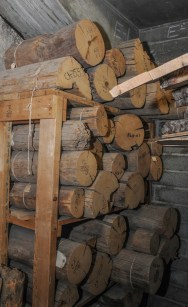

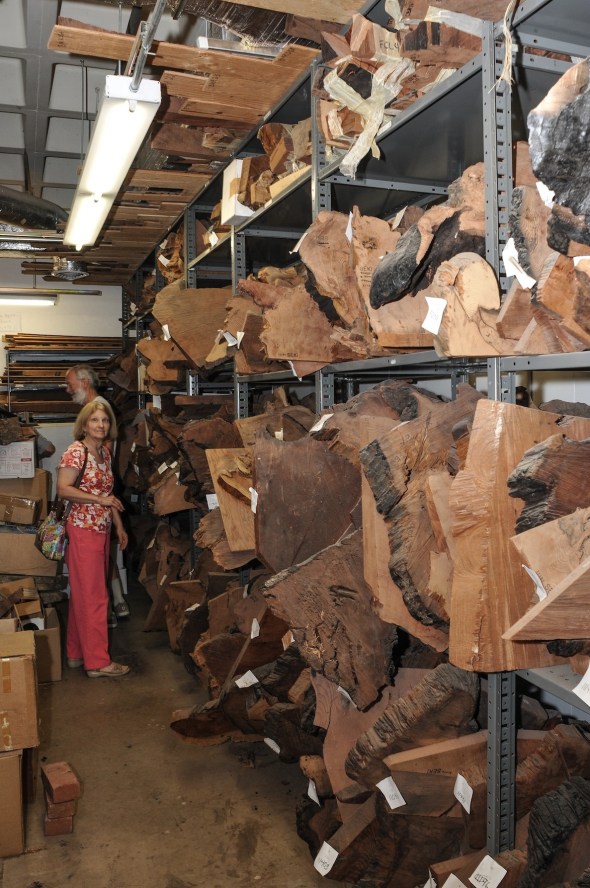
Each specimen carries a code which locates the site, the collector, the date
Douglass’s tree ring study has a distinct footprint limited to Mesa Verde to the north, Prescott on the West, Globe to the South and Pecos National Monument that lies north and east of Sante Fe, NM. Ironically there is little wood in Southern Arizona that can be dated without carbon 14, few tree species there yield good tree rings, but the Ponderosa Pine, Douglass Fir, Singlemann Spruce, and Aspen found in the Sky Islands and some Scrub Oak and Juniper can be dated in the high desert. The Saguaro has no fingerprint.
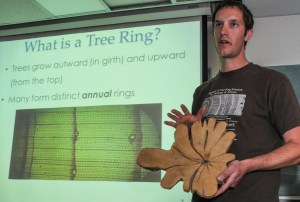
Chris holding a saguaro footprint which has no rings.
Was the abandonment of South West in 1200 AD a failure of the monsoons to form? Guiterman says the lab has begun the “Monsoon Project”, where data technicians are digitizing tree ring data by inputting (clicking on each ring) the growth cycles on tree ring specimens and their relative size collecting a history of wet, dry, fire, lightning, all data to feed studies from Archaeology, Arid Lands, Ecology, Biology, Geography, Geology, Forestry, Hydrology to name but a few. As the data is digitized it will be hosted online and made available to scientist around the world. The Lab long-ago realized tree ring dates alone held interest and have broken out all dates for the Tree Ring Bulletin, which monthly informs those interested in dendrochronology or a tree-ring public of any new contributions and possibly new data, rather than waiting for archaeologist to publish their findings, new tree ring dates are released quickly. Meanwhile, classic mysteries like “why did everyone leave ?” Might be answered in crunching the numbers.
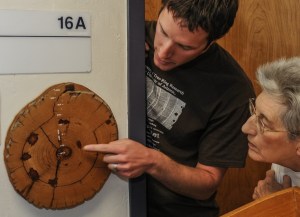
A cross section dating from 180 BC to 500 AD
Meanwhile our tour walked through numerous rooms set aside for the deposit and curation of large chunks of wood, some chunks from the oldest ever known tree, which the park service harvested for its tree rings not knowing it was the world’s oldest tree. Hanging on the wall, next to a doorway, hangs the oldest known tree ring 180 BC. Elsewhere we walk past log ends broken by stone axes, beams from pueblos and wood samples of every kind, collected from every end of the Earth. “Institutional knowledge” was the best description for how things were filed or salted away, each piece is coded by collector, location and collection. Dendrochronology has been so refined that scientists can now recognize “signatures” which give away where the sampling grew up, into a tree, the Flagstaff signature, is well known in Arizona. 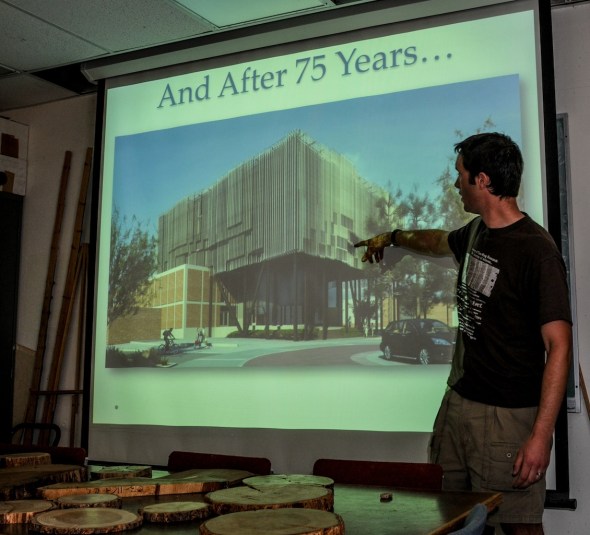
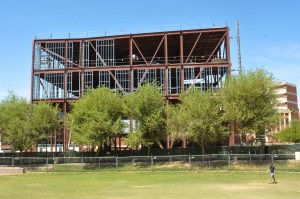
The building itself will be occupied in January, it was designed to look like a tree house with a block of offices and laboratories suspended high in the air at the roof level of the present Math East building. The offices are screened by individually articulated metal tubes that resemble the leaves of the Palo Verde tree. The main trunk beneath this block contains public exhibition space and the multi-purpose room that serves as auditorium and teaching lab. The Laboratory of Tree-Ring Research now houses approximately 2,000,000 wood specimens and their associated records, photographs, analyses, etc. As the oldest dendrochronology laboratory in world, the collections are unparalleled in size and diversity and has been built over the past 100 years. The new building will provide space for another 100 years of collection.
CONSTRUCTION WEB CAM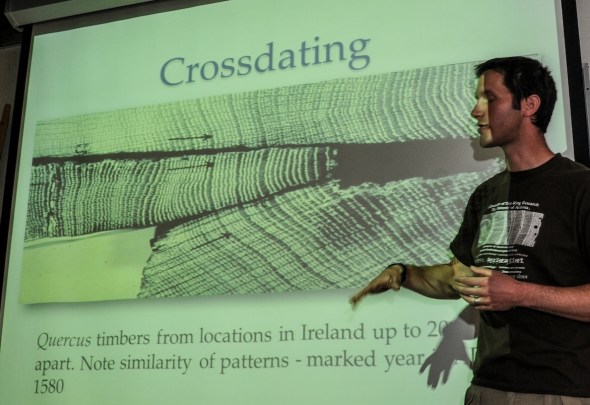
TREE RING CROSS DATING EXERCISES….CLICK HERE
MORE TREE RING EXERCISES…CLICK HERE
BRISTLECONE PINES INDICATOR OF CLIMATE WARMING…CLICK HERE
SOUTHWESTPHOTOBANK.COM IMAGE GALLERY … CLICK HERE FOR MORE TREE RING LAB PHOTOS
University of Arizona
Laboratory of Tree-Ring Research Tour on Utube …below

SPRING IS BUSTING OUT ALL OVER, CACTUS ARE BLOOMING NOW AND BIRDS ARE NESTING, COLOR ABOUNDS IN ARIZONA’S SONORAN DESERT

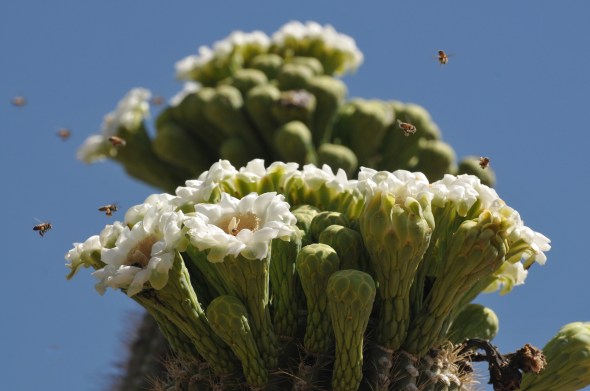
WARM SUMMERS HAVE MOVED THESE SUMMER BLOOMS TO SPRING ARRIVALS.

Different species start and stop at different times but by May everything will be aflame with color.
“You live in the Desert?”, folks ask from time to time. The “Sonoran Desert”, I always reply, “it’s different.” But still people first conjure up scenes from Lawrence of Arabia and figure you hang out at the waterholes.

SONORAN DESERT FOOTPRINT
The life cycle of the desert begins with wildflowers showing up in the middle of March and being greeted by the purple bloom of the Hedgehog cactus in early April. From that moment on, everything begins to bloom and since the last dozen years have been the warmest on record, lots of blooms are a bit confused and out of cycle. The saguaro blossom for one, was scarily seen until late May or early June, now they are one of the first blooms out. Most of the prickly-pear type plants are showing color, as well are the Ironwood and Palo Verde Trees and Octillo, who rely on high wind to move their seeds. So every year when the golden coat covers up the Blue Palo Verde Tree, winds always pickup within a few days, and carry those amazing coats away. They are replaced by another Palo Verde which has a dirty yellow coat but it lingers for a month to come. Every since I built my back porch I have fathered more Doves than any other one person, it allows their mothers to tuck away and find from the egg thieves, many of whom, find their way but as soon as one Dove finishes another starts up and so it goes.
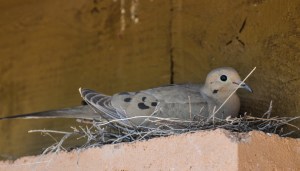
Swapping out on-the-nest-time with the Dad, the Mom finds a few minutes to freshen up and gather groceries before coming home to the grind.
In Tucson Arizona the city spreads out from mountain range to mountain range, maybe 40 miles square, and for years construction pushed out the wildlife that surrounds this desert land. In recent years the wildlife has begun to return and fit in, into the folds of life where people come and go and basically leave the critters alone while going on about their lives. A mother big horned owl Has set up a nest at the end of busy La Canada Road in Northern Pima County inside Oro Valley.
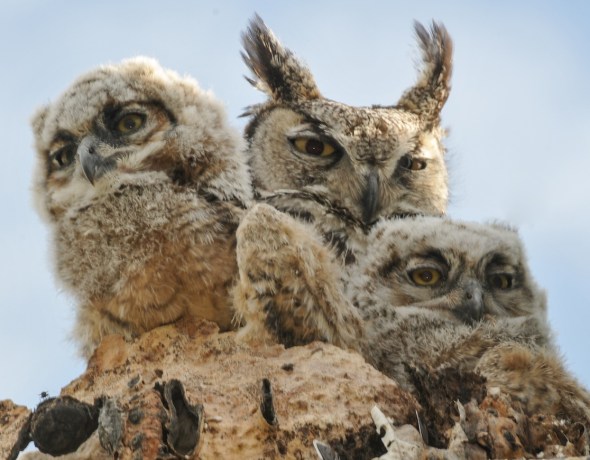
Neighborhood sensations sitting atop a saguaro, runners, joggers, school kids waiting for the bus all check in on the Owls. Last I checked, the small one was alone in the nest making me think the bigger one was out hunting with mom.
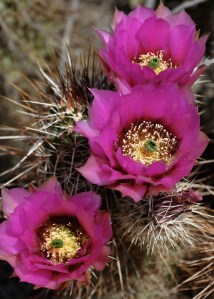
First indicator of Spring in the Sonoran Desert, once this bad boys light up, every thing else is just around the corner.

This brilliant yellow coat never lasts long, usually rain or strong winds come along and throw their seed to the wind.

These blooms will linger for a month of two before being eaten.
A wildlife re-habilitar modified the nest with a cardboard box to provide extra space and shade for the babies and everyone seems pretty comfortable. The nest has become a major curiosity and folks go by regularly and see how the owls are doing. Lots of Kodak moments, kids with binoculars, and curious walkers, motorist all who do a slow roll by, trying to see if the baby horned-owls are hunting yet on their own in Honeybee Canyon.
Not enough feather yet to fly, this horned owl is waiting for the moment of flight.
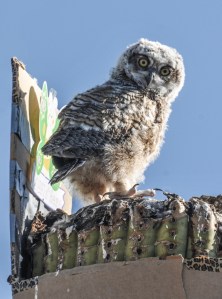
MORE CLOSEUPS OF BABY HORNED OWLS….CLICK HERE
SOUTHWEST SPRING PHOTOS … CLICK HERE
SOUTHWEST SPRING 2012 PHOTOS CLICK HERE FOR SOUTHWEST PHOTOBANK GALLERY
<a href=" SPANISH TRANSLATIONS:
HORNED OWLS OF LA CANADA ROAD PUTS NEW FACES ON THE BLOCK, A NEIGHBORHOOD BLESSED EVENT, BUT KEEP AN EYE ON FIDO

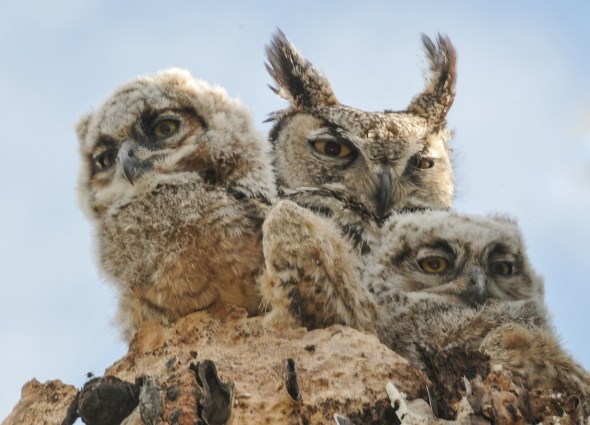 When lightning sliced from the sky last summer and exploded the top five feet of the neighborhood saguaro, residents felt it tragic, but few could imagine it set the stage for what happened next! Few noticed in mid-March when a horned owl started hanging out, eyes started noticing when it was obvious the momma owl had babies. Soon neighborhood walkers, runners, schoolkids, sidewalk superintendents, everyone started coming by the north end of La Canada Road and checking out the nest. Real drama unfolded last weekend! When eight year old Alexander burst into the kitchen yelling, one of the owls had fallen from the nest. The mother of two, Marian, called Fish and Game and alerted them to the horror unfolding on Pima County’s northwest side.

Mom with baby and new shaded nest.
The baby owl had scooted beneath a bush and more than fifty people gathered to help, or do what they could…since a riot was probably not far off Oro Valley Police responded and was able to keep peace in the neighborhood and to keep traffic moving. When “Karen the Owl Lady” showed up to help out, the state and federal licensed wildlife re-habilitator, first secured the baby and then folks in the crowd provided a ladder tall enough to deal with the almost 20′ high saguaro.

Heros of the day, Marian and Victoria called Game and Fish and provided materials...
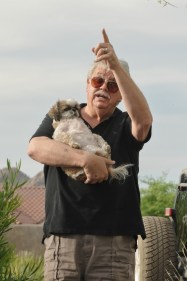
Showing Fido the Horned Owls
Mother Marian, son Alexander and four year old Victoria dug up a large cardboard box and duct tape enough that the owl lady could set up a bigger platform and shade for the trio. As Karen climbed the ladder, mother owl flew away, the remaining baby stayed in the nest, while the owl lady fashioned a new larger cardboard nest and duct taped it around the top of the blown off saguaro. Karen reported the nest had a dead rabbit so the babies had food enough for a couple days. With the loose baby re-nested, the whole neighborhood now sat on pins and needles awaiting to see, if mom would come home. Nothing happened the first day but by the second day mom was seen watching from near-by housetops and soon she came home with dinner.

Meanwhile the neighborhood has it’s focus back and everyone is coming by and checking out these massive horned owl babies. Many dog walkers bring fido by and those owls eyes get huge as they see this moveable feast shaping up at the base of their nest. Game and Fish posted the area trying to get the owls some space and hopefully the owls will move along before they are big enough to take Fido with them.
In the evening, Marian reports she hears the mom owl hooting with her mate, who visits, sitting on houses nearby and hoots about the days news. The owl lady says it will be a couple weeks yet before the babies will be able to fly and soon after they will be off hunting in Honeybee Canyon, as their ancestors have for centuries.
MORE OWL CLOSEUPS, SEE SOUTHWESTPHOTOBANK.COM, FOR MORE IMAGES…
GREEN VALLEY’S ASARCO DISCOVERY MINE TOUR SHOWS THE BEST AND WORST OF COPPER MINES AND THE ART OF HARDROCK MINING


Where ever hard rock miners scratched the Arizona soil, they found mineral wealth, like gold, silver and copper, now-days low grade rare earths are needed for plasma TV’s and the demand for minerals, right now, is roaring. The insatiable appetite of China and the entire Pacific Rim has Arizona Copper Mines working hard to extract low grade ores for big dollar returns, jobs are being created and the trickle down economy will benefit us all. The first copper mine creation in 65 years happened in Safford, Arizona. Rosemont Mine wants to start up in the foothills of the Santa Rita Mountains and its creation is extremely controversial. “It’s the environmentalists” said Roger Stokes who leads Mine Tours for ASARCO Discovery Center in Sahuarita, Az. Stokes leds tours of snowbirds and tourists to viewpoints, to the crusher facilities and educates them with facts and figures about copper mining.

Many prefer this view to that of the Grand Canyon say tour leaders at the ASARCO Mineral Discovery Center six miles south of Green Valley, Az
Stokes meets hundreds of people who appreciate the awe, the scale and the grand color which the setting sun brings out of the wall of the open pit. Some folks say it is almost as beautiful as the Grand Canyon says Stokes of the ASARCO Pit whose 100 plus years of mining has left a hole 2 miles across by 1.75 mile and a half mile deep. The tailing stretch for almost twenty miles.
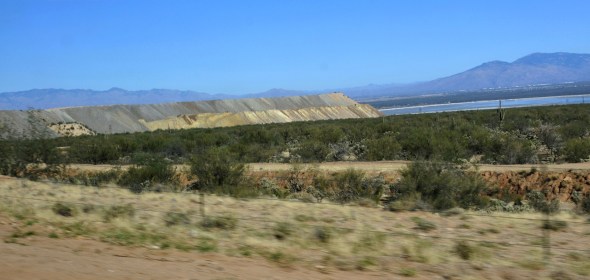
Next spot that will be completely covered by copper mine tailing.
“Pecans use lots more water than we do!”, offers Stokes, aware of the ever present push and pull of politics in Southern Arizona. It is no secret Farmer’s Investment Co.(Fico) is opposing both a new pipeline from ASARCO’s CAP tap to the proposed Rosemont Mine. Pecan groves are among the largest water users in the area, largest Pecan Orchard in the United States and locals says the region is undergoing notable ground subsidence due to the pumping of groundwater. Estimates suggest a mine the size of ASARCO’s Mission Mine and the proposed Rosemont Mine would both require the water needed for a town of 25,000-30,000 people.

Right next to the ASARCO Mine which has held water rights since 1898.
The Federal Bureau Of Reclamation concluded that “plans for taking and using the CAP entitlement will not result in significant environmental impacts to the Green Valley/Sahuarita area, Upper Santa Cruz Sub basin of the Tucson Basin Aquifer, or the human environment in the vicinity.” As long as the CAP delivers water to Southern Arizona, the mines have been promised water.

Aerial view of one of three southern Arizona Open Pit Copper Mines, this is the ASARCO Mission Mine
The Mission Mine dates back to the 1898 Mineral Hill Mine which grandfathers water rights for this ever-increasing footprint of a copper mine. The proposed Resolution Mine in Superior plans to use CAP Water, as does the proposed Rosemont Mine in the Santa Rita foothills near Tucson. One theory is the pipeline from Pima Mine Road to Rosemont would be paid by Rosemont Mine owners Augusta Resources, another possibility is that it will be paid for by the next 25,000 residents who move to the valley and hook up, Green Valley Water will simply pass the cost along to new customers.

Lots of ore must be moved, crushed and separated for pure copper ore to be made.

Spinning cages with ball bearing that wear down the ore to small pure concentrations.
The ASARCO Pit is pure efficiency, everything is hooked to the grid. It produces about 1000 jobs. The trucks, crusher, tumblers all run on electricity, the monthly Tucson Electric Power bill amounts to about $1 Million. They use pine oil to separate copper and silver during the floatation process before pouring off the waste and adding to the miles and miles of tailing. The tumblers begin with boulders up to 5 feet, mixed with 8 inch steel balls, and reduced until mixed with 3 inch steel balls, more tumbling, until a 28 per cent pure copper powder is produced. Ten pounds of 28% pure copper ore is produced from one ton of copper ore and ASARCO produces 130,000 tons of copper a year.
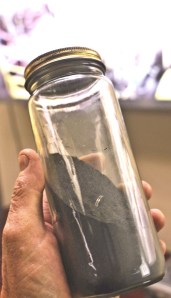
Twenty five trucks haul 28% pure ore every day 90 miles north to Hayden, AZ Smelter where other mines also ship their concentrated ore and have for more than a 100 years-smelted ore into 99% pure 750 pound anode which is then shipped to Amarillo where a refinery takes all the 99% pure ore and takes it to 99.999% purity making it electrically conductive. This process was once handled by a century old smelter in El Paso, Texas has now shut down and the courts have negotiated a $50 billion plus cleanup required of ASARCO.
MORE COPPER COUNTRY PHOTOS SEE SOUTHWEST PHOTOBANK GALLERY … CLICK HERE
ASARCO Discovery Center
1421 West Pima Mine Road
(520) 625-8233
For Mine Tours and gift shop
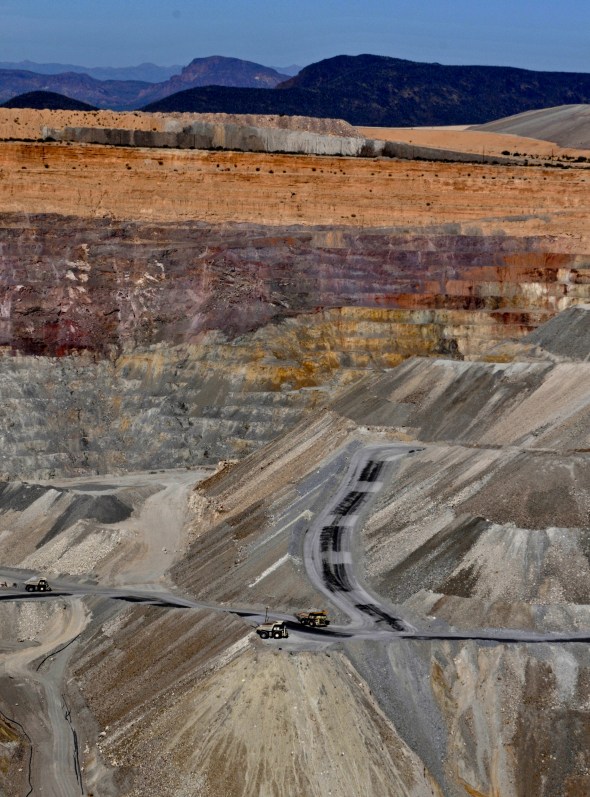
The multi-colored pit wall reveals the varied ore content.
<a href=" SPANISH TRANSLATIONS:
SUPERIOR COPPER MINE TO USE ROBOTS ON WORLD-CLASS ORE BODY, SAN CARLOS APACHE VOW FIGHT TO SAVE RESERVATION WATER FROM IRANIANS

 Jo Holt, candidate for Senate LD26 speaks with Adam Hawkins,lobbyist for Resolution Mine with a backdrop of Apache Leap Mountain’s mantle top.
 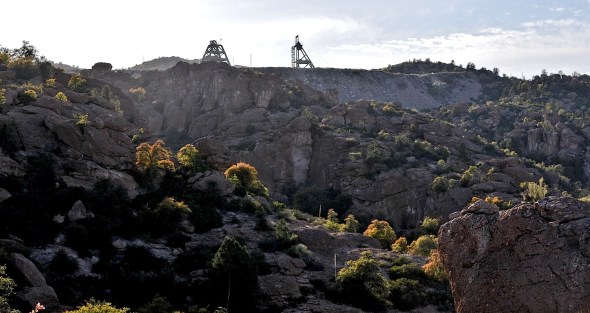 APACHE LEAP Mountain, when mining begins robots will extract 4,000’of ore, subsidence will drop the roof of the mountain and the surface will become unstable, foot traffic will not be allowed to traverse the Oak Flat Campground area.
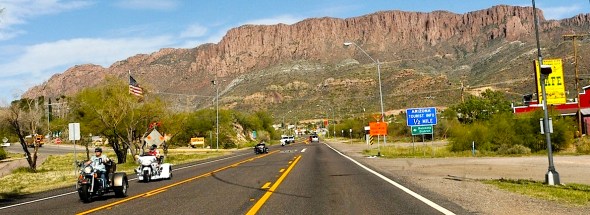
Highway 60 traffic splits Superior in half and leads you on top of Apache Leap Mt.
Arizona’s Copper Triangle for a hundred years developed huge mining complexes which produced small company towns that served the worker, educated the children and hospitalized and doctored the sick. Many believed the mines were GOD sent, since it fed, clothed the family and many felt it had their back, and made every difference in their lives. Others knew if you worked hard, did what you were asked, got-along by going-along, the mine was your friend. If you talked back, got into trouble or made waves the mine was not there for you. Mexicans were discriminated against; from the jobs they could have, to where they could live and where they could drink or eat. Whites made more money for the same work and corrupt supervisors extorted kickbacks from Hispanic workers to keep their jobs. The Unions fought to enter the mines and won numerous concessions, an hourly wage for everyone and for Mexican-Americans the right to train for the better jobs.

Faded mural on a downtown wall showing a smelter and miners.
Over time lives were built, copper was mined, families grew up and the youth left for college, or to work or find opportunity anywhere but Superior, Hayden or Globe-Miami, most leave to join the military, to see the world, many come home, some find a better life. Small town fever is nothing new, but copper towns in Arizona have seen the boom and bust cycle that rolls up the sidewalks in a place like Superior, Globe, Hayden, Jerome, Bisbee, Douglas, Clifton-Morenci, Tombstone, Kentucky Camp, Rosemont, San Manuel, Silverbell and Ajo–all great Arizona Copper company towns who peaked and busted when the money left, most have water problems and health concerns left behind like in the smelter towns like Hayden, Ajo, or Douglas. The $6 billion mining project near Superior, is the third-largest undeveloped copper resource in the world and the largest and most accessible ore body in North America.
CONGRESS PASSES LAND SWAP, MINE BEGINS TO BUILD AND TEAR UP SACRED APACHE LAND…CLICK HERE
APACHE REACT TO NEWS OF LAND SWAP….CLICK HERE
PREHISTORIC SITES THREATENED, INDIAN BURIALS FOUND, MINE THREATENS ARCHAEOLOGICAL SENSITIVE SITES
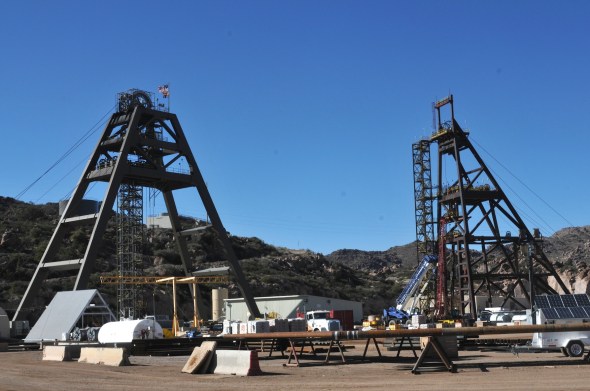
More than $352 million has been spent sinking and restoring shafts nine and ten for the deep mine.
Resolution Copper says their project will create at least 1,400 jobs on site and more than 3,700 related jobs at full production when the project could produce a billion pounds of copper per year, representing 25% of the U.S. annual demand for copper. It could become one of the largest copper mines in North America. In 1937 Magma built the Superior Hospital which served the community until 1983, in 1973 the hospital had 22 beds and 35 doctors, nurses and the lowest semi-private room rates in the state. The building then sat empty for 20 years following the Magma closure in 1996. When Resolution Mining started reclamation on the old Magma Mine it thought to tear down the hospital since it was almost a century old, but many residents began and ended their lives there, the mine chose to restore it in a good faith effort to show support for Superior. Restoration crews reported hearing voices, tapping on walls, lights turning on and other “ghostly” appearances.

For decades miners were born and many died in this hospital...

A developer has said he will pump more than $3 million into restoring the Magma Hotel...
“The streets of Superior should be paved in gold,” says ex-mayor Roy Chavez about the billions of dollars taken from this “mining camp” during the past century. Instead of prosperity-paint peels in the hot sun, the faces of miners flake off boarded up buildings downtown. New red “Discover Superior” banners line Highway 60 as traffic wind through town and straight up 2000’ to the Oak Flat Campground, where a simmering battle is mounting between Resolution Copper, a global mining company and “the people” folks who have visited there for centuries, the San Carlos Indian Tribe and others who believe their “Home Tree” is endangered. Not unlike the battle in Avatar, the Apache fear mining will destroy their water source and render their land uninhabitable. Meanwhile, “people are scared” Chavez says. “We’re dying on the vine. As for the mine “you are either on one side or the other, folks watch what they say for fear of being blacklisted, you are either for the mine or you are against it, if you speak out you might be negatively impacted. All of us (mining towns in the copper triangle) have lost people.” Superior’s population in 2010 was 2800, a constant decline from 7,000 since the 1996 mine closing. Roy Chavez Sr.’s High School class in 1950 Superior had 100 graduates, his grandson Josh, four years ago graduated in a class of twenty-four.
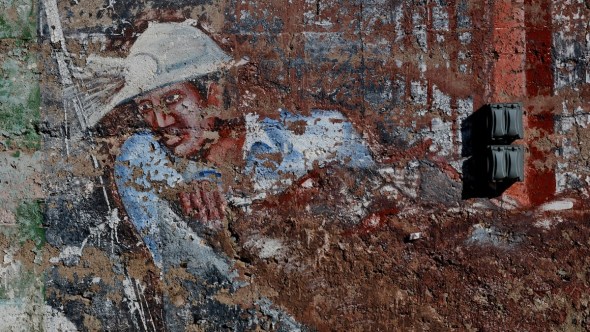
“Visionaries say the Phoenix growth wave will eventually sweep up Superior but others believe most miners will commute to the mine from the East Valley instead of bringing new life to Superior.”]
REP. RAUL GRIJALVA vs JOHN McCAIN …. McCain wants Iran and China to get the World’s largest deposit of Copper FREE, and Raul Grijalva thinks they should have to pay for it. The Apache’s say Go away!
Rep. Raul Grijalva, D-Ariz., and other Democrats have complained that under current law, the mining company does not have to pay any royalties to the U.S. government (or Arizona) for lucrative mineral rights that could be worth tens of billions of dollars and called the mine proposal one of the most significant issues facing Congress this year. “A foreign-owned company (Canadian and Australian) doing business on U.S. public lands which is getting a blank check on extraction (of copper) and a green light from Congress to go ahead and begin this without any return on the money,” he said.
JOHN McCAIN SCHILLS FOR IRANIAN MINE OWNERS, SANCTION QUESTIONS ABOUND….CLICK HERE
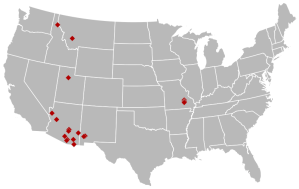
MOST OF THE U.S. COPPER MINES ARE IN ARIZONA.
Jon Cherry, a vice president of Resolution Copper, said he is optimistic that over the life of the project, the mine could generate as much as $61 billion in economic benefit for Arizona “without the need for one dollar of federal stimulus,” Cherry said. “We will mine out of this mine in the first year more than they took out of [the old Magma Mine] in its nearly (1912-1996) century of life,” David Salisbury, Resolution Copper’s chief executive. “That’s the difference in the scale of this mine.” Salisbury believes the lifetime of the mine could produce $140 Billion for the total project. Using robotics, not copper workers, working below the surface at 7,000 feet, block cave mining, which strips out large pillars of rock, one pillar at a time, collapsing the rock into ore cars surrounded by temperatures of 175 degrees. Working in this much heat has never been attempted before and special suits will be needed for repairmen working at this depth, to install, maintain and repair, there are many unknowns. As the robots strip out these 200′-300′ high columns, the rock will collapse, as Apache Leap Mountain is undermined, the surface will begin to collapse just like the devastation from a large earthquake.

Highway 60 traffic jets through the spires and pinnacles jutting up on both sides of the roadway.

Shows the impact crater in cross section

Mining studies suggest the Oak Flat Campground will be undermined and made unsafe for the public. What assurance does the state have that the main east-west route through central Arizona will not be severed?
Driving Hwy 60 east from Phoenix, through the vastness of the Sonoran Desert, the heat and glare beats down on the windshield, Apache Leap Mountain stands above the Sonoran Desert just five minutes past Superior via Highway 60 up 1000 feet to Oak Flat Campground in the Shrub Oak-Pine Habitat. The name, Apache Leap, comes from an Apache band, so the story goes, who refused to surrender its land and move to the reservation. Instead the tribe jumped to its death here when finally surrounded by federal soldiers. So today Apache Leap is considered an ancient burial ground by the San Carlos Tribe, it’s the Tribes long-time summertime home where they have collected acorns for centuries and today use it as a sacred spot to minister their Apache Manhood ceremonies.

Oak Flat Campground, its serenity and unique rock formations stands out against the sky and has been called one of the best climbing rock in the United States, bringing in climbers year round. This riparian habitat helps water the land held by theSan Carlos Tribe who fears for its water supply based on the track record of all copper mines. Many miners have offered the amount of explosive necessary to collapse a solid mountain of copper will certainly alter the water aquifer. For backup, Resolution has identified CAP Water from half empty Lake Mead and Roosevelt Lake, as their secondary water source.
Charlie Brush is one of many Americans who lives on the road-he and his Navajo-Zuni wife Debbie for the past 5 or 6 years, have blown into Oak Flat Campground for two week stays, four times a year. Brush is a prospector who once sold enough gold for a tank of gas, but principally he makes and sells jewelry for the little cash he needs to get on down the road. An early riser, he often finds himself tracking deer or coyotes in their Oak Flat habitat. Brush reports finding occasional bear scat as he strolls through the national campground set aside by special proclamation by two American presidents, Nixon and Eisenhower, both protected this spot because they knew it would be threatened. We should respect that. For Charlie and Debbie, Oak Flat was home, a comfortable spot that embraced them both while they were on the road, one of three places they knew on their wide swing from Yuma to South Dakota. Charlies wife died recently and now he finds a special closeness here with the land he once walked with his wife, Debbie.

Apache Leap Mountain

Campground host Wayne Brasher struggles with a silt blockage in a runoff channel in Oak Flat Campground. Brasher finds himself "in the middle" over the campground controversy, he strives to find out the facts from both sides of the fight.

The boulder strewn landscape is the big draw for climbers looking for a challenge.

Superior residents setup camp at Oak Flat Campground two weeks before Easter weekend to lock in their campsite. Meanwhile they locked out everyone else the two weeks prior. "Not very fair!" says the campground host.
“Over regulation is never the problem”, says Adam Hawkins, a Resolution Mine spokesman and state lobbyist for Rio Tinto, who oversees much of the permitting process. Tell us exactly what we have to do and we will do it for the permits needed to mine, instead Resolution will spend $5 billion he says and ten years before they make a penny, on courts and the lack of regularity clarity. In return the Resolution mine expects to extract ore for the next 40-50 years, and says it will produce 3700 jobs with a payroll of $220 million, bringing $60 billion plus economic impact to Arizona plus an additional $20 billion in tax revenue.
After all the money is spent, “We have no guarantee in developing this mine, Hawkins says, “Who else is going to do that.” “Mining has a high impact on a place,” Hawkins said. “Anyone who tells you differently is full of beans. But things are better when we leave.”
Resolution Copper is buying up flat land between Gonzales Pass and Florence Junction, for twelve miles west from Pickettpost (below) along Highway 60. In a fifty year plan, tailing will be deposited along the busy state roadway roadside for 12 miles stacking tailing up to 500 feet high in one view of the plan but another view believes the tailing could reach 2000 feet in height...
 Working in the San Manuel Underground in the 1970’s miners push ore from the shaft in ore cars moving copper to the surface and eventually the smelter. Superior miners developed San Manuel as a “sister Magma mine and the town San Manuel was laid out and designed by Del Webb.

The view from the "Top of the World" has a spectacular view in all directions.

Tourists stop along Queek Creek for photos of funny rock
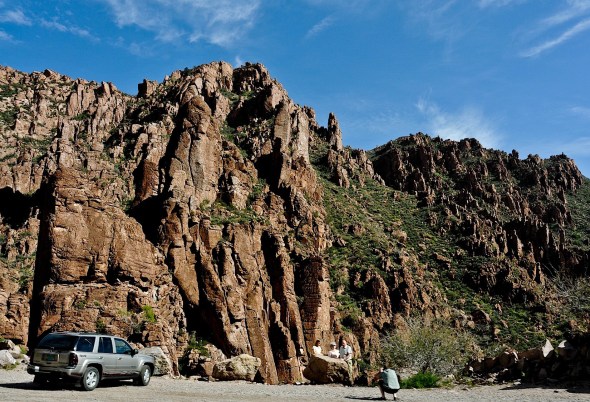
One of eight jobs in Arizona is supported by the Copper Industry says the Arizona Mining Association, as of today there are 12 producing copper mines in Arizona who directly employ nearly 10,000 workers, not including contractors and sub-contractors. Half of Arizona’s copper is mined in Morenci. An additional nine copper mines are expected to begin production in the coming years. The Resolution Copper Project, near Superior, is expected to provide 25% of the U.S. demand for copper after it begins production. Other potential new copper mines are the Carlota project (owned by Quadra FNX Mining) in Pinal County and expected to start in 2008, and the Rosemont project (owned by Augusta Resources) in Pima County.
“Mining is the cornerstone of our region, without the mine, we would not be here, says ex-mayor and miner Rudy Chavez. He realizes however this is 2012 and not 1912 we need to look into the future, see how mining technology will change and the reality of the job market. Will the good jobs, be high-tech jobs where hiring won’t be done locally? We can only imagine the technology ten years from now say Chavez who believes “talk is cheap” without a mining operation plan from Resolution spelling out how the mine will work and outlining precautions they are planning to protect the environment. Mining websites show a new driverless technologies, capable of ore delivery, blasting and excavation without people. These copper mines are now reaching their “highest point of profit” says Chavez as new technology replaces people and jobs. Chavez believes the Superior could be run remotely from Magma, Utah, the Australian counterpart is 900 miles away from the mine site. Still Chavez says he wants the mine. “I’d love to see it”. “We want it with some parameters, we need the environmental concerns to be hashed out, prior to being given permission to mine. If the mine was really responsible, regulation would not be necessary. I’m not a fan of government intervention but who else will regulate it. With the proper studies and mandated laws, what complaint would we have? Compliance with existing law is stressed by the Concerned Citizens and Retired Miners Coalition.
Picnic and Rally April 20-21 Oak Flat Campground…EVERYONE IS INVITED
Mining has changed considerably from the days when all employees were local and they supported their families and the town. Easter weekend Oak Flat Campground was full by Thursday and jammed pack on Sunday as a 1000 people came and went while they barbequed, visited, drank and napped in the cool air. This is the place they come to cool off during the hot summers. For the people of Superior this campground means a whole lot, the place you go for a six pack after work, on birthdays, spot to get snow and it is sacred to the San Carlos Apache, White Mountain Apache, Zuni, Fort Dowell, Apache-Yavapai Arizona Indian Tribes. Roy Chavez believes townsfolk take the campground “for granted and will miss it when its gone”, he worries Jobs are one thing, what good is a job if you live with no water.” Likewise, Chavez believes if the pending land swap is allowed before an operation plan is submitted, most believe, fixing environmental concerns later-would be impossible, particularly if mines don’t have to report any of their environmental failings forgiven by a recent law just sent to Jan Brewer for her signature.
MORE COPPER COUNTRY PHOTOS SEE SOUTHWEST PHOTOBANK GALLERY … CLICK HERE
ROSEMONT COPPER ATTEMPTS TO SQUEEZE CONGRESS FOR LAND EXCHANGE
<a href=" SPANISH TRANSLATIONS:
RELIGION IN CUBA; POPE BENEDICT PARTIES WITH 300,000 FAITHFUL PUSHES CASTRO ABOUT CIVIL RIGHTS AND U.S. ABOUT EMBARGO
POPE BENEDICT XVI PARTIES WITH 300,000 FAITHFUL, CALLS FOR AN END TO CUBAN ISOLATION AND RELIGIOUS INTOLERANCE so read this week's headlines
This week hundreds of Cuban-Americans have made the 40 minute flight to Havana to spend the week with Pope Benedict XVI, to attend mass at the Cathedral of Havana in Revolution Square and to close the gap caused by decades of exile from their homeland. Cubans hope the attention of the Pope’s visit will bring them greater freedom and open their door to America. Closing his visit the pontiff meet with Fidel Castro and 300,000 Cuban faithful who turned out for the mass at Revolution Plaza. Alongside the large face of Che’ filling the side of a highrise were huge banners proclaimed CHARITY UNITES US…
My visit last year to Havana (a professional researcher license to attend a literary tour was my ticket in) allowed me to walk the streets of downtown Havana for almost two weeks. The locals soon greeted me daily as “Hemingway” since I have a long white beard and hair. Everyone was very friendly and open to my photography. Never was I challenged or chased off, I found getting access to photograph in a local school, easier than anything I have experienced in Arizona. After ten days, my tour returned to the U.S. and I moved in with a local family in the shadow of the Capitol building in downtown Havana. Each day, I moved through the streets never being asked for papers or being quizzed, police officers stood on every corner and I never felt threatened or endangered. I did fall in love with the Cuban people who love Americans and who have suffered most from the Cuban embargo. It needs to end, it is pointless now, and exists still for the Cuban-Americans exiled by Castro fifty years ago. Cuba is Kansas fifth largest wheat buyer, many other cracks exist in the U.S. blockade. America needs the Cuban customer and they need us.
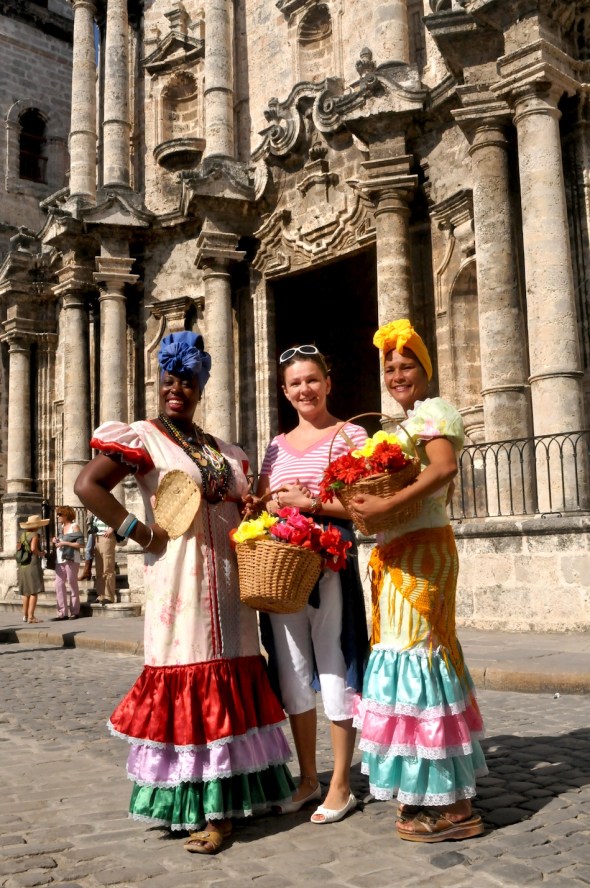 Cathedral of Saint Christopher of Havana near the harbor in the historic distric

Cuban faithful attend mass mid-day in Havana.
Since I was a tourist, churches, cathedrals were big draws and Cuba realizes they serve visitors on many levels and act accordingly, all were open, accessible, but a weak draw for the Cuban. Today Miami Archbishop Thomas Wenski held mass in the Cathedral of Saint Christopher of Havana in the Historic district for Cubans and 300 Cuban-Americans pilgrims from Miami. In the sermon the Archbishop called for Cuba to abandon Marxism without embracing the materialism of the West. Many attending had left Cuba as young children or are the sons and daughters of exiles. In Spanish the archbishop called for dignity for all Cubans.
Pope Benedict and the Vatican have set the stage for the Church to raise a voice with a sizable voting block and escalate the possibility of reduced sanctions. Since December a dozen U.S. cities have been cleared for direct flights to Cuba, while not all have ramped up yet. At least five international airports, DC, NY, LA, Miama and Denver all presently have flights making the short hop and landing at the new San Jose International Airport that Cuba built a year ago to handle their increasing need.
I visited the Cathedral of Saint Christopher of Havana at different times during my visit, Revolution Square is a big tourist stop and a local band has a permanent spot in the square and probably offered up a tune for “Papa” while the Archbishop delivered his sermon inside.


Tourists enjoy the Cuban winter sun in Regla a suburb of Havana

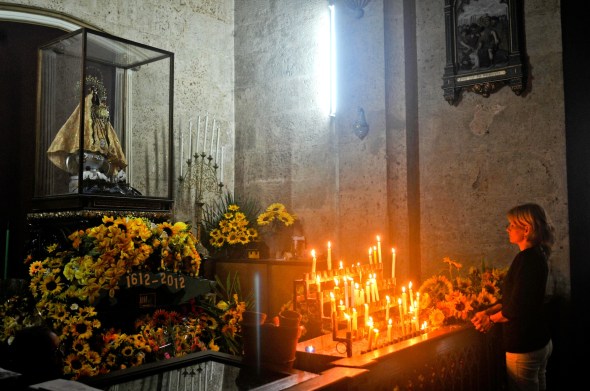
Some come each day, some once a week, all take counsel from the saints and light a candle.

Another day, we took a water taxi to Regla Cuba, a suburb and home to a beautiful small Catholic Church adorned by statues of the Saints, many whom, drew in regulars who relied on their help and they lit candles in thanks. The same day we passed in the harbor, the new Russian Orthodox Church, built by Russia during the “special period” (the collapse of the Soviet Union). Walking the historic Barrio Chino we saw and entered a district Catholic church which was celebrating the 500th year of Cuba. Barrio Chino, reached 40,000 Chinese who arrived in Havana in three waves. But after 1959, most left after Fidel outlawed private property. There are 500 Chinese-Cubans left in Cuba today it is reported that many are lawyers and doctors but few live in the Barrio. Barrio residents often report hearing ghostly voices, akin to a crowd of Chinese speakers in a morning market.

The Regla Catholic Church had a steady flow of folks visiting saints and this couple came in with a new infant and took photos inside the church with their saints.
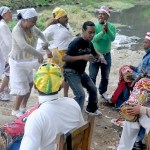
All pretty tame stuff, until we got hooked-up with a Santeria New Year’s celebration, complete with dead chickens and blood. A variety of slave religions exist in Cuba mostly of African cultural origin. According to a US State Department report, some estimate 80 percent of the population consults with practitioners of West African religions, like Santeria. The hour long ceremony held openly in a city park, consisted of singing, drumming and dancing until flowers are tossed into the stream and they flow downstream to the sea. It was a beautiful performance of singing and drums. Brought to the New World by slaves imported to the Caribbean to work the sugar plantations combines with Roman Catholic and Native Indian traditions. These slaves had a religious custom, including a trance for communicating with their ancestors and deities, using animal sacrifice and sacred drumming.

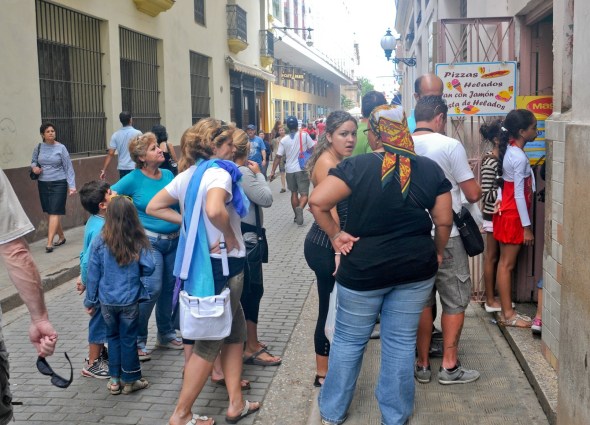
Personal business licenses allow Cubans to open their doors and sell food out of their homes.
Pope Benedict XVI’s visit to Cuba has spotlighted the Communist Island and his pleas for reform–begging for more freedom for the Cuban people many hope the Pope’s influence will bring change to Cubans lives on this Caribbean Isle. Increased freedoms were known following the historic visit of John Paul in 1998, and over the years the Communist lock down on people’s lives has slowly been lessened. In the past year, Cubans have been allowed to sell private property; houses and cars, and thousands of personal business licenses have been issued so individuals can provide paid services, like selling pizza slices on the street. Many Cubans set up restaurants in their homes, or rent out rooms to tourists, collecting about $25 for two people for the night.
 SENORA RAUDELINA RODRIGUEZ LEYVA WAS MY MOST GRACIOUS HOST IN HAVANA, A BIG FAN OF BARACK OBAMA…EMAIL raudelinaleyva@yahoo.es.

Held at a local night club this Santeria performance blesses the crowd ....
LOCAL BAND AT REVOLUTION SQUARE SEE VIDEO CLICK HERE
FOR MORE CUBA PHOTOS…CLICK HERE

Inscribed artwork inside a monument along the seawall of Havana showing the Church's role once.
<a href=" SPANISH TRANSLATIONS:
CONFEDERATES SCARE OFF YANKEES PICACHO PEAK PARK SALUTES 150th ANNIVERSARY OF ARIZONA VICTORY
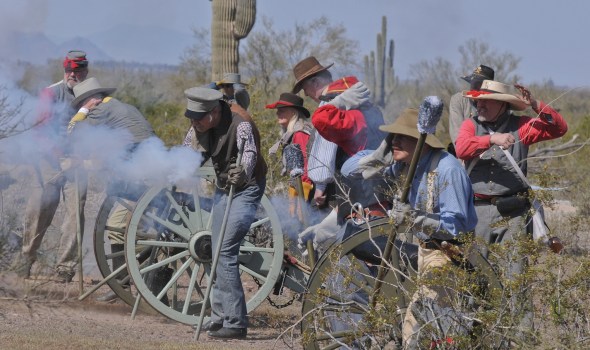
Johnny Rebs teeth rattle from the firing of a 6 pound gun during the 150 Anniversary of the Skirmish at Picacho Peak.

FORT HUACUHUA's historic and ceremonial regiment empty their pistols before turning their horses and beating a hasty retreat from advancing Confederates.

Visiting spectators at the wire, many re-enactors, like Robert Guyton, enjoy sharing their knowledge of the Civil War with the hundreds of spectators.
Great crowds turned out for the Civil War in the South West to watch more than 200 re-enactors battle out the great Civil War engagements of the South West. Two were fought in New Mexico, Valverde and Glorieta Pass, is often called the Gettsyburg of the West. The third battle, Picacho Peak is fought near the actual battle spot, just across I-10, lies the unmarked grave of a Union trooper who died, buried where he fell at the skirmish known as the Battle of Picacho Peak. Today hundreds turned out to relive those days of the the Confederate Territory of Arizona, and the 150th Anniversary is on everyone mind. “This is a rare thing,”! “A 150th anniversary”! says VJ Audegis and Annette who have been coming for 12 years to this contest between the blue and grey. “This is a really special year”, “this anniversary preceded by the statehood celebration has made it a very exciting year” say Baldy Cervantes and his thirteen year old son Elvis. Both had attended the Civil War in the South West Weekend before and wanted to become re-enactors so they both joined on the spot.

Gaining battlefield experience in 2012, next year, both will be able to bare arms in the battle, firing against the Yankees and be promoted to corporals.
Both father and son are reveling in the anniversary this April 15, the 150th year, of that chance encounter at Picacho Peak, called the most western battle of the Civil War. This summer Cervantes and Elvis are taking off three weeks and driving back to Gettsyburg for the 150th anniversary and re-enactment, a four day event that will see more boots on the ground this July, than has trampled those grounds since the original battle when 133,000 men battled and died in the most desperate fight of the Civil War. Cervantes is proud of his Arizona roots and his Hispanic culture, so when the recruiter mentioned the First Texas were made up of a number of Texacans, and their reenacted force was lily white now. “They needed us”, he said, “We fit right in”.
“We know that few people understand what was happening during the Civil War in the Southwest and these battles offer the public a glimpse into history and how the battles were fought,” says Rob Young, Picacho Peak State Park Manager. “This is also a popular camping park for RVers because it is just off the highway and surrounding Sonoran Desert habitat is so unusual, especially when there are magnificent poppies.” The Mexican Poppy were looking good about three weeks ago but warm days and hot wind frazzled this year’s crop into a less than an average display with pockets of opportunity if you catch them at the right place, at the right time, that spot won’t be Picacho Peak this year.

Lots of color, some clashing, but rebels were just that. Able to rebel against conventional uniforms and able to pursue their own look on the battlefield.
Today Confederate hats are flying out the tent door and Gerald Durbin, owner of the Coon River merchantile, can hardly keep up with the line at cash out. Confederate hats out sell Union all day long. Pausing for a breathe, between checkouts of hardtack, hats of blue and gray, uniforms, flags and dresses he reasons the Johnny Reb look allows variety enough to let its owner change his persona, “those Yankee troops never change”, he explained. “Like cookie-cutters, everyone looks just alike.” Fifteen year old Taylor Horrid, chose the Confederate side and dressed in period clothes to came with his uncle. He was having fun learning about the Civil War.

Moving troops skillfully was artfully demonstrated by the officers and the troops ability to follow commands.
For Taylor, learning how to load, fire, clean a black powder musket has been great and military drilling is something he learned and now loves. He looks forward to learning more about the United States and its history.
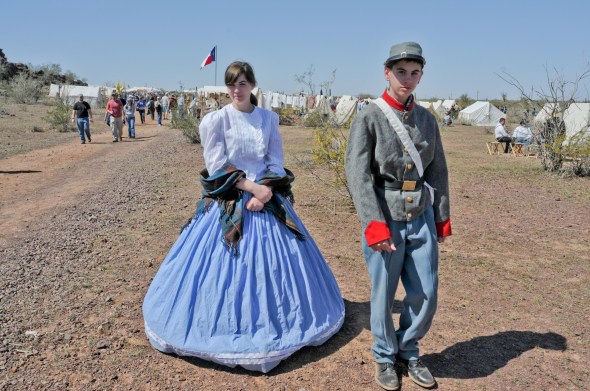
Seventeen year old Heather Jones, Mesa accompanied by her Johnny Reb brother, fourteen year old Bryson both have shared their love for history with their friends, "It's fun to be part of something that made our country great".

California re-enactors hung together at camp and enjoyed the desert setting.

Back at camp, Larry Hammack (left) and Robert Guyton pose for a filmless image
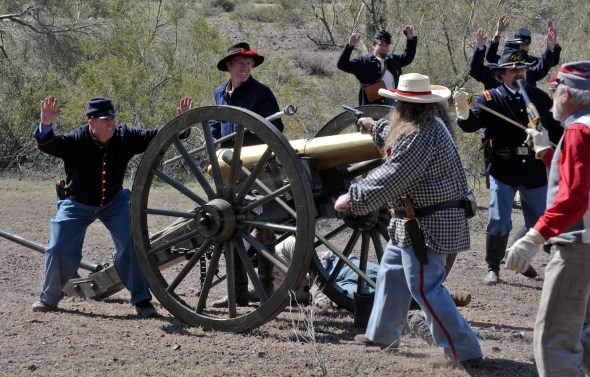
Rebels overrun the Union artillery taking over the cannon and turning it on their owners firing grapeshot till the North left the battlefield.
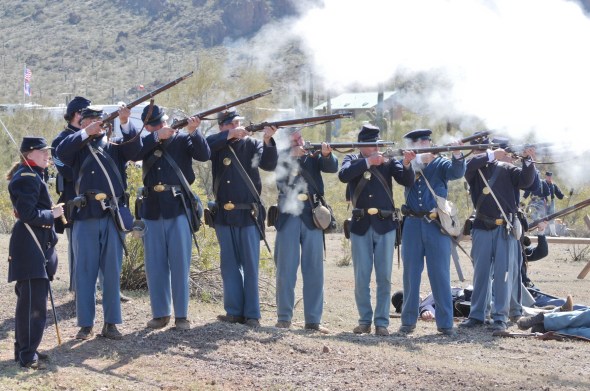
Heavy musket firing with black powder, was grimy and dirty work and after the 6th round, many found it difficult to ramrod the shot or simply clean the barrel.

"Members of the storied 4th Cavalry Regiment, one of the most famous and most decorated regiments in the US Army. Ft Huacuhua was in the middle of the Apache Indian War"
Since 1855, the 4th Cavalry has continuously served the United States of America in the Indian Wars, the Civil War, the Philippine Insurrection, World War II, Vietnam and the Gulf War. Today the 4th Cavalry is a historic and ceremonial regiment stationed at Fort Huachuca and its Troopers are active duty and retired military who care for their horses and drill weekly.

Rod Preuss USA (Ret.) Executive Officer of the storied 4th Cavalry Regiment Ceremonial Unit ...
SLIDE SHOW FROM 150TH ANNIVERSARY OF THE CIVIL WAR IN THE SOUTHWEST CLICK HERE
SLIDE SHOW OF PICTURES FROM EARLIER YEARS OF PICACHO PEAK RE-ENACTMENTS CLICK HERE …
<a href=" SPANISH TRANSLATIONS:
HAYDEN’S SMELTER TURNS 100 YEARS, POLLUTION ISSUES WORRY RESIDENTS BUT QUIET LIFE, GOOD JOB, A BIG PLUS

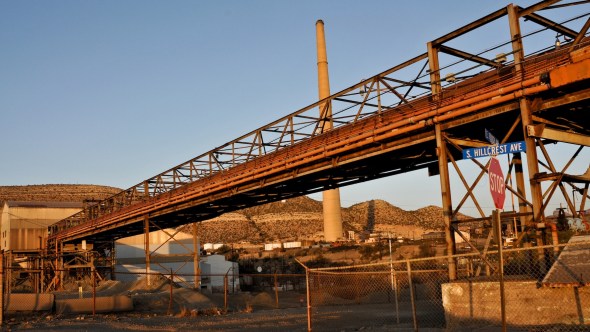
This conveyer belt carries ore from the crusher to the smelter
On Nov. 10, 2011 the U.S. Environmental Protection Agency moved against ASARCO for six years of illegal emissions of arsenic, lead, chromium and seven other dangerous compounds from the smelter. The EPA issued an unpublicized administrative action that could result in millions of dollars in fines for allegedly being in “continuous violation” of the Clean Air Act since June 2005. The action is a slap at both the company and the state for their failure to act.
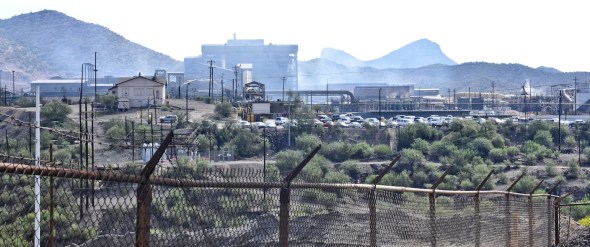
DUST AND SMOKE fills the Air with particulates from the Smelter
Hard Rock Mining has deep roots in Arizona soil. For 300 years miners have walked this state looking for minerals that they can dig and sell. In 1849 gold and silver was the big draw, today both are byproducts of Copper mining, taken from the earth in amazing small concentrations, leached from the soil by chemicals. Copper is the big dog now, and since it brings jobs, salaries, community development and opportunity to small town Arizona for over a hundred years it has ruled the state. The Army and State Troopers have broken strikes, busted heads, all in the name of Copper Corporations. The famous 1917 Bisbee deportation when 2000 vigilantes rounded over a 1300 strikers, herded them to box cars, loaded them up and dumped them in Hermanas, New Mexico, without money or transportation, told not to return to Bisbee. Today Arizona copper mines are largely self-regulating or watched by the state, the 100 year old Hayden Smelter is locked in debate between state and federal agencies declaring the air pollutions emulating from the mine stacks are outside the federal limits for safe air. The state says those particulates are within limits, however heavy metals like arsenic, lead and sulfur dioxide all have been found in the air and soil surrounding the mining community. Residents filed suit, cancer cluster have been reported and ASARCO have performed extensive testing and has cleaned the soil where warranted. Two homes were bought and condemned, they were downwind of the crusher conveyer belt and several other houses had their topsoil removed down to 18 inches, rocked over and dirt replaced. Residents have received $8-9,000 payment for damages, in retribution from the mine. Not enough say some and others whose homes were downwind but apparently safe, shrug their shoulders when they eye-ball the diagrams and pie charts on paperwork they were given, it must be so they smile.
 “Old Valley National Bank is now the home to Hayden Police Dept”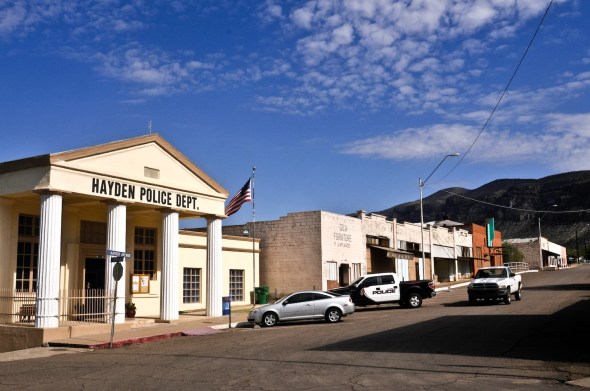
Why are some homes so polluted and others not so? One long-time Hayden observer Chris Martinez who was born here then spent 25 years in the Army seeing the world and now has retired to Hayden. Why we wondered? My wife, he says who is also a Hayden girl and besides “I like the quiet”, Martinez says while flashing on the traffic and commotion seen in Asian and European cities and then his quiet life in Hayden. “The smoke and dust bring a lot of environmental concerns”, he says while playing in the park with his grand-daughter, Elda.

CHRIS MARTINEZ AND GRAND-DAUGHTER ELDA GIANAH play in the park next to their house. Martinez served in the Army for 25 years and retired to Hayden.
 Contrerras buffs “Black Snow” Spots
Roy Contrerras has “done everything” for mines in the middle Arizona mining communities, he worked for the Christmas Mine, ASARCO, Kennecott. Father and son are polishing Dad’s newly-painted 1957 Chevy, and Roy Sr pauses over a couple spots on the hood he claims are left by acid-rain. “You can’t see it”, he says, but it appears “like black snow” and flakes paint on cars not kept in a garage. Some folks in Hayden paint their vehicle every few years. Contrerras says they received a payment “not enough” from the mine for their polluted soil and the lawn was removed and replaced. Now his lawn and the mine’s tailing across the valley constantly blows through his yard and deposits dust in his home. Still “life gets faster” in the city, says Roy Sr and “I don’t like it.” “I like the quiet here, no ambulances or sirens”. He lost his wife to Mesa, she needed more he says, his 32 year old son Roy Jr, tried living in Mesa a few years and but came home. Roy Jr found a job with a mine contractor on the graveyard shift and has a shiny new truck, a flashy new pickup, which “cost a lot of money” young Roy reports as he leaves for work. “I think I will die right here” says his father, Roy Sr. “If the mines don’t throw us out first”, he adds. Without the mines this town wouldn’t be here he continues. Copper is the only reason this place got going-without the mine-nothing would be here.”

ONE THOUSAND FEET ABOVE THE CITY OF HAYDEN THIS ASARCO STACK IS SUPPOSED TO LIFT THE POLLUTION ABOVE THE CITY...BUT DOES IT?
Hayden, Arizona, is 100 miles southeast of Phoenix on State Highway 177, it sits on a hillside beneath the smelter. The entire town covers less than one square mile, and with 365 homes below the confluence of the Gila and San Pedro Rivers. The town built in 1912 to provide housing for Ray open pit mine workers and those working at the copper smelter. The town has a population of 900, and it shares a school district, with Winkleman whose population 600 is located one mile south. The towns share a history with the several smelters and their emissions discharged over the towns since 1909.

Hayden Concentrator was built in 1911 it is one of the oldest building in town
Historically emissions contained large quantities of lead, arsenic, sulfur dioxide (SO2), particulate matter. These contaminants drifted over the entire region and many of these emissions fell out of the atmosphere and settled on the ground. The first air controls placed on the smelters were installed in 1920. These electrostatic filters removed particulate matter from the stack. The smelters had minimal emission control til 1969, when the Clean Air Act of 1970 required controls be installed to limit SO2 emission, controls were added in 1984, to further reduce SO2 emissions. The smelter stack height was designed to elevate the emissions above the valley air shed for optimum dispersion.

Some residents complained it made them feel sick to go outside on bad air days in Hayden said the AZ Health Dept Assessment.
Regardless of design many residents told the state Public Health workers of “not being able to have a barbeque at night, because going outside makes you sick”. Still in the public Health Assessment of the Hayden community most residents accepted the fact that the smelter produced air pollution, and that by working and living in the area they would be exposed to whatever was being emitted from the smelter. The Arizona Department of Environmental Quality maintains a particulate sampler at the Hayden Jail. This collects particulate samples including lead, arsenic, cadmium, and zinc and samples collected over the past several years have shown arsenic and SO2 present in concentrations that exceed limits in air. Water delivered to Hayden and Winkleman contains measurable arsenic. Drinking water obtained from several wells located in the area, show arsenic present in many groundwater aquifers. Urine samples for arsenic were obtained in late 1999, seven children from 6–36 months of age were tested, blood lead concentrations ranged below detectable limits but no cases of lead poisoning in children were found. According to a study by the Arizona Department of Health Services under cooperative agreement with the Agency for Toxic Substances and Disease Registry.

Vehicles left sitting beneath the open sky exposed to sulfuric acid
ASARCO AT 100 YEARS
MORE PHOTOS OF ARIZONA COPPER COUNTRY SEE SOUTHWESTPHOTOBANK.COM PHOTO GALLERIES….
REGION NINE; SUPERFUND HAYDEN SMELTER
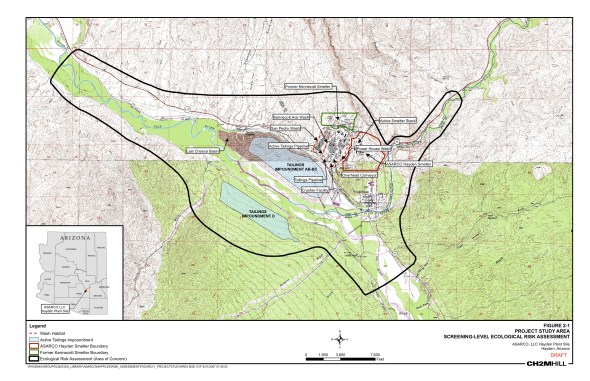
YOU ARE HERE
ARIZONA HEALTH ASSESSMENT ON HAYDEN SMELTER (PDF)
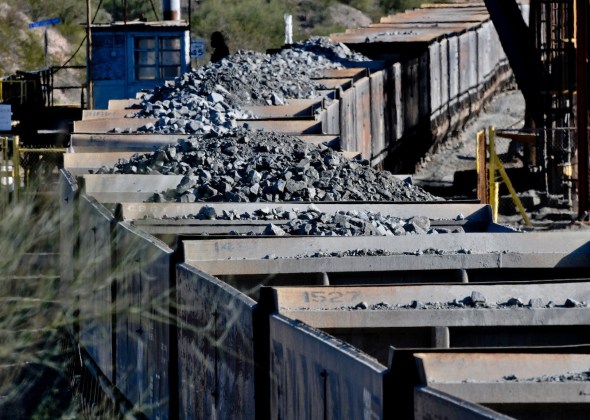
The Ray Mine 20 miles north runs a railroad to the smelter in Hayden

The Copper Railroad runs between the Ray Mine and Hayden
<a href=" SPANISH TRANSLATIONS:
STATEHOOD SNAPSHOT: SAN XAVIER ARIZONA TOPS SAY MISSION SCHOOL FOURTH GRADERS ON BIRTHDAY

FRONT ROW FROM LEFT: JOSETTE NUNEZ, TONY LEVARIO, JAZZMYN JOSE, LAMASI LEWIS, NATALIE, BURREAL, YESLIE PEREZ, JUAN GARCIA 2ND ROW FROM LEFT:4TH GRADER TEACHER VICTORIA McLELLAN, KEION LOPEZ, SARAH SALVICIO, DAKOT HOGAN, VICTORIA VALENZUELA, JAEDEN JOHNSON
Here are the students responses to the question…
What do you like about living in Arizona?
Dakota
When I wake up in the morning, I like to seeing the sun come up behind the mountains.
Victoria
What I love about living in the South West and Arizona is our school, which is a wonder to see!
Keion
What I love about living in Tucson is the mission and all of the roadrunners!
Sarah
Living in the desert is fun because the temperature is warm enough and we don’t have to worry about earthquakes.
Yeslie
I like Arizona because I get to see a lot of wild animals everyday of my life!
Juan
I love Arizona because there is water and desert and trees in Arizona.
Josette
If you go to the mountaintops, you will get a good view!
Nataly
I love Arizona because I have family and friends here. I get to see them whenever. I love our school and our teachers are the best, especially our 4th grade teacher.
Jazmynn
I love living in Arizona because a lot of my family members live here, and the summer is really warm. There are a lot of things to do like swimming, climbing mountains, and see animals, like coyotes, prairie dogs, and rabbits.
Tony
The things I like about living in the Southwest and Arizona are the fact that we don’t have to worry about things such as, earthquakes, tornadoes, or tsunamis, and we have a lot of cacti.
Lamasi
I like to look at the beautiful sunsets.
Jaeden
I like the smell of the desert when it rains.
Thank you so much! Victoria
ARIZONA’S 2012 BIRTHDAY was the 100th anniversary of Statehood for this western territory who in 1912 was the last link for the lower 48 and finally forged the United States into the geographical formation it enjoys today. Just 9 miles south of Tucson off I-19, lies the San Xavier Del Bac Mission which still ministers to the Tohono O’odham, who built the mission from sun-dried brick. A National Historic Landmark, San Xavier Mission was founded as a Catholic mission by Father Eusebio Kino in 1692. Construction of the current church began in 1783 and was completed in 1797. The oldest intact European structure in Arizona, the church’s interior is filled with marvelous original statuary and mural paintings. It stands as one of the oldest building in the United States.
I had the opportunity to visit San Xavier’s Mission School Fourth Grade class on Arizona’s birthday February 14th or Valentine’s Day. Teacher Victoria McLellan had solicited help from her sister-in-law and relatives to bake a birthday cake for Arizona’s 100 anniversary and they decorated it beautifully for her students to enjoy and celebrate the day.

San Xavier fourth grader Josette Nunez reads Valentines from Jazmynn Jose (left)
and Keion Lopez

San Xavier 4th Graders line up for a piece of Arizona's 100 years Cake being dished out by Teacher Victoria McLellan
Close to final bell, the 4th graders took the opportunity to finish up their Valentines and pass them out to their fellow students. While enjoying their good wishes from each other, McLellan led them in singing Happy Birthday Arizona and cut the cake and began to nibble on their piece of history and enjoy their celebration of the past.
The San Xavier Mission School has provided an education for grades K-8, since 1864 for the Tohono O’odham people. More recently the school opened enrollment to all. In 2002 the school added new wing that doubled the size of the school. Now they have four more classrooms, a computer lab, an art room, a meeting room that doubles as a music room.

Since 1864 Tohono Oodham students have been taught at the San Xavier Mission School

Mission school students visit San Xavier daily, learning a Catholic education, and a religious lifestyle
CLICK HERE FOR SOUTHWESTPHOTOBANK.COM PHOTOS MADE ON ARIZONA STATEHOOD
<a href=" SPANISH TRANSLATIONS:
INDIAN RODEOS ARE WHERE YOU FIND THE ACTION and TRIBAL FAIRS OFFER A RICH VIEW OF TRADITIONAL LIFE
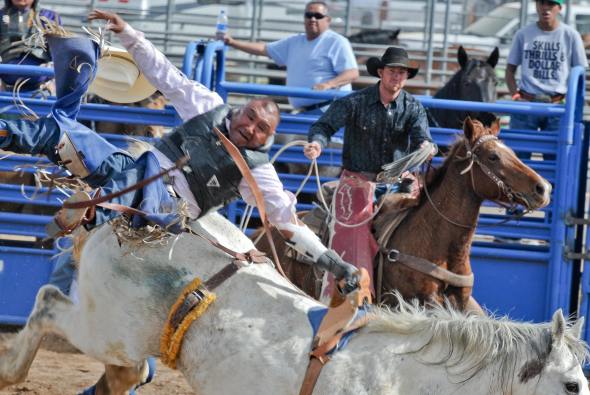
RICKY JACKSON CLINGS TO LIFE AND BLUE SKY, HIS HORSE.

Unable to free his hand, Shane Hardy was dragged all over and taken away by ambulence.
The typical Small Town in Arizona can be a sleepy place. Dust Devils rake the land and the dust brings a tear to your eye! Almost always the rule except on that one day or weekend when a whole community comes together and celebrates with each other, over who they are and why they live together as a community. In many places, locals celebrate history but in Arizona where there are 21 federally recognized American Indian tribes and almost 250,000 American Indians living on their reservations, Small Town Arizona is often the Capitol of a sovereign nation, places like Sells, San Carlos, Sacaton, White River, Peach Springs and Window Rock, represent the Tohono Oodham, San Carlos Apache, Gila River Indian Communities, White Mountain Apache, Hualapai and Navajo Tribes; each celebrates their own special weekend with fairs, rodeos, dancing, music, eating and pow wows, it brings everyone out to party.

Tohono O'odham youth gather with friends to enjoy carnival rides and food.

The Tohono Midway delights these youth as its twists and turns.
I find this is a great time to visit the reservation with my camera because all the action is concentrated in one place for two or three days and pictures come fast and furious. I recently spent a Saturday afternoon at the 74th Tohono O’odham Nation’s Rodeo and Fair, this nation’s biggest annual event and Arizona’s longest running All-Indian Rodeo. The Junior Wild Horse Stampede and Junior Rodeos offers a younger level of competition that fosters the cowboy lifestyle which ushers in the difference between the Tucson Rodeo and the Sells Rodeo, it’s all Indian, most competitors are from Arizona tribes from all over Arizona, some events might not fill, this year there were three bareback entries and one saddle bronc and rodeo slack is filled with team roping which is the big pastime here on the Sells Reservation, second largest reservation in the U.S. and historically it straddles the U.S.-Mexico Border.
While there may be fewer competitors in some events, the first two bareback riders at Saturday’s performance were hospitalized. Picked up and carted off in an ambulance. Action you don’t normally see at the big events, Indian Rodeo competitors, don’t get bogged down with all the rules, regulations. They frequently hammer their gloved hand, locking it onto the beast they have drawn to ride. Since their hand can’t come loose, and if they keep their feet beneath them they have a shot at the money. In both cases Saturday, their feet flew out beneath them and they were beaten badly.
Early Saturday, there had been a parade with floats and grand marshals, and marching school kids. (the whole event is accessed from one parking lot and one entry fee, $5 general admission, $2 seniors (55 and over)
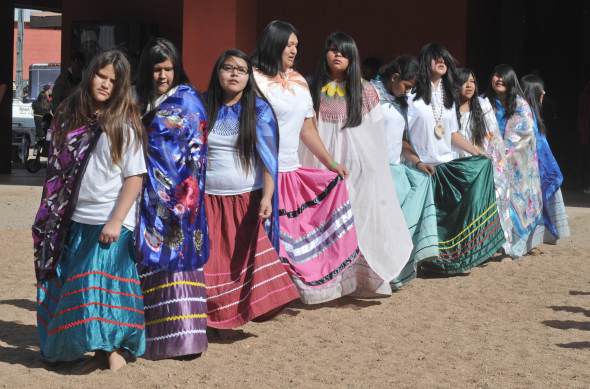
Women's singing group performs a wake dance depicting the creator's tale

Nani Reina performs with her dance group Bird singing by the River
After I left the rodeo I dropped by the traditional dancing being lead by the Maricopa Dance and Sing Group, “Bird Singing by the River”, for a Piman Tribe and Tohono Oodham cousin whose roots live along the Salt River. Their dance was most frequently sung at wakes, it was the Maricopa Creator Tale and allowed participants a glimpse into a tribal tradition not often seen in public.

Just women, no guys, all ages battle it out like they have for centuries.
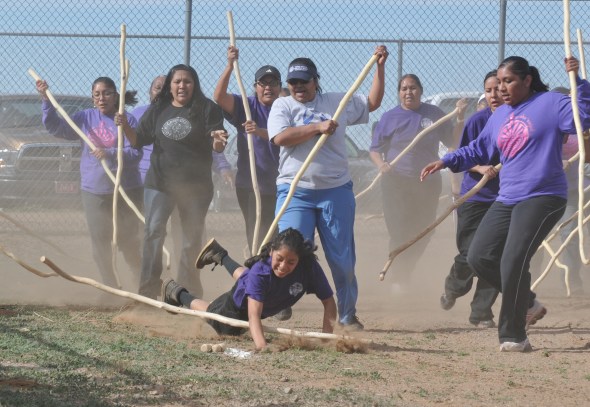
Toka player goes down at the goal trying to score.
Moving on I visited the Toka Tournament where a dozen teams had come together for an afternoon of Toka, a Tohono O’odham traditional game only for women which is a cross between lacrosse and hockey without the ice. Each team of eleven face off until the leather wood puck is dropped and like hockey, the action begins. Men are not allowed on the Toka field and traditionally, each match would be wagered on by the teams, today that might be Gatorade or a shell necklace. Next I toured the mid-way, over 14,000 Tohono O’odham are registered tribal members, three or four thousand where there enjoying the carnival rides, cotton candy and slurpies.

Kids grow up fast and the Sells Rodeo is an opportunity to get new pictures.
The photo booth is a big draw for moms wanting a baby picture of junior while he is still so cute. That changes fast, for many years I noticed the Goth movement had a huge foot hold on many reservations and specifically the Tohono O’odham, waves of black tee shirts, tribal signs and skulls. That seems to be passing, everything was extremely bright and colorful and great days for digital photography. I noticed a handful of old white guys, with expensive camera gear, hanging on the edges working with long lenses keeping a low profile.

The Apache Clown takes a Tohono prisoner for a dance

The San Carlos Apache Crown Dancers paint during the daylight and the White Mountain Apache Crown Dancers only paint the girl at night.
I dropped back by the traditional dancers and I found a real treat, the San Carlos Apache Crown Dancers were entertaining and the Clown took a pretty Tohono prisoner and forced her to dance with him. Finally I headed across the parking lot to the Pow Wow area, where the drums were competing for the top tier, and pow wow dancers from many walks of life, including ring dancers, gourd dancers from both the plains tribe and northern nations. The sun was starting to get lower now and I was able to get some back-lighting on the amazing feather displays found on these families of competitors who follow the Pow Wow circuit much like the Rodeo competitors, both of which find themselves on the All-Indian Rodeo Circuit.
FOR MORE PHOTOGRAPHS FROM THE 2012 SELLS COMPETITION CLICK HERE
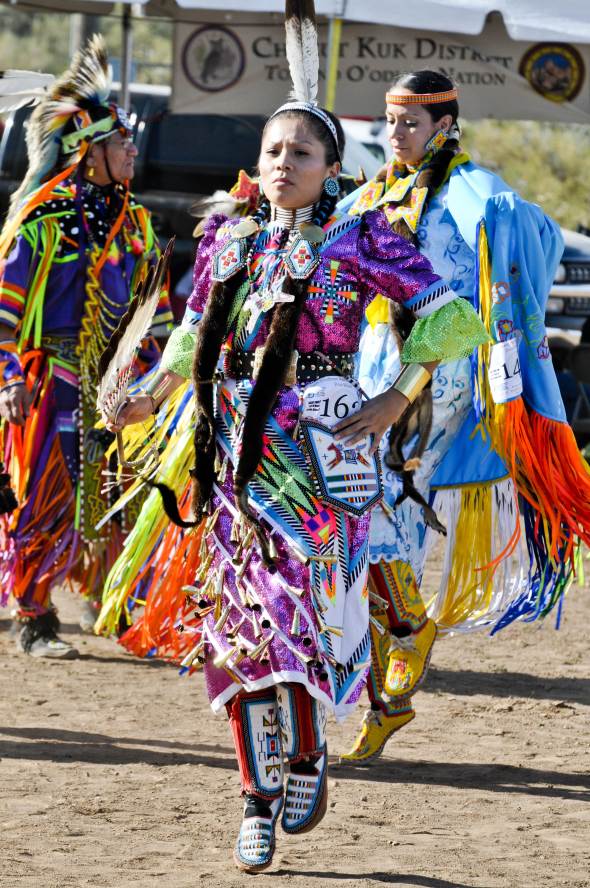
These fancy style dancers bring a lot of variety to the competition.
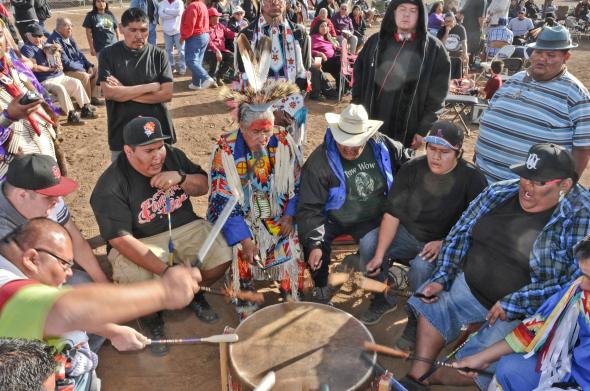
Four Native American drum teams beat out their songs

Eagle feathers gather great strength for their owners, if they are cared for.
TRIBAL RODEOS AND FAIRS
MUL-CHA-THA for the Gila River Indian Community March 16-18th 2012
Community gathering very much like the Sells Fair and Rodeo, however, the Piman Tribe has a very strong “Chicken Scratch” bent and numerous CS bands will compete there for the title.
CLICK HERE FOR SLIDESHOW FROM PREVIOUS YEAR

Eating roast corn off the cob is an age old Indian diet and still quite popular
One unique Day is the IRA HAYES PARADE held in Sacaton, AZ on February 25th at 8:30 am with a jet flyovers
The IRA HAYES IWO JIMA MEMORIAL PARADE held the third week of February each year. Ira was one of the five flag raisers on the Japanese Island of Iwo Jima where the Marine took the island. Tribes send color guards and participants every year and this is the biggest patriotic event in the state each year where veterans turn out each year to appreciated as warriors.
CLICK HERE FOR A SLIDESHOW FROM A PREVIOUS YEAR.
CASA GRANDE INDIAN DAYS RODEO
Casa Grande, AZ
February 17-19, 2012
Performances: 2/18/2012; 2/19/2012 1:00 pm daily
Slack 2/17/2012 10:00 am
46th annual
O’ODHAM TASH ALL INDIAN RODEO
Florence, AZ
March 2-4 2012

The Tohono Sells Rodeo has long been a tribal favorite.
11/17/2011-11/20/2011 Orme Dam Victory Days (INFR Tour) Fort McDowell
12/03/2011 Parker All Indian Rodeo Parker, AZ
2/17/2012-2/19/2012 Cowboy Indian Days All Indian Rodeo Casa Grande, AZ
3/02/2012-3/04/2012 O’odham Tash All Indian Rodeo Florence, AZ
3/31/2012 Mt. Turnbull All Indian Rodeo Bylas, AZ
4/01/2012 Mt. Turnbull All Indian Rodeo Bylas, AZ
10/06/2012-10/07/2012 SWIRA Regional Finals (Tentative) Parker, AZ
87th White Mountain Apache Fair and Rodeo, 1st weekend in September White River
44th Annual Western Navajo Fair
October 11-14, 2012 To’Nanees’Dizi Dine’ Fair” enjoy Inter-tribal dances, Carnival, All Indian Open Rodeo, Parade, Pageantry, Youth concerts, Elderly activities, Concessions, the popular Yeii bi cheii Ceremony, Arts and Crafts.Contact: Phone: 928-283-3415 http://www.DineFair.com
66th Annual Navajo Nation Fair
September 2nd – 9th, 2012
Window Rock, AZ
The Navajo Nation Fair was established in 1938 to stimulate livestock improvements and management through exhibits for the Navajo people. The Navajo Nation Fair has become a world-renowned event that showcases Navajo Agriculture, Fine Arts and Crafts, with the promotion and preservation of the Navajo heritage by providing cultural entertainment.For more information please visit the website: www.NavajoNationFair.com
9th Annual Page Lake Powell Hot Air Balloon Regatta November 2-4, 2012 Contact: Page Tourism Bureau Phone: 928-645-2741 www.PageLakePowellTourism.com Watch balloons lift off and float over the Lake Powell area, also a Balloon Glow and Street Fair.

Colorful tastes enrich shaved ice, always a hit in the middle of the desert.
PERIDOT Plans are underway for the San Carlos Apache Tribe’s 46th Annual Veteran’s Fair; Rodeo to be held at the Peridot Rodeo grounds in Peridot, Ariz. Nov. 11-14, 2012 are the scheduled dates for the annual honoring of veterans on the San Carlos Apache reservation.
2012 Native American Feast Days and Events in New Mexico
<a href=" SPANISH TRANSLATIONS:
LITTLE PICACHO WILDERNESS OPENS DOOR TO CALIFORNIA CHOCOLATE MOUNTAINS AND WINTER ADVENTURE

More than 38,000 acres are included in the Picacho Wildreness
In the American South West there are many “Picachos” or big peaks as translated in Spanish, Arizonans have long appreciated Picacho Peak, that marked the most western battle of the Civil War and more than halfway mark between Phoenix and Tucson. The California Little Picacho Wilderness and Recreation area is less well known, winter camping is great there. California fisherman, hunters, hikers and campers all know Picacho Peak on the Colorado River, a standout at 1947′, and a great spot for outdoor recreation only a three hour drive from San Diego. It stands about 30 miles north of Yuma on dirt roads first traveled in 1780 by Spanish gold miners who began dry placer gold claims there because of the dry conditions which exceed 100 plus degrees mid-summer, and lack of water. Miners would shovel sand and gravel on a blanket, shake it until only the heavier gold remained. Soon a Picacho town site sprung up with 2500 residents served by three stores, several saloons, three elementary schools and it was connected by the Colorado River with paddle wheelers who stopped there for wood to fuel their steam boilers. The mine payroll peaked at 700 men. Poor ore quality and mine accidents ended most organized efforts there by around 1910. That town now lies behind the Imperial Dam at 33°01′23″N 114°36′40″W flooding what was left of the original townsite in 1938. The Dam ended cheap ore transport by boat which was the last nail in Picacho’s industrial coffin.

At roads end, the California Campground offers boat launch, campsites, out houses, warm temps and mosquitoes in April.
Today Picacho is a State Park on the lower Colorado River on the eastern border of California, offering a diverse scenery, with cactus, burros, bighorn sheep and thousands of waterfowl. Take the mile dirt road north from Winterhaven, off Interstate 8 West of Yuma. The road is paved only a few miles, then becomes graded dirt. The last 18 miles is over a desert road that is passable for passenger cars and motor homes. In the summer months thunderstorms can cause flash flooding in the washes, making sections of the road impassable. Check weather forecasts before traveling into this region of the desert.

Flash flooding area next to the Picacho roadside ....
Fishing is a favorite activity for many Arizona and California residents and visitors. Anglers that are 14 years old or older will require a fishing license. If you plan to fish the Colorado River waters from any sort of boat or float, or you fish from the California banks of the river, you will also need a Colorado River Stamp. See Arizona Game and Fish for rules and to purchase licenses online.

Numerous species of water fowl and birds frequent the Picacho Wilderness during the snowbird season
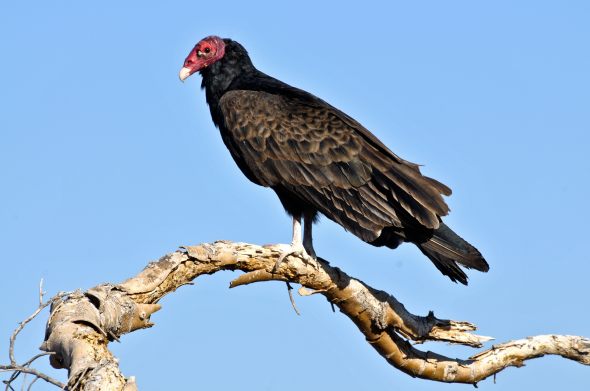
Little Picacho is a hot spot in the summer and this bird and his buddies look for the unprepared.
The Little Picacho Wilderness is a 38,214-acre wilderness area under the jurisdiction of the Bureau of Land Management and is a southeast extension of the Chocolate Mountains adjacent to the Colorado River. The wilderness is home to the Picacho wild horse herd, that roams the northwestern part of the wilderness, as do wild burro, desert tortoise, the spotted bat and about 25 desert bighorn sheep.
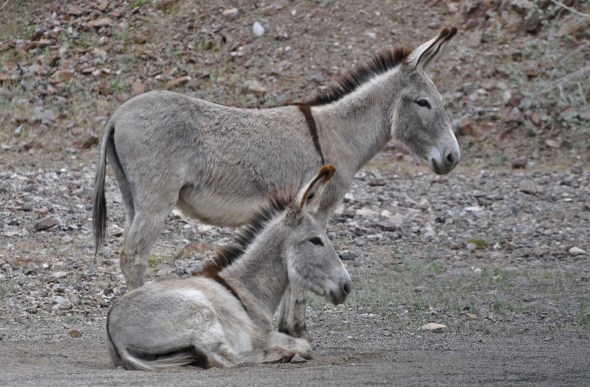
Keep your dog away from these docile appearing creatures. They have spent a lifetime repeling coyotes and will kick the life from a domestic animal.
General Things to Consider When Planning a Trip to Any Wilderness

VISIT COLORADO RIVER COUNTRY ON SOUTHWESTPHOTOBANK.COM
<a href=" SPANISH TRANSLATIONS:




 SOUTHWEST PHOTO JOURNAL