

“The surface is fine and powdery” said Neil Armstrong the first man to step on the Moon, on July 21st, 1969. Armstrong descended Apollo 11’s ladder and stepped upon lunar soil. He remarked ”It has a stark beauty all its own”, speaking as he moved across the surface collecting samples to take back to earth.
“Houston, this is Tranquillity Base! The Eagle has landed! “
Armstrong’s first step on the Moon’s soft surface called Tranquility Base was broadcast on live TV to a worldwide audience.
American Hero Neil Armstrong placed his left foot upon the moon at 10:56 AM Eastern Daylight Time…
Tucsonan Stan Shupe remembers sitting in Connie Mack Stadium in Philadelphia attending his first major league baseball game when it was announced that Neil Armstrong, a US Astronaut, just stepped on the moon.
Stan says everyone in the stadium immediately jumped to their feet and spontaneously sang “God Bless America” before the game could continue.
Apollo 11 effectively ended the space race against the Russians and fulfilled a challenge in 1961 by President John F. Kennedy: “Before this decade is out, landing a man on the Moon and returning him safely to the Earth…!”
Leave your memories in the comment section at the bottom of the blog.
I was nineteen years old living in my father’s house and eating my mother’s cooking. I was raised in the center of the country in a small Missouri community where our corn fed the rest of the country. The Moon seemed very far away. That night when the telecast came on TV I grabbed my 35mm Argus C-3 and tried to capture key moments using black and white film photographing a black and white television as Buzz Aldrin and Neil Armstrong floated around the landing site on Mare Tranquillitatis where the open panorama is from the thin flow of lava that covers the region.
51 hours 49 minutes – The time it took Apollo 11 to get from Earth to lunar orbit…
Often overlooked are the 400,000 workers who made the impossible possible, men and women working mathematical equations without computers to land Eagle upon the moon. Neil Armstrong’s four words, “The Eagle has landed!” gave the United States ambitious expedition success and fruition placing this pioneer effort as the new bar of success for everyone else on earth to shoot for.
VISIT WITH THE PEOPLE OF APOLLO…
 People made the same pictures all over the world, off the TV screen. I always felt bad that they left a Hasselblad camera on the moon, nice lenses. Once you run out of film, what are you going to do?
The dark and grainy pictures of Armstrong stepping upon lunar soil, saying; “One small step for man, one giant leap for Mankind!” still linger. Today we see the incredible images taken by those astronauts on that day and they still fill us with pride to be the first country to have landed a man on the Moon. Today there have been many spacewalks, moonwalks and successful landings. The entire Apollo series had US Astronauts dancing, driving and walking on the moon.


The Moon landing swelled our national conscience and “all things seemed possible” after sling-shooting our astronauts into outer space and getting them home again. Doing all this without computers, men and women sitting at desks working mathematical calculations to bring home the astronauts. Something we had never done before or even thought about doing. We did not know if it could be done.
CELEBRATION EVENTS AT THE US SPACE AND ROCKET CENTER
The following events are taking place at the U.S. Space & Rocket Center.
Location: Apollo Courtyard
Included with museum general admission Rockets on Parade is a way to note our city’s ongoing contributions to the American space program with designs specific to the Rocket City, the monumental achievements of the Apollo program, the future of space travel or through unique artistic expression. The rockets will be judged based on impact, creativity, subject matter and historical storytelling and be on display throughout the Apollo 11 50th Anniversary Celebration.Learn More »
Location: Saturn V Hall
Included with museum general admission Come join us as we relive the thrilling mission of Apollo 11 in a reenactment of the moon landing. Come join us as we relive the thrilling mission of Apollo 11 in a reenactment of the moon landing inside the Saturn V Hall in the Davidson Center for Space Exploration. Saturday, July 20, 10 a.m., 11 a.m., 1 p.m., 2 p.m., 3 p.m.


Two images complete the picture above of Man walking on the Moon.


Arizona Science Center is celebrating one of the greatest human achievements in science – the 50th anniversary of human’s first steps on the moon! That’s right, July 16, is exactly 50 years after the launch of the Saturn V rocket that carried astronauts Armstrong, Edwin “Buzz” Aldrin, and Michael Collins on the first manned lunar landing. All month long, the Science Center will be commemorating the historic mission with events and space-themed programming. And, leading to the BIGGEST Apollo 11 50th celebration in Arizona.
On Saturday, July 20, join us for an out-of-this-world celebration of man’s first steps on the moon on that monumental day in 1969 as part of NASA’s Apollo 11 lunar mission!
Today, the White House is concerned that international and commercial space activities and robotic spacecraft could cause considerable damage to Lunar Heritage Sites and artifacts. Including landing on top of or too close to Apollo Heritage Landing Sites, perhaps even “sand-blasting” away footprints.

 Other international interests could see our preservation efforts as a ploy “to plant the flag” and claim a bigger piece of the moon and are suspicious of any new international protections. One Apollo 11 Lunar Heritage site includes the plaque that the United States Astronauts left behind, it said,
“We came in peace for all Mankind”, July 1969.

At the time of landing, the moon was in a crescent waxing phase as seen from Earth. Planned to aid the Astronauts planners hoped the sun would rise over Eagles landing site and “believed the long morning’s shadows would aid in identifying landmarks”.
When Armstrong was descending to the Moon he noted that the auto-landing system was guiding Eagle toward the boulder-strewn floor of one crater the size of a football field. Armstrong took manual control and skimmed over the crater, landing in a flat plain beyond. “Eagle had only about 30 seconds’ worth of fuel left at touchdown”.

Photo made by Michael Collins when the Eagle lander began to drop down on the Moon. His job was to go home without them if they didn’t come back. Photographers observe that every one alive and dead is included in that picture except Michael Collins.
According to Wikipedia after launch by the Saturn V’s third stage, whose thrust propelled their spacecraft to more than 25,000 miles per hour. The lunar lander was tucked safely into the top of the third stage, where the astronauts rode in the Apollo command module atop the stack. After the Apollo 11 astronauts separated from the Saturn 5 traveling for three days to reach their lunar orbit.
Preparing to descend Armstrong and Aldrin then moved into Eagle and landed in the Sea of Tranquillity. The astronauts used Eagle’s ascent stage to lift off from the lunar surface and rejoin Michael Collins in the orbiting command module. They jettisoned Eagle before maneuvering out of lunar orbit onto a trajectory home to Earth.
Returning to Earth and splashing down in the Pacific Ocean on July 24 after more than eight days in space, fifty years ago this year (2019)…
Before man stepped upon the moon, NASA first had to launch robots to learn what we did not know about the surface, for instance, would the moon landers simply disappear from sight sinking into centuries of moon dust caused by billions of years of meteor impacts? Little was known other than what could be seen from telescopes.
SPEND THE DAY AT THE KENNEDY SPACE CENTER
$61 DOLLARS FOR A TEN HOUR DAY…

When the astronauts returned to Earth, they were quarantined for two weeks with several white mice. If the Astronauts survived, that was good. If the mice died, they were in a lot of trouble. Thankfully the mice lived.
http://WHY THE RUSSIAN FAILED TO PUT A MAN ON THE MOON
In the beginning, the first probes to reach the Moon were Russian. Luna 2 impacted the surface in 1959, and the moon was photographed from orbit by another Soviet robot later that year. The U.S. flew a series of impactor probes called Ranger; the first success of that program was Ranger 7, which returned 4,300 images of increasing resolution during the final 17 minutes of flight in 1964. The USSR scored another coup when it made the first soft landing and took the first low-resolution photos of the moon’s surface, in February 1966. The Lunar Orbiter photographed the moon from orbit in 1966 and 1967. But it was Surveyors that scouted the rugged surface for Apollo, the first of a series of landers that touched down successfully.

Image of Surveyor 1’s shadow against the lunar surface in the late lunar afternoon. Surveyor 1, the first of the Surveyor missions to make a successful soft landing, proved the spacecraft design and landing technique. In addition to transmitting over 11,000 pictures, it sent information on the bearing strength of the lunar soil, the radar reflectivity, and temperature, Surveyor 1 landed on the moon on June 2, 1966.

The first Surveyors were tasked with reaching the lunar surface successfully via a soft landing, then investigating the physical properties of the nearby landscape to understand the risks and challenges to landing astronauts there. But that first successful landing was far from assured. NASA had accomplished flybys of Venus and Mars they had never attempted a landing on anything.
The leap from impactors and airbag landings to a controlled landing was a big one, and required new, never-before-attempted techniques in guidance, navigation, robotics and imaging. Surveyor was the first spacecraft of its kind it had been sent on a direct trajectory — it would not enter lunar orbit prior to landing, but instead would hurl directly towards the surface at 6,000 mph. Thrusters had to fire at precisely the right moment to maintain perfect orientation in order to communicate with Earth, all the way down.

Several Ranger spacecraft failed en route to the moon, the success of the first Surveyor landing was an incredible relief. William Pickering, the director of JPL from 1954 through 1976, recalled in a 1978 Caltech interview that he had some concerns about the television networks’ request to carry the landing live on what he thought was to be national coverage: “We finally ended up by agreeing to let them do it, and we kept our fingers crossed and hoped it was going to be all right. But the thing that startled me was that about a half an hour before it was due to land, one of the network people said, ‘Oh, by the way, we’re live all over the world,’ that really shook me. Fortunately, it worked, and in fact, sometime later a friend of mine told me that he was in Paris, and he just idly turned on the television set and there was Surveyor 1 landing on the moon.”
By the end of Surveyor 1’s mission six months after it landed on the moon, 11,240 images had been returned, allowing for the creation of dozens of wide panoramas and allowing the examination of details as small as .04 inches in diameter.

Images of the three-foot-pads demonstrated that not only was landing on the moon possible, but lander had not sunk into deep moon dust – as feared by some – but had landed on a firm surface. Surveyor3 had a scoop attached to one arm that allowed scientist to study the texture and hardness of the lunar soil.

Ham the Astrochimp did things that no monkey ever did, he was the first Chimpanzee sent into space. This was a test for NASA to see if they could send a man into space, would he survive in 1961.
By the time Surveyor 7 completed operations on the moon in February 1968 — just 10 months before Apollo 8 orbited the moon — the pathway for the first crewed lunar landing of Apollo 11 on July 20, 1969, was open.

Buzz Aldrin (left) Neil Armstrong (center) & Michael Collins (right) Below Michael Collins speaks with Tucson visitors at Cape Kennedy prior to the Endeavor Shuttle Launch

Mission Commander Neil A. Armstrong was born Aug. 5, 1930, in Wapakoneta, Ohio. Armstrong became interested in flight while still a child. In 1950, Armstrong flew combat missions for the U.S. Navy. He became an astronaut in 1962 commanding Gemini VIII in 1966. In 2012 Armstrong died and in 2014 Kennedy Space Center’s Operations and Checkout Building was renamed in honor of Armstrong, Astronauts orbiting 260 miles above Earth participated in the ceremony.
The Kennedy Operations and Checkout Building now named for Neil Armstrong played a vital role in NASA’s space flight history. It was used during the Apollo program to process and test the command, service and lunar modules. Today, the facility is being used to process and assemble NASA’s Orion spacecraft, which the agency will use to send astronauts to an asteroid in the 2020s and Mars in the 2030s.
Lunar Module Pilot Edwin E. “Buzz” Aldrin Jr.(below right) born Jan. 20, 1930, in Montclair, New Jersey. Aldrin got his nickname “Buzz” as a child. Aldrin flew combat missions for the U.S. Air Force in the Korean War. He became an astronaut in 1963 and piloted Gemini XII in 1966.


Video Tour of the Moonhttps://www.space.com/40274-nasa-moon-in-4k-video-tour.html
APOLLO 11 INFOGRAPHIC https://www.youtube.com/watch?v=Zfer0eYqBrk
Apollo 11 Infographic
APOLLO 11 MOON LANDING https://www.space.com/17411-apollo-11-moon-landing-explained-infographic.html
NASA.gov features videos and historic images, audio clips that highlight the Apollo 11 50th Anniversary, and the future of space
WHAT MICHAEL COLLINS FEARING MOST
NASA TV STREAMING video, downlink & scheduling: http://www.nasa.gov/nasatv http://www.nasa.gov/exploration
Command Module Pilot Michael Collins (above left) was born Oct.. 30, 1930, in Rome. Collins became a pilot of jet fighters and experimental planes for the U.S. Air Force. He became an astronaut in 1963 and piloted Gemini X in 1966.
Apollo 11 https://www.youtube.com/watch?v=lRwKUScppvQ Apollo 15 https://www.youtube.com/watch?v=SQyVQxui2Q8
Mining on the Moon: https://www.youtube.com/watch?v=BYp5PM9oBHo https://www.youtube.com/watch?v=n9EMcyfGMDA https://www.youtube.com/watch?v=rQ7RfnsB_Is
MINING ON THE MOON ENDANGERING HERITAGE SITES; https://www.youtube.com/watch?v=rQ7RfnsB_Is
ORION-NASA’S DEEP SPACE EXPLORATION SPACECRAFT WILL TAKE HUMANS TO MARS


NASA APOLLO STORIES FROM THE GUY NEXT DOOR…. WHERE WERE YOU WHEN MAN FIRST WALKED ON THE MOON https://www.nasa.gov/apollostories
Suggested questions to answer yourself or ask others?
What does exploration mean to you?
What do you think it would be like to see humans walk on the Moon again? Think of the Moon, what comes to mind?
What do you want to know about the Moon?
If you remember the Apollo program
Where were you when humans walked on the Moon for the first time? Describe who you were with, what you were thinking, the atmosphere and how you were feeling.
What was your life like in 1969?
Do you remember learning about space in school?
If you have memories of the First Moon Walks and wish to share your story by using the comment area to respond.
FIRST SEASON OF SIX EPISODES ON UTUBE BY SMITHSONIAN CHANNEL
IN ORDER TO MAKE ROOM FOR MOON ROCKS GEAR WAS LEFT BEHIND MORE THAN 850 POUNDS OF MOON ROCKS CAME HOME WITH APOLLO FLIGHTS

Click on this photo of a lava tube in Mexico’s Pinacate Biosphere which helps demonstrate how colonist on the Moon and Mars might live within and thrive underground with protection there from the atmosphere as discussed in INVERSE MAGAZINE…

In this undated artist’s concept drawing provided by John Frassanito and Associates NASA’s new Crew Exploration Vehicle and lander are shown on the moon. NASA may be going to the same old moon but the space agency said it’s going to do something dramatically different this time: Stay there. To get to the moon, NASA will use two vehicles _ the Orion exploration vehicle and an attached all-purpose lunar lander (shown) that could touch down anywhere and be the beginnings a base camp, said exploration chief Scott Horowitz. (AP Photo/John Frassanito and Associates, NASA)
WILL THESE COUNTRIES BE COMPETITORS OR PARTNERS IN EXPLORING SPACE ?
China’s space program is directed by the country’s National Space Administration called CNSA. China had a rudimentary ballistic missile program for years their first crewed space program began decades later. Their achievement placed China as the third country to send humans into space independently. They are now planning to launch their fifth space flight costing about $6.27 billion. In the year 2020, CNSA plans to develop a permanent space station and with crewed expeditions to Mars and to the moon.
Chinese state television reported in January that China’s landing on the dark side of the moon was successful, using lunar craft Chang’e 4 touching down at 10:26am on January 3rd 2019. It marks the first time man has landed on the far side of the moon. This is the side that faces away from the earth. A huge achievement for China, and for space exploration in general.
SLS = NASA SPACE LAUNCH SYSTEM featuring the most powerful rocket ever built.
The U.S. backed lunar Gateway program will allow NASA to offer Germany and others in Europe to stake a claim to a program designing and developing a small spaceship that will orbit the Moon and serve as a temporary home for astronauts as a base for working on the moon’s surface and, later missions to Mars. NASA aimed to finish Gateway by 2026, now Washington is aiming to put humans back on the Moon by 2024, which could accelerate the schedule. The Lunar Orbital Platform – Gateway is a future space station in lunar orbit intended to serve as a solar-powered communications hub, science laboratory, short-term habitation module, and holding area for rovers and other robots.
India’s prime minister, Manmohan Singh, made speeches asserting, besides constructing giant solar collectors in orbit and on the moon, the world’s largest democracy intends to mine He3 from the lunar surface. Simultaneously, Japan and Germany are also making noises about launching their own moon missions.
The Israel Space Agency is part of the country’s Ministry of Science and Technology. The agency established in 1983 coordinates all space research programs in the country. Some space agency resource goes to the current Venus Project, with a $6 million budget, a fraction of the $70 million budget.
Iran has been launching satellites and space flights since the year 2005. The country has been active in the Asian space race. Their first launch was the joint Iranian-Russian Sinah-1 project, which cost them $15 million. In the year 2008, Iran joined research with Thailand and China, launching a satellite named Long March 2C, which cost around $6.5 million. Iran’s second satellite was actually placed in an orbit in the year 2009. This satellite was designed for research and telecommunications.
South Korea, together with China and Japan, is one of Asia’s leading countries when it comes to launching space missions. Today they have launched three space flights. The first one was the Naro-1 and it was sent outside the planet three times. The total cost of the first three launches was over $450 million and the third launch was the most successful among the three.
Japan is one of Asia’s leading countries in terms of space flights and missions. Japan always has the latest satellite and rocket capabilities for different purposes. They have also conducted manned space activities and other science-related missions and explorations. Their first launch was the Hayabusa that cost the country $138 million. Japan launched the Hayabusa 2 in the year 2014, which had an estimated cost of $150-400 million.
Russia was the first country to have ever launched a space mission. They actually had plenty of firsts: Russia was the first country to have ever launched a space mission. Russia actually had plenty of firsts: intercontinental ballistic missile, satellite launches, first man and woman in space and Earth orbit, put the first animal in space, moon impact and spacewalk, race rover, interplanetary probe, photo of the side of the moon, space station, and unmanned lunar soft landing. Russia’s first space flight was the Vostok program. The flight made Yuri Gagarin one of the most famous people back then since he was the first man to have ever journeyed outside the planet. The government had a federal space budget of $2.4 billion in the year 2009. In 2011, the government spent about $3.8 billion for their space programs. The budget for the year 2013 was $5.6 billion.
THE NINE-MONTH JOURNEY TO MARS, FROTH WITH COSMIC RADIATION AND UNKOWN UNKOWNS IN
COLONIALIZATION WILL BE LEARNING-ON-THE-JOB, PUTTING OUT FIRES AS THEY FLARE UP! FIRST THINGS FIRST WHERE TO LAND ???
Europe has the European Space Agency (ESA), which is dedicated to the exploration of natural occurrences outside the planet. The agency was established in 1975 and is now based in Paris. France’s space programs include human spaceflight and other unmanned exploration missions to other planets. They plan to launch a new space balloon, with a budget of $10 million for the construction and the flight itself. The agency already spent about $5.3 billion for their space flight missions in the year 2012.
The Indians in exploring more about space. Dr. Vikram Sarabhai founded the Physical Research Laboratory, which is a great leap that catapulted India into one of the leading countries in terms of space presence. India’s biggest success was the launching of its first satellite into space. India has provided a hefty budget for space programs to widen their knowledge of space. India has spent $1.6 billion on past launches and plans to spend about $1.34 billion total.
The United Kingdom recently established their own space agency. It was inaugurated in April 2010, and has taken over the responsibilities for government policy and budget for space explorations. The UK, together with the European Space Agency, has spent about $155 million for the delivery of astronomical data and the launch of sub-orbital rockets. They are budgeting around $16 to $31 million for the development of their intermediate missions.
Although the United States was not the first country to explore the universe, America has the most space missions out of Earth. Their first space flight was under the Mercury Program that operated five years and cost $277 million. The second one was the Gemini program, with a lifespan of six years and cost of $1.3 billion. The most famous space mission that the country has done was Apollo. The program cost $20.4 billion, which had a lifespan of fifteen years, the United States has spent $486 billion over 57 years on human space flights alone. On average, the US spends $8.3 billion on space missions, a year.
Germany is Europe’s economic powerhouse and the world’s fourth-largest economy. Germany had the seventh-largest national space budget in 2018, an estimated $1.1 billion, just over half the amount generated by fifth-placed France. Some companies are considering moving to Luxembourg, where recently enacted laws to limit liabilities and ease restrictions on mining operations in Space. This new legislation would limit financial and legal liabilities of private accidents that occur in orbit, it set standards for space operations and offer incentives for new projects, the German economy ministry told Reuters it has a $112 million investment fund for Space projects. A figure, dwarfed by the United States, the largest spender on space at $40 billion.
https://www.space.com/31659-spaceport-tucson-world-view-balloon-tourism.html
The moon by numbers
384,400 km – The moon’s average distance from Earth
3 – The number of new missions to the moon set to launch in 2019
29.5 Earth days – The length of the moon’s day
2.5 seconds – The time to wait for a reply when video-chatting to someone on the moon
-233°C and 123°C – Temperatures measured at the coldest and hottest points on the moon
12 – Number of people who have walked on the moon, all between 1969 and 1972
4.5 billion years – The age of the moon
5.5 km – Base to peak height of the moon’s tallest mountain, Mons Huygens
6 – The number of rovers that have trundled across the lunar surface
382 kg – The mass of moon rocks returned to Earth
187,000 kg – Estimated mass of rubbish left on the moon
75 hours 49 minutes – The time it took Apollo 11 to get from Earth to lunar orbit
100 HOURS-NEIL ARMSTRONG AND BUZZ ALDRIN PLANT THE US FLAG ON THE MOON

Tucson’s Moon Tree was planted at the University of Arizona’s Campus, the planted seed went first to the Moon and then was planted in Tucson.

World View is developing a balloon-based system that will take passengers up to an altitude of 100,000 feet (30,000 meters) or so in a pressurized capsule, allowing them to see the curvature of the Earth and the blackness of space. The ride will be gentle and relatively lengthy, lasting 5 to 6 hours from liftoff to touchdown. Tickets aboard the six-passenger capsule (which accommodates two crew) currently sell for $75,000 apiece, and the first commercial crewed flights were scheduled to begin in 2017…
Tucson’s Pima County’s Board of Supervisors voted 4-1 in favor of setting up Spaceport Tucson, which the county will own but World View will operate. The vote authorized a bond sale of $15 million to build all of these facilities.
World View will construct a headquarters building next to the spaceport, to serve as a tenant of the new Pima County Aerospace, Defense and Technology Business & Research Park.
Editors Note: Tucson’s biggest shot in the arm to grow and flourish came with World War II, the world needed pilots and flyers and Tucson had air fields, Davis Montana AFB and flying weather. After the war folks who came here to train came back and brought everyone with them….Tucson grew by 100,000 people in one decade. The point to be made, Tucson’s airfields had what the Air Force needed, when it was needed. World View has critics, particularly tax payers who wonder why they should pay for World’s View playground.
Hopefully like airfields, space ports will become needed for new access to Space and Tucson will become the Gateway to the Stars…
Tucson Moon Tree on the University of Arizona’s Campus, the seed went to the Moon and was planted here.
VECTOR ROCKETS BUILT IN TUCSON
Vector Rockets wants to provide launch services with two rockets, the smaller Vector-R, and the larger Vector-H. Both rockets use a single engine for their second stage and a cluster of engines (three in the Vector-R and six in the Vector-H) for their first stage, all of which use liquid oxygen and propylene as propellants.
The 45-foot-tall, two-stage Vector-R is designed to carry payloads up to about 140 lbs to low-Earth orbit at a cost of $1.5 million. Less than half Rocket Lab’s larger Electron rocket cost, whose debut test flight was held in New Zealand.

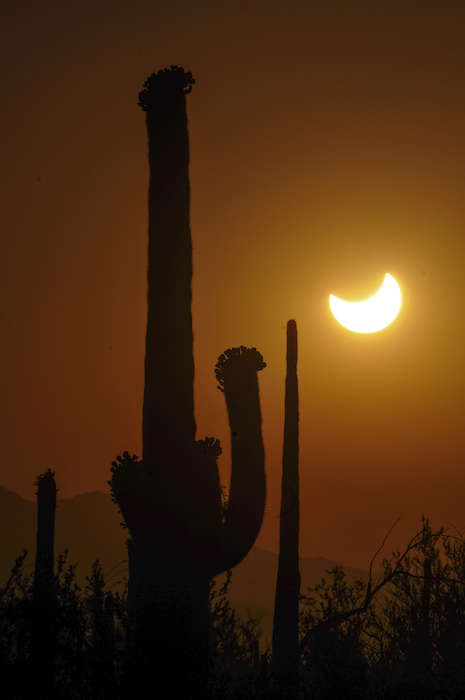
Lunar Eclipse seen at sunset within Saguaro National Monument West
An optional third-stage electric motor on a Vector-R can deliver a satellite up to 500 miles above Earth for an additional $500,000. The larger Vector-H version sells for about $3 million. The rockets are simple, with no pumps, and fewer components than the competition. The Vector’s first stage, for example, has just 15 parts. Launches are presently held on the East coast in Florida. One launch was planned from Kodiak Island in Alaska.
The original idea behind Vector was to build a satellite-based system that would allow customers to use software to operate sensors, using a constellation of satellites as “virtual machines.” Galactic Sky, as that concept is being developed as Vector perfects its launch business, a billion-dollar business by itself. Vector plans a 70,000-square-foot rocket factory in Tucson after securing a lease with Pima County for the county’s Aerospace, Defense and Technology Business & Research Park. The company, which has about 25 employees now, plans to add 40 to 80 people, mainly engineers and skilled workers like machinists, early and hopes to hire 200 employees in Tucson in a few years. Besides Tucson, the company has operations in Orange County and San Jose, California. The lease deal came after a successful test of the new rocket engine Vector is developing with NASA. Vector already has more than 100 launch contracts in hand.
FRANK BORMAN TUCSON SPECIAL SON…
Frank Frederick Borman II (born March 14, 1928), Col. USAF, Ret.), is a retired United States Air Force Pilot,  aeronautical engineer, test pilot and NASA astronaut, best remembered as the Commander of Apollo 8, the first mission to fly around the Moon making him, along with crew mates Jim Lovell and Bill Anders, the first of only 24 humans to do so before flying on Apollo, Norman set a fourteen-day spaceflight endurance record on Gemini 7, and also served on the NASA review board which investigated the Apollo One fire. After leaving NASA, he was the CEO of Eastern Airlines from 1975 to 1986.
Borman received the Congressional Space Medal of Honor.
Borman was born on March 14, 1928, in Gary, Indiana, where the Frank Borman Expressway is named after him. He is of German descent, born as the first and only child to parents Edwin and Marjorie Borman. Because he suffered from sinus problems in the cold and damp weather, his father packed up the family and moved to the better climate of Tucson, Arizona, which Borman considers his hometown.
Borman started to fly at the age of 15, later he graduated from Tucson High School in 1946.
Borman later received a BS degree from the United States Military Academy at West Point, in 1950, where he served as an Army Football Manager, and along with part of his graduating class, he entered the United States Air Force (USAF) and became a fighter pilot. He received his Masters of Science degree in Aeronautical Engineering from the California Institute of Technology in 1957. Later, Borman was selected for the Aero Space Research Pilot School and became a test pilot.


 The 45th President Donald Trump has brightened his Oval Office with new gold curtains and he is working hard pushing paper behind the Resolute Desk. President Trump said “a nation without borders is not a nation. Beginning today America gets it borders back.” The President’s first 100 days will have a honeymoon period where he will be allowed to accomplish almost anything he wants…President Trump wants a wall, “a wonderful wall” on which he can place his name. Trump believes he can crush “the crisis on America’s Southern Border”, for just $9 million a mile.


 ‘You can’t dismiss that illusion, it’s important to people, but they provide the sense of security, not real security.’ Even the fearsome Berlin Wall with its trigger-happy sentries still leaked thousands of refugees even in its most forbidding years. Supporters of walls say a few leaks are better than a flood. But, author Di Cintio says consider the psychological price.


 of Labor Statistics. Manuel Cunha Jr., president of the Nisei Farmers League farming association, estimates 85 percent of California farm workers live in the United States illegally.


 The Monument’s, Echo Canyon Loop Nature Trail, is perfect for short distance legs, folks who want to stretch their legs after a long drive but don’t want to break out the water bottles and packs—it is less than a mile long. Topside you greet the sun and wander the summit enjoying the different points of view.


 The Chiricahua Mountains are part of a collection of forty neighboring mountain groups that lie between the Colorado Plateau and the Sierra Madre Occidental. Named the Madrean Archipelago, because it resembles an oceanic archipelago – a sea dotted with islands – only here the sea is hot desert grassland. These isolated mountain ranges are called ‘sky islands’.
 The gold pan of Arizona, SouthEast Arizona, home to Tombstone, a huge icon for all of the wild west that spilled over the landscape will get a huge shot in the arm if Congress acts on the proposal to make the Chiricahua National Monument the 60th U.S. National Park. Statistically, national parks get ten times more tourism, than do national monuments. So the new park who might see 50,000 annual visitors today could begin drawing in close to a half million tourists each year who may require meals, hotel rooms and gasoline.


 In 1963 the Colorado River was dammed and allowed to back up 186 miles through Glen Canyon forming Lake Powell. Built originally to provide a water supply to the arid Southwest, today the dam undermines that very objective and it has caused damage across the Colorado River Basin. Before the dam, Glen Canyon was the biological heart of the Colorado River, with more than 79 species of plants, 189 species of birds, and 34 species of mammals; and a cultural treasure, with more than 3,000 ancient ruins. All of that was lost!


 I stood behind my tripod making exposure after exposure. By luck I watched a bright streak of light appear above me while the camera shutter was open and was delighted to find the meteor trail recorded on the preview screen. My initial intention was to capture our Milky Way galaxy with an unearthly object, but I got the bonus meteor because the picture was made during the prolific Perseid Meteor Shower. In August the most dependable meteor watching nights occur during a moonless night. There is no way to predict if it will be a terrific or boring display.


 Called “one of the ten best museums in the world” that title might be argued, however, it’s success is without doubt. Tucson residents might be guilty of taking such a treasure for granted, visiting on birthdays or when relatives come to town, but ASDM can be busy as a beehive during Southern Arizona’s cooler months, thousands of visitors come to town, rent motels, eat in Tucson restaurants and spend their entire day surrounded by the incredible beauty of the Sonoran Desert.

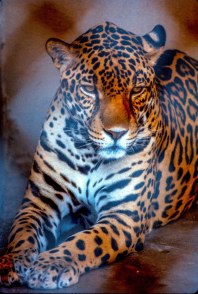 Back in the day, the Jaguar, was the last cat to live behind bars because of it’s ability to escape and resourcefulness, after that cat’s death, ASDM decided cages were no longer true to the Museum mission and the species went dark for decades. Today plans are on the drawing board for a new 1.5 acre exhibit called “Coasts to Canyons”, perhaps the most ambitious and expensive habitat, ever envisioned for the facility. Its completion would greatly increase visitors and no doubt bring out the locals to see the new digs and blow away visitors with the new air-conditioned exhibit. While this exhibit was part of Proposition 427, a $99 Million bond designed to improve roads, water control making Tucson a better place to live, it was defeated by a 39% voter turnout most of which were Republicans who felt an additional $18 a year would break their backs. Lots of private funds have been donated to ASDM and those monies alone will open the new “Winged Wonders of the South West” in 2015 and the million dollar “Midden Project” in 2017 where visitors will be greeted by a 75’ Diamondback Rattlesnake which they can choose to climb through.
 the Desert Museum opened it’s first major exhibit in a decade. The aquarium exhibition, called “Rivers to the Sea,” highlights the role of the rivers, including the Colorado and the Gulf of California. The 1,100-square-foot aquarium exhibit, housed in one of the historical structures built in 1937, includes many now-endangered species of freshwater fish, as well as several dozen species of fresh and saltwater creatures found to be at home in the brackish waters near the Sonoran coast, and the Sea of Cortez. That $1.3 Million project was opened with private donations.


 The amazing Hummingbird enclosure, full of lots of species who nest and buzz about the visitors and their cameras. Their eggs look like gum drops, the hummers are going so fast, one visitor jumps back, a baby cries, camera shutters click, big cameras and cell phones alike. One parent tries but can’t pull one kid away from his cell phone. “I hear the hummingbird! He’s way up there,” attempting to get his picture. “See the hummingbird?” says another dad, “brace yourself with that long lens,” he coaches.
 The Museum developed this enclosure and garden while and in doing so it developed new understandings of what attracted these fast-moving birds and what it took to keep them happy and alive. They wrote the book on Hummingbird gardens.


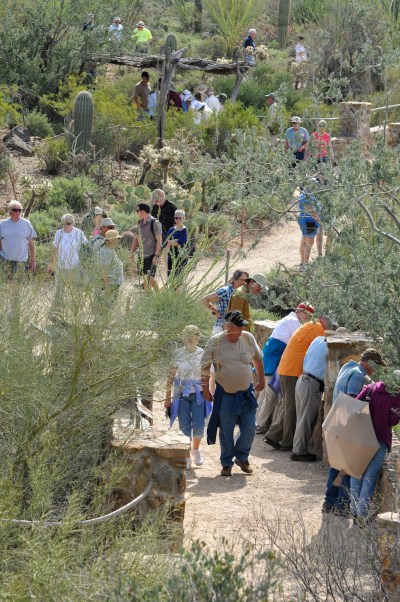 is outdoors! The 98 acre Desert Museum is a diverse experience: featuring a zoo, botanical garden, art gallery, natural history museum, and aquarium. The 21 interpreted acres has two miles of walking paths through various desert habitats, housing 230 animal species, 1,200 types of plants with 70,000 individual specimens. It houses one of the world’s most comprehensive regional mineral collections. Beyond merely an attraction, the Museum’s conservation and research programs are providing important information to help conserve the Sonoran Desert region. The Desert Museum’s Art Institute inspires conservation through art education and gallery exhibits. The Museum’s publishing division, ASDM Press, has produced over 40 books and guides on the natural and cultural history of the Sonoran Desert.


 Today, one year plus and counting, activists are marching for Oak Flat in Honolulu, Seattle and Sacramento and protests are being held elsewhere in the U.S. The San Carlos Apache began their 2016 anniversary march in February from “Old San Carlos”, 13 miles from present day tribal headquarters, when Coolidge Dam was built it plugged the Gila River. As the water rose the historic, painful and criminal San Carlos Indian Agency was lost to the waters, as well as, 400 Indian graves.

 The Save Oak Flat Act, authored by Tucson Rep. Raul Grijalva and cosponsored by presidential Democratic candidate Sen. Bernie Sanders, Rep. Ruben Gallego and Sen. Tammy Baldwin, would repeal this amendment to the National Defense Authorization Act, thereby disallowing mining in this area. According to the Save Oak Flat Act, the establishment of a mine would result in, “the physical destruction of tribal sacred areas and deprive American Indians from practicing their religions, ceremonies, and other traditional practices.” Furthermore, the Act considers the potential environmental degradation due to mining waste.
 Nosie then led his people on a march to Apache Leap Mountain towering over the mining community of Superior where Resolution Copper plans to use robots working deep underground to collapse the mountain beneath itself imploding the Apache sacred ceremonial grounds where their ancestors are buried, where their daughter’s held Sunrise Ceremonies, where their parents wakes and funerals were enshrined—a holy place for every chapter of Apache Life.


 We used to roam the entire South West, but we were told to stay at San Carlos and extermination was the response when we didn’t. The white man killed our ancestors, my great grandparents, when they tried to continue their nomadic lifestyle. My mother told me, stay on the reservation-don’t bother those white people outside or they will rain down hurt upon you and our people! That was a sickness pressed upon our people by the U.S. government, that ends today, “Today we pray to our God and through God we will win!”


 “I’m very proud of my ancestor’s “Apache Pride” we were supposed to be exterminated but we are here today, let’s take over Oak Flat, this is our time to be involved! Apache were slaughtered and killed here—we will fight for the blood of our ancestors. The chairman said the San Carlos Tribal council voted against any copper mines being built upon their land.”


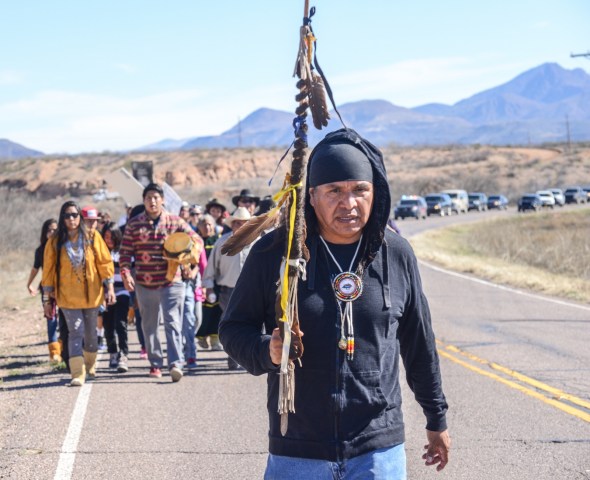 Wendsler Nosie Sr. marching to Oak Flat


 Annetta Koruh “Nita” bakes Piki Bread for her godson’s Naming ceremony and to feed the Kachinas that come to dance at 3rd Mesa.
 KATERI TEKAKWITHA BATHS HER LOVE LIGHT ON THE WHITE DOVE OF THE DESERT ! SAN XAVIER MISSION…..203 views


 The route starts in Talkeetna, a
  funky town of about 600 people (think Bisbee hauled about 2,900 miles north) that is the jumping-off spot for climbers determined to scale Mount McKinley, the highest peak in North America. The train turns around less than 60 miles north at Hurricane, nothing more than a train maintenance building.
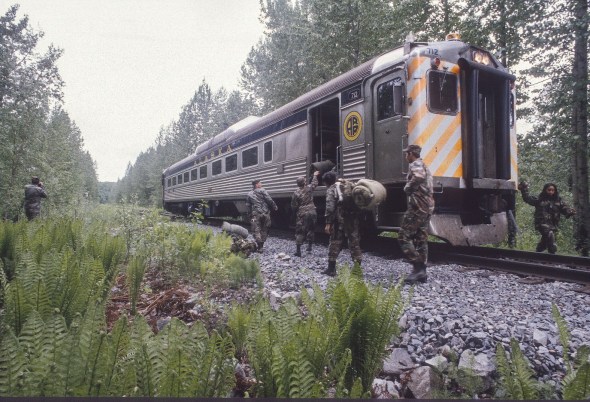 High school ROTC students disembark to live off the land.


 Engineer Pete Hackenberger says the Talkeetna-to-Hurricane run is the best job on Alaska’s rails.


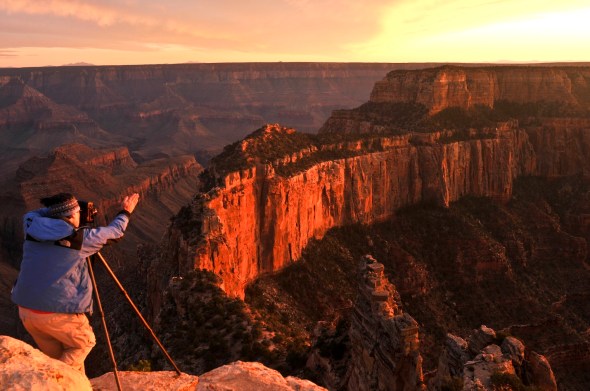 “Leave it as it is. Man cannot improve on it; not a bit. The ages have been at work on it and man can only mar it.”
 “Leave it as it is. I hope you will not have a building of any kind, not a summer cottage, a hotel or anything else to mar the wonderful grandeur, the sublimity, the loneliness and beauty of the canyon.”

 pressures could be mitigated with a “Wilderness” status not to mention new pressures to open old uranium claims and at the same time open new sources of mine waste pollution to Canyon waterways, creeks and streams, some of which are already unsafe for drinking. More than a half million unstable mine tailing ponds, shafts stand ready to drain into western water tables, as well as the Colorado River, a water source for 28 million people scattered across deserts from Tucson to LA.
 Motorist entering the Grand Canyon’s South Entrance is entering one of the NPS busiest gates any where in the United States, four lanes of traffic, bringing in annually 5-6,000 visitors daily. Today lane four is closed and traffic is backed up 13-15 cars deep in lanes one thru three, “Lane four was worn down to the bare dirt, it was really bad–they had to close it. “Just worn out”! Driving through the park the first signs you see ask the public not to approach wildlife or feed it, deer frequently graze on the roadsides and close contact with motorist is always possible. Almost two dozen deer were destroyed in Indian Gardens after becoming addicted to junk food and were slowly starving to death after campers had pampered the deer with handouts that destroyed their wild constitutions.
 by visitors arriving from the East Entrance Gate, making my way to the Lookout I start getting the idea English may not be the first language of
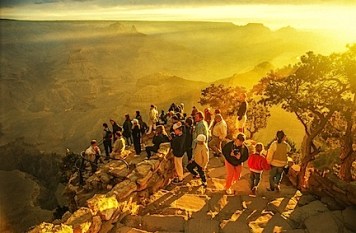
 choice, but the common denominator is the Grand Canyon, everyone wants to see it. Sunset is approaching and the building crowd is drifting toward the point jutting out from the South Rim’s iconic Historic Tower. As the sun lowers folks begin to debate whether this is the BEST viewpoint to photograph the Sunset, for many visiting the Grand Canyon is a once in a Lifetime happening, so photographers want to make the most of the moment.
  Tourist begin squeezing toward the furthest spot to get their iconic photo of their visit to the “big ditch” a photograph destined for a lifetime in a frame. Four English-speaking Ukrainian women take their turn when a
  Greek man pushes to the viewpoint moments before the sun sinks into the horizon. “We made it”, he proclaims spinning taking in the whole 360 degree panarama, he pulls out his five week old chichuaha pup and hoists the dog above his head giving Marianna the ultimate viewpoint. “She goes everywhere with me, he says I’ve been trying to get here since I was in the fifth grade, he whoops. “We made it” he repeats asking the Ukrainian women to take his picture passing his phone only to have it returned. Dead battery!
 money makers in the National Park portfolio, it was Jan Brewer,Governor of the State of Arizona who paid to keep the Canyon open when Republicans shut down the US Government. The tourist dollars fallout from a Canyon visit for the State of Arizona is enormous. It is so beneficial that places like Las Vegas, keeps trying to sell it as Nevada’s Grand Canyon, selling flights to the Canyon including flyovers and ground visits via buses or the popular Pink Jeep Tours. Not long ago I heard a NPR broadcaster speaking about Utah’s Grand Canyon and that I can sort of understand. Utah’s still sore because Arizona stole Monument Valley and could be looking for payback…


 Garrett Paulsen writes in the
  I move on to the Canyon’s edge. “I’m on the edge of the World”, shrieks a eight year old, his arms spread as wings cast long shadows as the Canyon light moves lower in the West. As old as it is, fans and new technologies, still bring fresh perspectives to the timeless Grand Canyon. Selfies are what the Grand Canyon is all about. Gone are the days of everyone passing their phones or cameras so everyone had a view in their phone gallery.
  Today the “Selfie Sticks” and “Selfie Apps” which allow you to view your camera’s viewfinder in your phone’s monitor allowing for ease in composition, gone are the “Hail Mary” composition where you just pray you included everyone in the photograph. Couples now just hold out their camera or phone on a extension stick replace the middle man.
 Like Marianna and endless number of others had pleasant exchanges with people from all over the world in that simple moment when they turned to a strangers and universally ask them to make their picture, technology often loses the human part of life in its rush to make our world better.
 Whether you have seen the Grand Canyon from the North, East, West or South Rim, from a raft or kayak on the Colorado River or by sitting atop a mule or walking in to Indian Gardens or Phantom Ranch and climbing
 back out. Everyone enjoys the Canyon at their own pace, some never get enough, there is a large number of folks who walk from atop the South Rim down to Phantom Ranch, cross the Colorado River by bridge, climb up to the North Rim, turn around and go back to the South Rim in one day. Who does that ? A surprising enough number of people who love the challenges the Canyon throws at them and finds the challenge fills their inner soul as well as pushing their bodies to overcome natures obstacles. Rather than being punished on the trail-some want to experience the Canyon on the back of a mule and are willing to pay $550 for one or $960 for two to overnight at Phantom Ranch. But first, riders must be at least 4 feet 7 inches in height and must speak and understand English, must be in good physical condition, should not be afraid of heights or large animals, and cannot be pregnant. Finally must weigh less than $200 full dressed.

 absolutely unparalleled throughout the rest of the world. I shall not attempt to describe it, because I cannot. I could not choose words that would convey or that could convey to any outsider what that canyon is. I want to ask you to do one thing in connection with it in your own interest and in the interest of the country–to keep this great wonder of nature as it now is. I was delighted to learn of the wisdom of the Santa Fe railroad people in deciding not to build their hotel on the brink of the canyon. I hope you will not have a building of any kind, not a summer cottage, a hotel or anything else to mar the wonderful grandeur, the sublimity, the loneliness and beauty of the canyon.
 El Tovar Grand Canyon first opened for service in 1905. The premier hotel and restaurant at the Grand Canyon was originally operated by the Fred
 Harvey company. The El Tovar is been the most sought after lodging for over 100 years. In 2005, the Park celebrated the 100th anniversary for this classic historic National Park lodge. It was originally built to accommodate those distinguished passengers who arrived on the Sante Fe Railway. You can make the El Tovar a part of your Grand Canyon vacation if you plan far enough in advance. If you desire to stay at the El Tovar, we recommend that you call Xanterra Parks and Resorts at 1-888-297-2757 at least 18 months in advance.
 “THUNDER RIVER”, Arizona Senator Barry Goldwater once said was his favorite spot in all of Arizona. He was mesmerized by a river appearing wild in the wall of a rock cliff and watching it tumbled down the rock and create Deer Creek, a trusted water source.
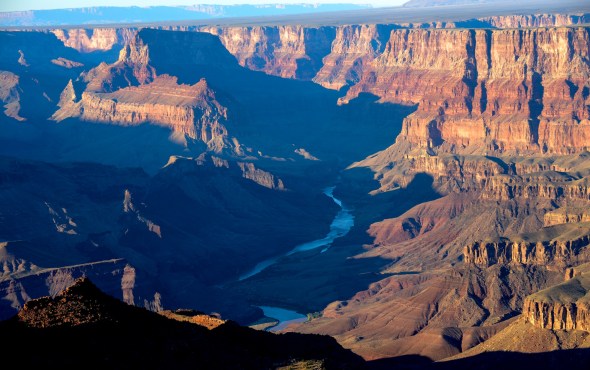 Activist say the Grand Canyon is facing the most serious threat in its 95-year history. It would alter the natural beauty of the canyon and encroach on its borders. Secondly, a major housing and commercial development, jeopardizes the fragile ecology and water supply on the arid South Rim. The Tusayan development would add 2,200 homes and 3 million square feet of commercial space to a town two blocks long. Park officials say existing development around the park and the scarcity of water have already stressed the park’s ability to handle visitors and new projects will only make matters worse.
 LA Times reports water is already so precious in the park’s resident elk herd have figured how to operate the Grand Canyon’s new water faucets
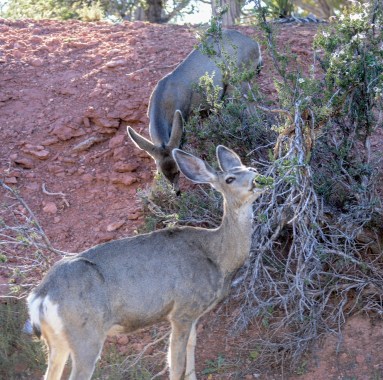 and began serving themselves. A young elk defending his water fountain began chasing away all who would drink. The park imports all water for its South Rim hotels, restaurants and amenities from springs on the north side of the canyon. An antiquated aluminum pipeline threads 13 miles though the serpentine fissures on the canyon floor, then up a mile of sheer rock on the South Rim. The pipeline regularly breaks down, requiring helicopters and burros to ferry crews at a cost of $25,000 per service call.


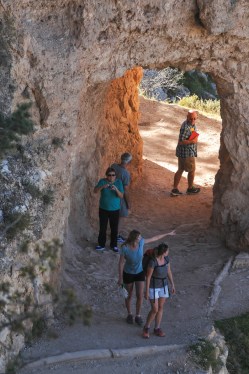 Each has a different focus from balancing recreation with resource protection, to solitude to expanding recreation activities. Another option would leave things as is. The public has 90 days to comment. Park officials are trying to get a better handle on how many people head into the canyon and to the most primitive areas with recent proposals to manage the backcountry. They say the trails are too congested and hikers complain of noise, trash along the trailss and long lines for toilets. The park says it will be a year or more before a final decision is made.

 Reservation


 Visitors may purchase professional photographs of their visit to the Skywalk in the gift shop. Personal cameras -OR- Cell Phones are NOT allowed on the Skywalk itself; along with other personal property, all must be stored in a locker before entering the Skywalk. Grand Canyon West is located on the Hualapai’s Tribal lands, and the National Park Passes and other Entrance Fee’s DO NOT apply at Grand Canyon West. Info&Reser: 1-888-868-9378











 SOUTHWEST PHOTO JOURNAL