MEXICO: THE ECOLOGY OF THE COLORADO RIVER


THE ENDANGERED SANTA CLARA WETLANDS
The lower Colorado River plays an important role in the migratory pathways of birds that winter in the southern United States and serves as the gateway for those species continuing south into Mexico. Although not extensively studied, the delta’s significance for migratory birds is indisputable, as it is the principal freshwater marsh in the region. A total of 358 bird species have been documented in the Colorado River Delta and upper Gulf of California region. From these, two are listed as endangered, six as threatened, and sixteen are under special protection in Mexico. Two wintering species and five breeding species have been locally extirpated, including the Southwestern Willow Flycatcher, the Fulvous-whistling Duck, and the Sandhill Crane.
 birdcount
The delta supports a variety of wildlife, including several threatened and endangered species. Mexico’s Environmental Regulations on Endangered Species lists the following endangered species found in the delta:
• the Desert Pupfish, also listed as an endangered species in the U.S., the largest remaining population anywhere is in La Ciénega de Santa Clara
• the Yuma Clapper Rail, also listed as an endangered species in the U.S.
• the Bobcat
• the Vaquita porpoise, the world’s smallest marine cetacean, listed as a species of special concern by the U.S. Marine Mammal Commission. There are less than 250 vaquita left in the world.
• the Totoaba, now virtually extinct, a steel-blue fish that grows up to seven feet and 300 pounds and once supported a commercial fishery that died in 1975
• the Colorado Delta Clam, once an extremely abundant species and important in the ecosystem.
• The delta of the Colorado River is one of the major desert-river estuaries of the world and contains the largest wetland ecosystem in the Sonoran Desert.

Much of the delta has been converted into irrigated farmland; but approximately 250,000 hectares of unconverted delta land, too low for drainage and too saline for agriculture, still exists at the southern end of the delta in Mexico. Within this area lies the Cienega de Santa Clara, the largest brackish wetland habitat in the lower delta. This wetland is about to undergo major alteration in flow and salinity of input water due to activation of the Bureau of Reclamation’s Yuma Desalting Plant in Arizona.
• Prior to the construction of Hoover Dam and other upstream water diversions, the majority of the delta was lushly vegetated with an estimated 200 to 400 plant species I as well as numerous bird, fish, mammals. The Cienega de Santa Clara may be the largest wetland bird habitat left in the Delta long known for its higher concentrations of Yuma Clapper Rails and Pupfish than known elsewhere. Both species remain on the endangered list. Mexican officials have also expressed interest in cooperating to protect the delta wetlands where the diminished river trickles into the Gulf of California.

mouth of the Colorado River at entrance to the Gulf of California
The lower Colorado River also separates two great deserts, the Mojave on the California (western) side and the Sonoran on the Arizona (eastern) side. Over the eons the River has served as a genetic barrier, separating both sides as well as isolating species that can’t swim across the river or fly across the desert, limiting the development of subspecies in the region.
Birds of the Colorado http://www.pinesandprairieslandtrust.org/CRR_Bird_List.htm
Colorado River Nature Center http://www.azgfd.gov/outdoor_recreation/wildlife_area_co_river_nature.shtml
THE COLORADO RIVER WATERS THE AMERICAN SOUTHWEST
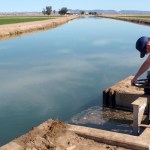

The Colorado River system, including the river, its streams, and the lands that those waters drain, is called the Colorado River Watershed. It drains 246,000 square miles, including parts of U.S. states Wyoming, Colorado, Utah, New Mexico, Nevada, Arizona, California and Mexico. Colorado River Basin is federal land comprised of national forests, national parks, and Indian reservations. The drainage total runoff is 25,000 cubic feet per second, about two-thirds is used for irrigation, and the other one-third supplies urban areas, evaporates into the atmosphere, or provides water to riparian vegetation.

Today nearly 17 million people depend on the Colorado’s waters 80 percent of the region’s residents live in Phoenix and Tucson, Arizona, and Las Vegas, Nevada are the largest cities in the basin, and they use the Colorado River as their prime source of water. Water from the Colorado River is diverted eastward across the Rocky Mountains to Denver, The Colorado River Aqueduct carries water to metropolitan Los Angeles, and the Central Arizona Project supplies the Phoenix and Tucson areas. The All-American Canal provides water for the Imperial Valley of southern California, a productive agricultural region created in the desert.  Los Angeles Canal built in 1930-31

The Central Arizona Project brings 1.5 million acre-feet of Colorado River water per year to Pima, Pinal and Maricopa counties in southern Arizona between Phoenix and Tucson. Glenn Morales fertilizes CAP water on the San Xavier Farm south of Tucson.
The CAP carries water from Lake Havasu near Parker to the southern boundary of the San Xavier Indian Reservation southwest of Tucson. It is a 336-mile long system of aqueducts, tunnels, pumping plants and pipelines and is the largest single resource of renewable water supplies in the state of Arizona.

The Colorado River is the primary water source for these four major US cities, all considered at-risk for suffering from acute water shortage, Los Angeles (first) Phoenix (third) Las Vegas (seven) and Tucson (eighth). Other cities on the list are Texan towns of Houston, San Antonio, Fort Worth and Orlando Florida, Atlanta Georgia and the entire California San Francisco Bay area.
Currently Tucson (ranked 8th) receives less than 12 inches of rainfall each year, the Tucson region uses about 350,000 acre-feet of water per year. At this rate, Tucson’s groundwater supply, which now provides the majority of the city’s water, has a very limited life span. In addition to this, the city is currently bringing in 314,000 acre-feet per year from the Colorado River under the Central Arizona Project. However, Tucson has added more than 20,000 people since 2000.
Las Vegas (ranked 7th) receives 4.5 inches of rainfall each year. Home to a half million people living in the middle of the Mojave Desert getting 85 % of its water from Lake Mead which is now almost 60% dry. Perhaps the lights going out in LA will be noticed when Hoover Dam stops producing electricity in 2013.
Phoenix (ranked 3rd) receives 8.3 inches of rainfall leaving 1,593,659 people depending upon their groundwater, the Salt-Gila Complex, and the Colorado River for their drinking water. Phoenix is adopting an recycling campaign to aggressively replenish groundwater, and cut back on over use.
Los Angeles (ranked lst) receives 14.77 inches of rainfall annually leaving 3,831,868 people depending upon the Colorado River drinking water carried by miles of pipes, aqueducts. The fastest growing city in the country continues to increase its demand at an unsustainable rate.
Hoover Dam, which is the main source of electricity for LA and much of the greater southwest, is now producing at a lower rate than it has historically. Some scientists suspect this drop-off will continue to a point where its electricity production is too small to sustain the dam economically. Los Angeles, even if the dam doesn’t cease production in 2013, as some predict, it still faces serious water shortages.
 aerial view of the US-MEXICO BORDER showing Colorado River Water in the ALL AMERICAN CANAL and the irrigated Imperial Valley and note the lands south of the border-the empty lands of Mexico.
THE ALL-AMERICAN CANAL
The All-American Canal is a 170-foot-wide conduit that transports water from the Colorado River near Yuma, Ariz., across the arid desert along the Mexican border for 17 miles into the Imperial Valley of Southern California and with over 500 people having drowned in the canal since 1997, it has been called “the Most Dangerous Body of Water in the U.S.. The canal was constructed in the late 1930s and early 1940s, it supplies water to the Imperial Irrigation District. It is the largest water canal in the world at 80 miles in length.
 MILTON COLEMAN from YUMA Says the BLUEGILL fish he catches is the “best-eating” fish he catches in the All AMERICAN CANAL…
FOOD GROWS WHERE WATER FLOWS … THE COLORADO RIVER VALLEY IS DYING

PAUL W. “loved the Colorado River” and his friends left his marker overlooking the river he lived for. ..
Famed humorist, actor, statesman and cowboy Will Rogers said this about the OWENS VALLEY that the LA aqueduct drained in 1930: “Ten years ago this was a wonderful valley with one-quarter of a million acres of fruit and alfalfa. But Los Angeles had to have more water for its Chamber of Commerce to drink more toasts to its growth, more water to dilute its orange juice and more water for its geraniums to delight the tourists, while the giant cottonwoods here died. So, now this is a valley of desolation.”
 Alfredo
Alfredo Cervantes, a life-long agricultural supervisor or field-worker that came to the US in the 1960’s from Mexico with his father to farm land next to the Colorado River and he never left the River. Across the river in Arizona there are some folks who would hate Alfredo because he had three kids, all did well, one son’s a paramedic and another works admission at a hospital another works elsewhere in the medical field and all ask dad “why do you work so long and hard”. Cervantes admits he works day and night for his fields, always has. He gets up to turn on the water and nurses the water into the rows to beat the sun and the evaporation. ” When I farm I grow enough food for almost a 100 people”, he says modestly of his yearly efforts farming his fields adjacent to the Colorado Rivers nine miles south of Blythe, CA. He nurtures his alfalfa, his family, the sugarcane he grows on the family farm outside of Guadalajara in Jalisco and has struggled for a lifetime to give his kids a better life. Alfredo admits he never went to school!
 cervantes
 field irrigation
But he learned to read, he liked World Books, folks gave him other reading, he pursued his interests–I mentioned my Cuba trip and he brightened when I pointed out they shared his Spanish blood … “Richest land anywhere, they say in Cuba you can grow anything there”! he announces with absoluteness. But his readings have also made him worry about what he sees around him. The field across the road became a RV Park adjacent to the river “for people on vacation” he says they sold their water rights to LA like about 30-40 per cent of the entire valley has already sold and the richest land in the world sits fallow. Meanwhile the water flowing next to this field is siphoned from the river pumped uphill day-in, day-out sending the farmer’s water share to LA since they bought the water rights there. just like LA did in Owens Valley says Alfredo who explained how LA had bought up all water rights in the richest Eden ever-known and after building an engineering miracle of a 200 mile aqueduct they returned to pump out the ground water and to turn the once green, lush paradise into an alkali wasteland of blowing dust void of topsoil. “You know, like they did in Oklahoma during the depressions” Alfredo continues … He also feels bad feels bad about his lack of education, but he believes he “elevated his children’s opportunities in life but feels bad because none of them want to do the work he had done all his life and inherited from his father, a life of living off the earth. A life in harmony with the land. After talking to Alfredo, I cheaked facts and found he was right about so much, the Mono Lake debacle, where the 20 mile-long lake, the centerpiece of Owen Valley had disappeared, destroying the resident’s way of life and property values, some say, the residents of the Owen Valley were made whole by final settlements, but how do you reimburse someone for destroying their quality of life.
Alfredo Cervantes is the canary in the coal mine ! He’s worried, he is looking around and it’s getting dark all around him and he is speaking out–doesn’t everyone see where this is heading … it has happened before. LA is doing it again ! They are still debating whether or not they can plant lawns in LA. Tucson gave up lawns for green gravel in the mid-1970’s. St. George Utah is fast growing, and happens to be the driest county in Utah. Presently, they are debating the building of a canal to Lake Powell 130 miles away, some are for it and other say they don’t need it. They point out St George has the highest per capita water consumption rate for desert cities in the US (335gal/person/day twice Tucson’s usage) and still enjoys the country’s lowest rates and grow green lawns made from Kentucky Bluegrass, a species known for its thirst.

Morrow Mayo, a Los Angeles reporter wrote: “Los Angeles gets its water by reason of one of the costliest, crooked, most unscrupulous deals ever perpetrated, plus one of the greatest pieces of engineering folly ever heard of. Owens Valley is there for anybody to see. The city of Los Angeles moved through this valley like a devastating plague. It was ruthless, stupid, cruel and crooked. It stole the waters of the Owens River. It drove the people of Owens Valley from their homes, a home that they had built from the desert. For no sound reason, for no sane reason, it destroyed a helpless agricultural section and a dozen towns. It was an obscene enterprise from the beginning to end.”
SOUTHWEST PONZIE SCHEME…the next economic bubble specific to every homeowner in the South West Region
I got to thinking that the Colorado River could be the biggest ponzie scam of all. There were lots of warnings, but not until I read how the $68Million relining of the All American Canal had been financed and paid for by San Diego County for the rights to the water that would have been lost from the canal had it not been relined. It was then, I thought of the campers shoulder to shoulder, backed into a parallel parking spot with maybe a picnic table, shared toilet and water for $20-$45 a night or $320 for the week. Drop a boat in the water, add $20-$50 (summer rates) a day to moor. Need power, septic, cable, shade, try $60 a night. Extra person in campsite or RV add $6, Dog deposit fee $20 refundable, if all goes well. Or the twenty-five boat dealers or rental facilities who will rent a pontoon boat from $275 up a day and delivery it anywhere on the river for $150. This is big business! From the resorts, hotels and folks squeezed into campsites shoulder to shoulder. People spend $45 or more to park their rig in sought after cove operations which are self-sufficient, having their own fuel pumps, restaurants, club house and enforced peace and quiet. They will collect A premium fine, if you or your dog misbehaves.
 for sale
It is in this focus that the warnings that Lake Mead, the largest reservoir in the United States, could feasibly run dry, with catastrophic implications. FOR EXAMPLE; take a mobile home worth $30,000 everywhere else and place a hundred of them next to the river and sell them each for $99,000 each, everyone’s happy till the water runs out. Everything is leverage against everything else and if the water goes away so goes it all. The water is the glue that holds all of it together.
COLORADO RIVER’S SPRING TRANSITION FROM SNOW BIRDS TO RIVER RATS
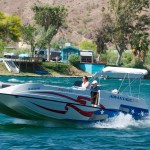
 Waverunners with California backdrop
 Arizona Shoreline north of Parker
SPRING BREAK, is a nation-wide popular rite of SPRING, at Lake Havasu on the Colorado River, it also begins the transition from the quiet SNOWBIRDS to a long-summer infestation of RIVER RATS. Talked with one winter visitor who parks his RV Bus on a strip of dirt called Imperial County long term parking and he and 900 other vehicles or approximately 1800-2000 people hang out and prowl the hills looking for birds and bighorns. When winter ends my RV Visiter, former military from Conneticut, drives it ten miles north to the :Yuma Proving Grounds and parks it there for the summer at $40 a month. He son from Gilbert, AZ picks him up there and puts him on a plane in Phoenix til next year. Further up the road on the Arizona side, in Quartzite, gem sales popup everywhere and between 20-25,000 RV’s showup and park in the warm winter sun, creating a city in early January of 50,000 campers. LAKE HAVASU which sits on the Arizona side of the lake and borders California this year is also in the nation’s theaters with PIRANHA 3D, a hi-tech view of the river community during spring break but then fish start eating people-there are lots of half-eaten folks-strange PR—but the best press you don’t read—you simply weigh it. Much like fishing, don’t tell me about some fish you caught, put it on the scale.
Today nearly 17 million people depends upon the water of the Colorado River’s 80 percent of these folks live in Phoenix and Tucson and Las Vegas and Los Angeles.

Hoover Dam in 1931 was the greatest engineering accomplishment of it’s time and made it all possible. It’s 726’ height and 1244’ length dams up the greatest river in the American SouthWest, the Rio Colorado, whose headwaters 1450 miles north in Colorado, drains almost a quarter million square miles. The Dam, enjoys seven million visitors a year, and has enough concrete (4.5 million cubic yards) in Hoover Dam to build a two-lane road cross-country from Seattle to Miami. Lake Mead has added 550 miles of shoreline behind the dam and has a capacity of 1.25 trillion cubic feet of water that could cover the state of Pennsylvania one foot deep. It is the largest reservoir in the United States.


Roughly 60 million people today live in the American South West amongst with the ruins of civilizations that were brought to their knees by severe droughts experienced frequently in this region over the last 2,000 years. Droughts serve as stark reminders of just how inhospitable the great American desert can be. Previous catastrophic droughts occurred in times free from the influence of global warming and the increasing aridity that many scientists predict will bring new challenges to living in the southwest.
 CALIFORNIA Sunrise
 ARIZONA River houses
The Colorado River has long been the lifeline of the American South West, the watershed covers seven states and Mexico. More than 100% of its water today is used for recreation, agriculture and drinking water. Heavily recycle, the water is constantly re-used. Because of over-use the massive reservoirs, Lake Mead and Lake Powell have gone down in the past decade to half capacity. When the Colorado River was divided up in 1922, more water was awarded than actually exists most years, and the recent drought make those numbers worse moving into a period of “global warming” clearly the golden period of water has past. Last year’s rainfall and snow melt are now predicted to cover the region’s needs but last year it was feared CAP water allotments might be necessarily cut due to shortages at Lake Mead. Nature and the poorer regions like Mexico receive less and less. The South West view that money flows uphill toward money is seen by the unchecked growth of LAS VEGAS, NEVADA and today water flows to where man demands rather than to where nature intended, a tradition that began at the turn of the century and continues today. But can it be sustained ? Warnings have been made that Lake Mead, the largest reservoir in the United States, could feasibly run dry with catastrophic economic implications to the Southwest.
http://www.coolestspringbreak.com/lake-havasu-spring-break.html
NOGALES BORDER FIRE UNCOVERS SUMMER CROSSERS

Duke fire burned along the US-Mexico Border
SOMETIMES WE JUST GET LUCKY, maybe when the “man-made” DUKE Fire started out as a warming fire for illegal crossers it ended up as a 4000 plus acres desert wildfire which scorched the desert floor right up the ridges into the pine leaving no grasses, or ground cover and essentially nothing growing. Which means, no ground cover, no camo or no shade … Just scorched earth. Duke fire burned along the US-Mexico Border. 
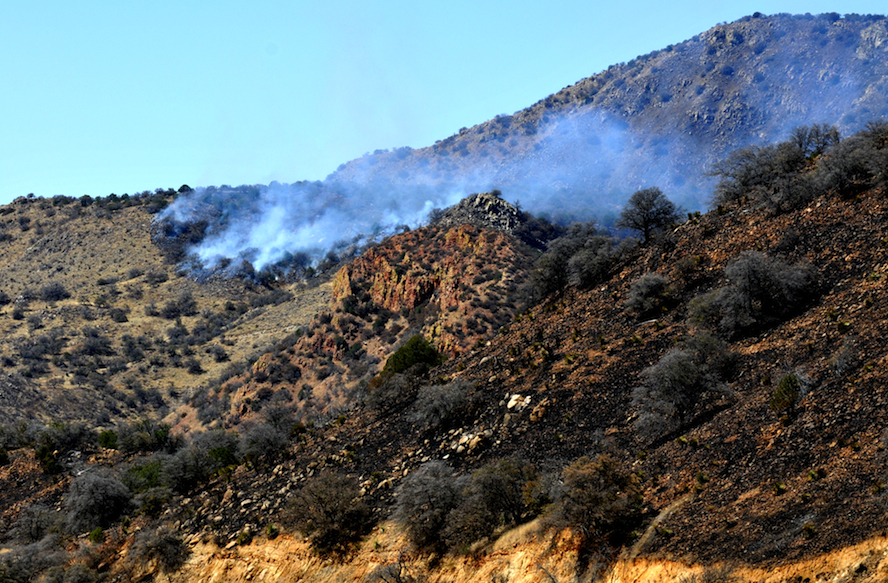
Low intensity desert fire burns through the grasslands which holds the soil and the scrub oak which anchors everything with its root system
<img src=" Tight view of the DUKE FIRE burning northeast of Nogales AZ” alt=”” />
So the DUKE FIRE was lucky, it came at a time when all the Wildfire Teams are in place and preparing for a big season, working on maintaining forest in anticipation of the upcoming burns, lots of burn offs come at this time just to lower the risk, doing it as time allows and weather permits. The Duke Fire has 190 wildland firefighters in camp and working on the fire lines, yesterday they were doing backfires along the Harshaw Road north of the ghost town of Duquesne. Today’s Wildland Fire Report said the border fire is 10 percent contained and that firefighters are prepared for a long fight. It appears they plan to burn off the entire area, which will keep them from returning later this summer, clear the land for Homeland Security, and since no housing is endangered, they will keep backfiring and let the brush burn off.
THE CIVIL WAR in the SOUTHWEST, a Southern Arizona Standout

<img src="  <img src="
  ” alt=”Couple from the Old South” />CLICK HERE FOR SLIDESHOW
<img src="  ” alt=”Cannon Fire Shakes Your Teeth…”
Tucsonan Gary Eichholtz uses a stick to get the nasty grease layered thick over the pistol balls he just loaded into his Army Colt. “Without the grease when you release the trigger and all six loads might fire at once” he says about the black powder pistol he uses as a re-enactor at the annual Civil War in the SouthWest Campaign held each March at Picacho Peak State Park between
Casa Grande and Tucson in Southern Arizona. Chain-reaction firing could damage the pistol and possibly injure the user which makes the single shot black powder musket the most reliable weapon next to the bayonet on the muzzle which is the last line of defense when you are out of lead balls or powder or time. In the early years, the Park celebrated the skirmish as” the most western battle fought in the Civil War” so the Battle of Picacho Peak was re-enacted. It was strictly a skirmish, which lasted an hour, and was totally fluid and nothing was planned just reacted to. Twelve Union Troops looking for Confederates found three lookouts and took them prisoner but failed to notice their seven comrades who blasted them soundly, killing Lt Barrett and two more blue bellies. Union reported two rebels were injured in the shootout but the Rebels apparently failed to notice. In later years, the Picacho Battle Celebration was joined by two more battles, “The Gettysburg of the West” or the Battle of Glorieta (NM) was a Union Victory, the Sante Fe Trail was no longer threatened by Confederates trying to drag the American West into the Battle between the States. Confederates lost 36, 60 wounded and 25 missing, the Union lost 38, had 64 wounded and had 20 missing. Truly a hard fought battle but no less violent than the Battle of Valverde (NM) where 2000 Texans forced marched to Valverde where they tired and cranky engaged 2500 Union and eight cannon with shotguns and a Rebel Yell. The Battle lasted all day and the out-manned Texans had 38 killed, 150 wounded and one missing. The Union had 68 killed, 150 wounded and had 35 run away, oops-go missing inspite of their superior number had their ass kicked by these cranky Texans who had no breakfast and a long walk to meet up with these no account Yankees who had greater number and more cannon but they were weak in spirit and the Rebels just over ran their positions took their cannon and turned it on them. Remember History favors those cranky enough to take the day…
<img src=" ” alt=”Some kids never Grow Up” />http://pkweis.photoshelter.com/gallery/CIVIL-WAR-in-the-SOUTHWEST/G00007jkvJMt6A54
In the old days the dead seldom died–lot of firing–but as the more severe battles merged, the dying became more professional and today, there are bodies everywhere till taps is played and all are resurrected. This year an injured foot soldier approached the spectator gallery and vomited body parts all over the mothers, toddlers and kids watching from the sidelines, realistic ? Great weather 2011 not too hot, unlike those years with great poppy crops when daily attendance might reach 4000 cars in the park to see the poppies and the battle, this year, Picacho Peak State Park barely got that attendence in both days. The Parks bring a lot of volunteers and borrow help from other State Parks for this weekend each year, they have the passenger shuttle from Kirchner’s State Park, they parked cars with military precision, the burros were good. More than 200 re-enactors participated it was good to see the youth of America jumping into the fray and enjoying the past. Old Timers like Tucsonan Gary Eichholtz has his tent, cot, floor rug, latern, easy chair and work table where he enjoys his comforts but he notes some of his younger comrade in arms are sleeping on the ground. Gary and I agreed sleeping on the ground is not as much fun as it used to be…
 ” alt=”Ft Huachucha’s B Troop at Picacho Peak” />
 ” alt=”Gary Eichholtz” />
STEP BACK IN TIME, ARIZONANS, ENJOY BIGGEST RENAISSANCE FESTIVAL IN THE SOUTHWEST …



CLICK HERE FOR SLIDESHOW

PERHAPS A QUARTER MILLION PEOPLE will visit the ARIZONA RENAISSANCE FAIRE this year near APACHE JUNCTION off HWY 60, which is now in its twenty-third year and going strong. The Medieval cityscape constructed midway between Phoenix and Tucson has become as Arizona, as is the Tucson’s Gem Show or Phoenix’s Spring Training. This event carved from 1500AD the century of Tudor England has grown significantly in size and each year it stays open a week or two longer. So when our weather permits, the Arizona Renaissance Faire is often in the TOP FIVE Festivals of the 236 in the United States and that reknown brings in some of the finest craftspeople, shows and reenacters. It is not unusual for the locals, to dress up and join in, bring along their own beer steins which they carry down to the joust and cheer on their favorite knight. The new arrival will be amazed by the hub-bub of the ancient community which offers opportunities to throw knives, axes and wet sponges. On the sidelines, craftspeople spin pots, blow glass, bend metal, cast bronze, harpest entertain and the beer and wine stands have a steady line but at the end you can only buy one beer–for yourself. Next to the drink stands, faire-goers can find food stands selling Turkey Legs, steak or chicken on a stick, pretzels, or beef stew in a bread bowl and as you stroll stuffing your face you can visit photo galleries, get your face painted, or hair styled by a Pirate. I went last weekend and the Toga Crowd were on hand with the exception all togas had a tartan plaid, whole families dress as pirates (including the dog), a few kilts showed up, but mostly dress from the Elizabethan Period was everywhere. It should be noted that the faire has embraced most One Percent Groups and offer sanctuary for fairies, klingons, wild men, pirates or buccaneers and FOOLS. TREEBEARD attended this year and was a big hit with the smaller members of the crowd who may not have yet seen the “Fellowship of the Ring” Trilogy but loved the talking tree who played with them. Most folks arrive between 10-11am and start leaving around 4:30 and the 5pm joust is the final event of the day. As you stroll out, take a minute, to soak up the great color of ladies and lords shopping and strolling along the main street where the smell of delicious cinnamon rolls fill the air. When you are ready to leave, there may be one more test of your ability. Sitting at the exit, looking like he is having a terrible day, last weekend was a sargent with the Pinal County Sheriff, he was backed up a two beefy Faire Security and they appeared that they could pluck drunks from the crowd before they got to their cars or check on designated drivers, anyway, keep those folks in mind as you enjoy the faire…you are quite a distance from anywhere. The Faire remains open through April 3rd and tickets can be bought at all FRY’S Groceries Stores for two dollars off or purchased at the front entrance for $22 per adult.

CLICK HERE FOR MORE INFO

“PAPA” HEMINGWAY LIVED LIFE TO THE FULLEST PERHAPS WAS “BIGGER” THAN LIFE


Having walked in Papa’s footsteps, drank in his favorite haunts, visited his homes, stared at the family photos on both sides of the Atlantic, viewed the sunset from Havana’s Malecon not far from Ambos Mundos the Hotel whose room 511 displays the uniform the writer wore as an ambulance driver during WWI which later would fuel his novel “Farewell to Arms”. It was a young man who left America’s breadbasket to “go to war”, it was a story that would repeat itself throughout his life, Ernest Hemingway was always going on one more great adventure … MAYBE HIS LIFE ENDED THE SAME WAY.a href=" CLICK HERE FOR ERNEST HEMINGWAY BIO from Wikipedi Perhaps he is best summed up by actress Marlene Dietrich, a close friend, who commented on his life to his biographer: “I suppose the most remarkable thing about Ernest is that he has found time to do the things most men only dream about. He has had the courage, the initiative, the time, the enjoyment to travel, to digest it all, to write, to create it, in a sense. There is in him a sort of quiet rotation of seasons, with each of them passing overland and then going underground and re-emerging in a kind of rhythm, refreshed and full of renewed vigor.” It was perhaps that he had reached a point when life no longer refreshed and that he decided to end his life as had his father, uncle, sister and brother and decsendents since in Hemingway fashion but he is remembered richly still for the life he did live. His writings today still bring in seven figures annually testifying that his tales, many thinly disguised from his own adventures, are still appreciated for his gripping tales with his economy of words and they sell. Tours visit both the 15 acre villa in Havana and the corner lot in Key West Florida only 90 miles and a ocean away, a trip Hemingway made many times, in “Pilar” the boat Hemingway bought to cruise the Caribbean, outfitted once to attack German Subs, his home on the sea and window to another world. Today, it sits at the Cuba home awaiting renovation, the Cuba government spent $1 million to renovate the Villa itself, called Finca Vigia (Lookout Farm) – Ernest Hemingway’s home in Cojimar Cuba where the American writer lived happily for a while with his wife Martha Gellhorn (he was married four times). – Ernest Hemingway’s home in Cojimar Cuba , and their two sons Patrick and Gregory.<a href="
 “> The 15 acre grounds are crowded by tropical plants, particularly fruit trees, which attracted lots of local boys who ventured onto the grounds to gather fruit. Hemingway was impressed by the local boys ability to throw rocks and knock the fruit free from the high trees. Wanting his sons, to mix more with the locals, Hemingway started a baseball team which he coached and he provided gloves, bats, uniforms, his sons played and neighborhood kids filled out the roster. The team took on challengers from all over Havana and soon, the players who heard Hemingway’s sons call Ernest “Papa”, they too called him “Papa”, in fact, so did their parents and so did the teams they played against. That’s when he became known as “Papa”. Still Papa is remembered fondly and still appreciated for his tale “OLD MAN AND THE SEA”, a literary masterpiece which the Revolution adopted as an omage’ to the Cuban People and still the Cuban people love him. Today you can have your photo taken at the El Floridita Bar on Obispo street, in Old Havana where the novelist Ernest Hemingway spent many hours drinking his favorite Daiquiri’s and today a bronze Hemingway sits there still where almost all the tourist get their picture taken with the famous Pulitzer prize winning, Nobel Prize winning writer as he holds court at the famous bar. In Key West, Florida the Conch Republic’s parallel is “SLOPPY-JOE’S”, a downtown corner bar where each July they have the annual “Papa Hemingway” LOOK-A-LIKE Contest, where one year the winner didn’t even have a beard, last year’s winner, a barber from Mesa, AZ, did sport a fine beard. As you walk around the two homes, look in the closets, bookcases, wall hangings, view the photographs, numerous animal heads, African decor, you know this is the home of a restless individual, someone always getting ready to go somewhere else or going off to explore new lands. Its true his depression drove his mood, so did his health and he was a man’s man to whom fear was a stranger and he died in the autumn of his life…


 <a href="
CLICK HERE TO TOUR HEMINGWAY’S KEY WEST Walk in his steps through his home to his favorite bar Sloppy Joes and the fence he pissed on … “><a href="
 “><a href="
 “><a href="
 “><a href="
 ”
”
EPIC SW BIKE RACE TESTS RIDERS ENDURANCE AND SPIRIT

 24 HOURS IN THE OLD PUEBLO’S 12th Year WILL BE REMEMBERED AS THE “WINDY YEAR” Wind gusts over 25 mph early Saturday blew several bikers into cactus and many were sporting cholla spines as they navigated the 16.1 mile course around Willow Springs Ranch about 45 miles north of Tucson. 1850 riders turned out for the running Lemans Race Start, perhaps 5-6,000 people including volunteers, spectators, deputy sheriffs, paramedics, search and rescue settled at the base of Black Mountain in southern Pinal County not far from the World famous Biosphere in what is known as “24 Hour Town” which each years springs up to support this epic sporting event.
  The track record is 58 minutes for the 16.1 miles and traditionally this event is plagued by challenging weather, each year has its trademark, this year wind, other years, rain, mud, snow or biting cold, Sunday morning usually brings more sober faces and the kidding is often gone as solo riders wind out their string trying to ride for 24 solid hours and the relay teams who trade off in this huge tent set up on the track and used for the finish.
 How do you take a chunk of desert, drop 5000 people on it and the next minute search and rescue is picking up women spectator on hillsides with a broken foot. Pima County deputy sheriff patrol the 24 Town on quads but today was Windy and wiping people hard, a real hat chasing afternoon with promise of rain.

HAVANA CUBA FACE LIFT: GETTING READY FOR “THE BEST TOURIST”


 Havana Cuba is anything but a sleepy tropical community, it’s a huge city has been built next to the Atlantic Ocean over the past Five Hundred Years, ever since Christopher Columbus landed or 491 years ago construction began and continues today. This huge natural harbor on leeward side of the island was the logical place to begin the city and as it grew across the flat plains it finally hit the river which is now the City Park and itself newly restored from the once toxic dump to the serene focus of this riparian district. Havana itself, is constantly being renovated, Plaza Viejo and its surrounding communities,


 in the 1980-1990’s were in ruin and no place for smart people to hang out. Today Plaza Viejo, is the crown jewel of the Tourism community, nice restaurants, planetarium, microbrewery with beer bongs, live bands, primary school and the renovation spreads out from the square, you can see the reconstruction cross the street and move down the street. Cuba is literally rebuilding the entire city. In a Police State or Communistic community it easier, no one owns anything–so you just move folks to transitory housing–and as new renovations come available move people in to accomodate their needs. CLICK ON PHOTOS FOR CUBA SLIDESHOW




 SOUTHWEST PHOTO JOURNAL