WHATEVER HAPPENED TO McCORMICK & DEERING ?
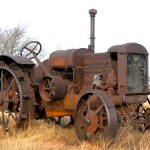
THIS TRACTOR’S HISTORY REFLECTS THE PAST CENTURY’S CORPORATE CULTURES AND HOW MISMANAGEMENT SERVES AS WARNING TODAY FROM OUR PAST

It has been a long time since someone asked, “Whatever happened to McCormick & Deering ?” I happened to notice an abandoned McC&D Tractor in Tumcumcari, NM and I was impressed with its condition and wondered what might have been the history of a piece of equipment which pulled its weight through the 20th Century to end up on this roadside in New Mexico.

Between the mid-1880s and 1902, a vicious battle known as “the Harvester Wars” was waged on America’s grain fields. The farm equipment manufacturer’s capacity to build harvesting machines far exceeded demand, so sales representatives of the two giants, McCormick Harvesting Machine Co. and Deering Harvester Co., along with their smaller rivals, tried every trick possible to sell their binders to reluctant farmers. The struggle became so intense that competing salesmen would not only bribe farmers to buy, but also allegedly sabotaged the competition’s machines and physically attacked people.
As the war dragged on, binder prices fell drastically and selling expenses grew to more than 40 percent of total sales. Something had to be done and, in 1902, a merger among the five largest companies was brokered by the J.P. Morgan banking firm. The McCormick, Deering and Milwaukee Harvester companies, Piano Mfg. Co., and Warder, Bushnell & Glessner (Champion harvesters) merged to become the mighty International Harvester Co. For many years after the merger, IHC sold two parallel lines of equipment, one named McCormick and one named Deering, each slightly different from the other, but wearing the IHC logo. This was deemed necessary since each line had its loyal customers, and there was usually both a McCormick and a Deering dealer in every farm community.
The U.S. government filed an antitrust action against IHC in 1912, and the suit dragged on until a consent decree was signed in 1918. One of the terms of the agreement called for IHC to have only one dealer in each town, meaning that the dual McCormick and Deering lines of equipment could no longer be maintained. Indeed, the expense of designing, building and supporting both lines of equipment had been a serious drag on the company, so in 1923 a new grain binder – one combining the best features of each of the older machines – was introduced and called the McCormick-Deering. All of IHC’s other farm implements soon followed suit, and the famous McCormick-Deering line was born. McCormick-Deering farm implements and Farmall tractors helped IHC become the giant of the industry. Its 1923 U.S. farm equipment sales of $150 million tripled those of second place Deere & Co. “Harvester is, of course, the greatest single agricultural enterprise in the world,” trumpeted Fortune magazine at the time.

However, even a corporate giant such as IHC wasn’t immune to the calamity of the Great Depression. By 1932, its U.S. sales fell 78 percent, and the price of its stock dropped to $10.37 from a 1929 peak of $142 per share. Tens of thousands of Harvester employees were laid off and remained so through most of the lean 1930s. The McCormick family had, starting as early as 1862, crushed several attempts at unionization by their own workers. In the late 1930s, though, the unions started organizing among Harvester’s workforce of 60,000. IHC management fought bitterly, but by 1945, most every worker was a union member. After VJ Day, Harvester started a round of diversification and acquisition that cost the company a fortune and diluted its focus. The old core business of farm equipment and trucks was joined by construction equipment and home refrigeration. Meanwhile, the attitude of IHC’s management was summed up by one longtime dealer: “They thought that whatever they built and painted red was going to sell.” Just three years later Deere green outsold Harvester red for the very first time.
 A combination of factors finally killed the International Harvester Co. These included the huge and expensive proliferation of truck models, and the stiff postwar competition in appliances. Also, several of IHC’s new crawler and farm tractor models were rushed into production without being thoroughly tested, and then broke down in the field. Obsolete factories were kept too long in service, and there were chronic and costly labor problems. All of these were reasons, and yet, the reason for all of these was poor management. Getting back to the original question, “Whatever happened to McCormick-Deering?” The name was used on farm implements until some time in 1948 or 1949, when Deering was dropped and McCormick alone was used. During the 1960s, the proud McCormick and Farmall names were replaced by International, the name Harvester’s farm machinery carried until the sale of the farm equipment division to Tenneco Inc. in 1984. It occurs to me you can reread this story and replace McCormick-Deering with Gannett and tractors with newspapers, and their mismanagement parallels the other.
Author Sam Moore has been interested in tractors, trucks and machinery ever since his years as a boy on a farm in western Pennsylvania. He’s been a collector of antique tractors for the past 11 years.

SOUTHWEST’S RURAL ECONOMY STRUGGLING TO SURVIVE
ANY EXIT OFF I-40 LEADS TO HARD TIMES…NOWHERE is it more telling-just how much America has frayed between the spaces–than between the spaces–TUMCUMCARI New Mexico lies between Amarillo Texas and Santa Rosa, NM or Albuquerque. All stops along the great way or Highway 40, the main EAST – WEST cooridor across AMERICA which offers an interesting cross section of the American Dream and how it has played out into new challenges and the loss of an American Way of Life. This roadside view was maturing in the South West Sun and had begun to melt into the Land of Enchantment, soon the summer glare will take it all. Til then it lies testament to another time, people’s dreams realized and un-realized but always free choices driven by the Great American Spirit to be Free and Succeed.

The town of Tucumcari itself got its start in 1901 as a tent city known first as “Ragtown” and later as “Six Shooter Siding” along the Chicago, Rock Island and Union Pacific Railroad. When the railroad turned the camp into a division point in 1908, the settlement was renamed Tucumcari after the nearby mountain. By 1910, Tucumcari was a major railroad center – complete with roundhouse, depot, and water tower. Not to mention more than 60 thriving businesses. The first businesses to open in 1902 were the Barnes and Rankin furniture store, the A. B. Simpson hardware, A. A. Blankenship’s livery barn, Pioneer Bakery, Arcade Restaurant, Waldorf-Astoria Hotel with rooms for $2 a day, the Owl Saloon, Weldon and Young Real Estate and Investments, Jackson and Foxworth Lumber Company, and the Exchange Bank. The birth of Route 66 in 1926 brought new travelers to Tucumcari by the carload. Wagon yards, livery stables, and blacksmith shops were soon replaced with gas stations, motor courts, gifts shops and cafes. Today, Tucumcari’s proximity to I-40 continues to attract travelers from all over the country.

<a href=" SPANISH TRANSLATIONS:
SOUTHWEST BORDER WARS or MEXICO: THE WAR NEXT DOOR
 ”
”
“PECK CANYON is heavily patrolled and the terrain rugged.”
Few saw that the US-MEXICO BORDER would tear apart families or tribes whose cultures and languages are threatened but the cities that sprang up on both sides were predictable the division created entrepreneurial opportunity which sprung from the law, culture and needs of society. The international border became a way of life, a geological oddity (like the Grand Canyon) right in their own backyard, if their property had backed up to a great viewpoint they would have set up a pay parking lot and required admission.
The fence or border brought traders who provided the needs of the locals, like Sasabe Merchantile sells both parlor and kitchen stoves all wood-burning and priced for a population where electricity and gas are a new world commodity. Until recently, places like the San Miguel Gate, (a strip of no man’s land) became a row of boxes and traders on Saturday mornings who tried to sell goods to folks who needed their products from either sides of the border.
Recently I spoke with a young man who grew up in the Peck Canyon corridor and he believed crossings may be down “but business was being done, and if a load needed to go, it went and arrived intact! Business has been conducted through Peck Canyon since the day when Geronimo used those foothills’s perfect cover as he made tracks for the border. In our last posting, a local deer hunter said, “all border traffic was being funneled into Peck Canyon” much of this because of the high-tech sensing equipment elsewhere and the high profiles of the National Guard and additional manpower to the Border Patrol.
Unique to Peck Canyon, is the mixing of wilderness and residential, its close proximity to dense high
desert terrain and I-19, which is next to the large Border Patrol Checkpoint on I-19. I thought it would be quite easy for drug cartels to own several houses along I-19 where folks could move north from one house to another, for $5000 a head, many things are possible, like tunnels. Locals can think of four or five houses that might fit that description or have, from time to time. Likewise, the bandits who prey on crossers and smugglers alike, they probably live right there and know the terrain like the back of their hand and could be watching TV while border patrol searches.
Maybe, these Border businessmen started out young as mules! Perhaps, in the beginning they carried marijuana on their backs into the US, for $200 a pound, forty pounds equals $8000, 50 pounds or $10000, whatever they could carry quickly. Once in, they drop their load in a remote spot and hotfoot back to Mexico. When they drop their packs a man on a hillside watches and carefully telephones “his crew” who he directs to the load and they bring it further north. For decades, people have stuffed their doors and wheel wells full with pounds of grass and more than 200 pounds might be stuffed into a single ride to travel north without a second look. Driver of a loaded car might make $2000 traveling between Rio Rico and Tucson where the keys are passed to new driver to take the car on into Phoenix. This practice limits anyone person having full knowledge of the network. Lots of stolen or borrowed cars end up abandoned in the desert and they are quickly stripped by yet other border entrepreneurial opportunity. Living on the border separates families and social responsibilities can collide with professional responsibilities may result in a phone call home where an agent tells his wife he is stopping for bread on the way home. That might mean he will not be on a certain mountain and that route will be open for cousin Jaime to bring his load through. Some people living on the line, say “it business!” and others, call it “family”. Anything is possible, here. If a load needs to go, it does so successfully!
Here are some links to recent articles on the Peck Canyon and its every growing violence and how the cartels are pushing back against Mexico and USA …
A Border Patrol swat team member was shot and killed Tuesday night in a gun battle with suspected bandits south of Tucson. Agent Brian A. Terry, 40, was killed when his team exchanged fire with a group of five people about 11 p.m. in a remote area west of Rio Rico, said the FBI. Four of the five suspected bandits were in custody Wednesday morning, including one man who was hospitalized with gunshot wounds. Border Patrol since “have buttoned down the Pena Blanca Lake area” covering all the squeeze points and by placing agents on quads and horseback into the interior they are looking for a fifth member of the group. The shooting occurred in a remote area near Forest Service Road 4197, west of Interstate 19, said Santa Cruz County Sheriff Tony Estrada. When deputies arrived at Peck Canyon Drive and Circulo Sombrero in Rio Rico, they found Terry dead of gunshot wounds, Estrada said. The remote area where the shooting occurred is an area frequently used by drug traffickers and people-smugglers.”All these canyons in Santa Cruz County are notorious for smuggling humans and drugs,” Estrada said. “Obviously, it is a very dangerous situation for anyone patrolling those remote areas, particularly for Border Patrol. There is always that threat.”Santa Cruz Sheriff’s Department was only serving in a support role, Estrada said. The FBI is handling the investigation.”Our thoughts and prayers are with the Terry family for their tragic loss,”
Border Patrol Agent Brian A. Terry was shot and killed Tuesday night in a fire fight with suspected bandits near Rio Rico, south of Tucson.


VIDEO: Mexico the War next Door…

Mexican Crime Reporter Speaks Out
BORDER BATTLEGROUND: ALL QUIET ON U.S. FRONTIER–GUARD DEFENDS QUAIL
NATIONAL GUARD OCCUPIES “NO MAN’S LAND”: CROSSING TARIFFS, SMUGGLERS AND ILLEGALS MOVIN ON….


Southern Arizona’s Altar Valley, once was a huge Spanish Land Grant, today it is a border battlefield between the Sinaloa cartel’s “Zetas and the Beltran-Leyva cartel” in 2006 the valley was closed to public entry because of incursions. Last week 30 National Guard lined the border making the southern region of the Buenos Aires Wildlife Refuge safe for bird-watchers and fans of the desert pronghorn. Jaime Molina has hunted deer in Fresnal Canyon which parallels the border for a dozen years, most of his adult life, in the past he says he would maybe see 150 crossers from his secret perch, this year Molina brought his new bride and together they got a three point rack but they haven’t seen any crossers, at all. “I’m told all the traffic is being funneled toward Peck Canyon”, he says referring to a canyon further east. This fence is headed that way and everyone is being pushed out of their familiar routes he says. The “fence” is the infamous “virtual fence” which has been plagued by costs overruns and millions of dollars, most recently, it was said it didn’t work and would not be extended.
ARIZONA’S EASTERN BORDER CLOSED FOR BUSINESS
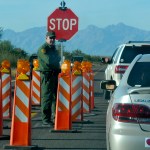


Anyone who yells, U.S. Government “DO YOUR JOB” protect ARIZONA from MEXICO just flat has never been to the border. Last week I drove halfway across Arizona driving along the border so I have seen, heard and observed the effort being expended to keep elements from the south crossing the border into the United States. It is quite impressive, the efficiency found in the Douglas District is amazing when you see they have an human eye on almost every inch 24/7, these folks sit quietly and watch from portable platforms in the flats near the border. Every mountaintop has been scraped flat and a homeland security trucks sits there seeking heat thermal signatures and flat sees everything that moves across the landscape. That truck doesn’t move until its replacement is in place. Cameras on towers observe favorite crossings and the border itself, is lighted each night at dusk until sunrise, much of the lighting are on poles but where needed, generators are brought in to fill in the gaps. Trucks just sit, watching their piece of the border and where some tracking is needed saddled horse teams or ATVs are trucked in, to initiate the search. Homeland Security is making a clean sweep of the US-MEXICO Border using bundled worn out truck tires to drag clean the soil at the end of each day, so the next morning, they know if anyone, or how many crossed and which way they went.
That is just what you can see. What you can’t see are all the noise sensors, the video cameras, the drone and helicopter over flights and Aerostat, the Southern Arizona mystery of the cold war now made relevant by an invasion on its doorstep. In the NACO Sector, there are a 1000 people assigned there alone and as you move into forest and army land, the presence becomes less in your face and more implied. My last blog on the Border with the National Guard, showed how electronic-monitoring monitors the entire landscape, keeping US turf safe from the hordes from the south. This land from Montezuma Pass west to Nogales makes up the San Rafael Valley, and it probably the most user-friendly land to be crossed because it is treed, water occurs, less cactus more grass land, it is even cooler. West of Nogales is another story and one I will save for another blog. Arrests are down, people still try and some do get through and some are even rescued.
In year 2000, the US Border Patrol arrested 1.7 million, typically 97 per cent of those arrest comes from the 1,952-mile border with Mexico and the rest from Canada. Last year’s arrests were down 72 per cent to 463,000 made this year (down from 556,032 the previous 12 months) by the all-time high 20,500 agents who now backed up by 1200 National Guard troops. Those numbers reflect a 17 per cent drop in arrests this year reflecting the results of the heightened enforcement. Homeland Security Secretary Janet Napolitano said the weak economy also helps explain why fewer people are crossing the border illegally.
The Tethered Aerostat Radar System or TARS is a stationary platform for surveillance, capable of low-level aircraft and surface target detection over 200 nautical miles. The Fort Huachuca AZ deployment in 1986 was the second, today operational sites are located at Yuma and Fort Huachuca, Ariz.; Deming, N.M.; Marfa, Eagle Pass and Rio Grande City, Texas; Cudjoe Key, Fla.; and Lajas, Puerto Rico. They usually fly at 10,000 feet but are capable of altitudes of 15,000 with 25,000 feet of tether length.
KEEPING AN EYE ON MEXICO on the US BORDER with the NATIONAL GUARD


 “NATIONAL GUARD IN CAMOUFLAGE” />
In the past 24 Hours I have driven halfway across Arizona following the US-Mexico Border photographing “the Wall” and looking for the National Guard–reportedly there are 1200 guardsmen working in support of Homeland Security, half of those are watching cameras, the other half are in the field!
I’m climbing out of my Xterra and Chester jumps out to stretch after the long dusty, rocky, climb up Montezuma Pass to this scenic viewpoint where I scan the horizon miles distant deep into Mexico and Southern Arizona. “Can I pet your dog”? I turn and there is the National Guard marching right toward me, “Sure, Chester doesn’t mind,” drawing them in closer. In the parking lot, is a ford 450 with a funny looking gizmo spinning 360 and the windows are blacked out. “Are you with this I ask”? Naw, we’re bivouac up the hill keeping an eye on the border” I sure miss my golden”, he adds stroking Chester who is patiently putting up with the glib soldier. “we’re 4-man teams, 24 hour shifts staying at Ft Huachuca 22 miles away when they aren’t sitting on a rock overlooking the US – Mexico Border. They scan the terrain, looking for UIA’s (undocumented illegal aliens) or smugglers, if they see something, they call the Border Patrol. How good are these guys coming in I ask, “Extremely good”, he retorts three times in succession. “I saw ll guys slipping past 1800 meters beneath me, called in BP and had my binocs on them in a draw, watched them the whole time, maybe they heard us but I directed BP in and they had slipped away, “they are there-I saw them”, nope says BP, “not anymore”. “They are extremely good”, he repeats, “another team saw 38 crossing”, they know we are here “we’re just a deterrent”, he adds. “We’ll be here as long as the politicans want us here.” “They are paying me $5,000 a month to sit on this rock and watch Mexico”, we can stay as long as they want.
The gizmo on the Ford 450 is still spinning and I ask, does it scan the entire valley and point to a distant ridge 5-6 miles away and ask if that ridge is in play. “Absolutely, he says, “it’s like in Preditor”, he says referring to the scifi flick where the alien has heat-seeking thermal signature vision. These guys (Homeland Security) get a lot of training how to read thermal signatures, how to avoid cows, rocks heating up! We (the guard outpost) have a hand-held thermal binco says the guardsman. That thing, (the gizmo on the 450) is 3 and a half times stronger than ours. “Can you see faces I ask” “Kinda, he says but it is the preditor-thing, they are kinda hard to make out.” Anyway, we gotta go. Needed a puppy-fix we gonna get coffee. “Can I checkout your outpost?” Sure the guard says, it’s a public hiking trail. You will see the camouflage.
They’re gone and I stick Chester in the car and head up the rocky, exposed trail up to Coronado Peak a half mile to the summit. At the top, 6575’, there is a bench and shelter and the wind is just whipping anything in its path, down below on a hillside perch are two more guardsmen. I make several photos from a distance and finally I announced myself and a head pops out of the camo. “Mind if I checkout your outpost”, closing the distance between myself and the two dumb struck soldiers. “Well, we’re not really open to the public” one guardman offers. “Do I look like the public?,” I ask as I snap a few frames, the other guardsman busies himself with picking up two M-16 automatic rifles with clips engaged and moving them out of sight in the camo. The other guard man, flustered, turns toward Mexico and looks through his bincos and I get my photo. The wind is still flaying in gusts, under the camo are packs, two cots, a water jug–pretty Spartan I think. “Well, I can see you folks will be more comfortable if I wasn’t here…so I’ll just move along.” “THANK YOU”, both guard men say in unison. They were all perfect gentlemen.
FALL COLOR GRACES HIGH COUNTRY
 From Flagstaff to the North Rim of the Grand Canyon the color shift has begun, first with the Aspen, so prominent now-days because it gets the first foothold after forest fires and followed in the Flagstaff Walnut Canyon area with yellowing Oaks. While tempid temperatures have quieted the shift, it is advancing slowly and may yet reach an ultimate peak. However Northern Arizona is forecast for showers and frequently downpours and accompanying winds knock off the final coat. Southern Arizona is still several weeks off, on an average I find, that the final weekend of October is usually the best to get out and look around. Watch out for the deer hunters, they show up in great numbers at that time, and frequently take all the campsites.
TWISTERS DAMAGE PATH ACROSS ARIZONA LEAVES BELLEMONT FEELING LUCKY
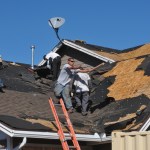
 “You should have been here Friday, the place looked like a tornado hit it!” My friend Joe Powell has a firm grip on the obvious and continues. “You should have been here Saturday and seen those 500 Latter Day Saint Volunteers who swooped into the devastated Flagstaff Meadows subdivision to help several of their own church members and their neighbors. Today is Tuesday and last Wednesday at least one tornado dropped from the sky and swept right down Bellemont Springs Drive blowing out all the windows and garage doors and hitting four homes at the end of the street head on and ripped off their roofs. No one was seriously injured, more 200 homes were damaged, forty were uninhabitable. Today Bellemont Springs is choked with repair trucks, dumpsters, insurance adjusters and the American Red Cross and security guards keep an eye on everyone and everything. On the other side of I-40 ten miles west of Flagstaff, Arizona on a rail line running through the Navajo Army Depot 30 Santa Fe railroad cars were derailed and rolled off the tracks. The hundred mile an hour winds also tossed idling semi trucks on their sides today work crews are trying to repair the rail bed and to right some of the derailment. “Not a soul was injured” insisted Powell, a Williams resident
 who is helping out with residents tearing out the bad and replacing the good. Joe’s not really for hire, he just does it to salvage some supplies to build a storage shelter at home. Someone gave him a banged up BBQ, he says he will fix it and give it to a friend, today I’m his friend and he takes me around the corner of a home he is working on to see the 12′ boat foot jammed into the gable of the home. “Isn’t that remarkable!”, we both mouth in unison. “These folks should get down on their knees and give thanks” says Joe. Minutes before the first tornado in Bellemont touched down, Jeff Cox was standing in his garage, his children nestled in bed. Rain and hail pounded hard against the windows and a fierce wind made it look like houses were swaying.Then Cox heard a deafening sound and ducked beneath a trailer when the tornado struck, it tore off the roof of nearly his entire home and throwing it into the nearby forest. The Cox home was at the end of Bellemont Springs Drive and the tornado went right through it and exploded the four homes surrounding it. In the driveway of ground zero lies a “Camping World” sign in fair condition but almost two miles from its perch on the other side of i-40 where the RV business suffered huge losses as much of the inventory was slam banged onto the stores’ parking lot and swept into a pile, the business was not open today. This storm continued into Nevada leaving record rainfall and into California bring heavy snow in the High Sierra. Tornados are rare in Arizona and while the state averages four twisters a year rarely do they all come at once.
RARE TWISTERS SLAM NORTHERN ARIZONA

 Last Wednesday four or more Tornados slammed into Northern Arizona while I was driving from Tucson to the North Rim of the Grand Canyon, I had left Tucson 6am and was just 30 miles from Flagstaff when I heard a radio severe weather warning advising everyone to be on the lookout for funnel clouds until 11am. Around noon, another twister was reported off 1-17 about where I heard the first reports. Apparently around 5:30 am two f1 tornados hit Bellemont, Az with more than a 100 mph winds ripping off roofs, rolling semis trying to sit out the storm and then derailed a freight train, damaging 200 homes before moving north toward Flagstaff. This tornado or another later dropped suddenly into the forest west of Flagstaff cutting a mile-long path through the forest, across AzHwy 180 and eventually mowing down 250-300 fir and aspens. Many of these trees were 40′-50′ in height, some were topped, others snapped at the base, even more were pulled from the ground–roots and all. While there were no serious injuries most folks in this neck of woods won’t soon forget the Day of the Tornados.
A GRAND CANYON VIEW: WILL FIST FIGHTS BREAK OUT! WHERE HAS THE LOVE GONE ?
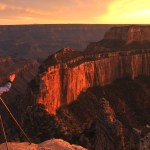
 Sunset at Cape Royal on the North Rim of the Grand Canyon is a meeting place for serious-minded photographers, it is the place and the time to be there. So as the sun sinks, lens men from all over the world begin to show up, lineup and watch the ski and imagine the possibilities. “Looks like it might be really special tonight”, says a photographer with an Australian accent as he eyes the break in the clouds at the horizon and the band of clouds above it–excitement builds and photographers work one angle and move on, cameras play musical chairs as the light plays across the landscape. On my rock, four photographers trade place and war stories, everyone is having a really good time, it is a creative moment and the possibilities endless. “Hey, you’re not going to stay in that spot, are you?” questions another photographer on a different rock, to one photographer on my rock. “Yes”, I believe I will” he retorts. “I’ve been lining up this shot for an hour” yells the questioning shooter from his distant perspective to the newly arrived photographer who has set up his tripod to shoot south when everyone else is shooting west into the sun. The new photog unravels a bit and complains “its my second night at the canyon, and I’m tired of folks bitching at me. The conversation turns dark, the light continues to peak and soon the cameramen know–the new guy is not moving and the distant rock guy is going to come over and stand in front of him, he promises, steam appears at both sites. Meanwhile, everyone else is wondering if this will escalate into punches being thrown, at the moment it could go either way, but as the sun sinks behind the ridge and night advances–photographers deal with the limitations of the moment and little more is said. “I thought those two were going to slug it out”, said a NPS park ranger at the scene but “in civies”, if I had entered the dispute–I would have pulled the new guy off this perch on the edge of the rock. The fella on the distant rock, was on solid ground, but the other was in harms way even if he didn’t think so”, the ranger said. Since 1860 more than 600 people have fallen into the canyon averaging 4-5 a year, last month a 18 year old French photographer fell 75 feet and survived, in 2007 the youngest fatality, a four year old rolled off the Mather Point viewpoint, as had the Frenchman, so it happens with some regularity. It is sad that a grand moment like that had to deteriorate into such a scene I think to myself as I walk back to my Xterra. I experienced a similar scene at Delicate Arch in Central Utah at Arches National Monument, a few years earlier at another sunset, there another mass gathering for the religious experience of watching the sunset set on a rock so remarkable that every Utah license plate carries a photo of Delicate Arch for the all the world to see. As today, photographers line up and wait for the sunset, most taking care to stay out of the view of the other cameras, and then as the light finally reaches its peak, a obtuse individual walks into everyone’s view stands under the arch, looks up and makes a picture. Everyone waits, each chews his lip and expects the photog who now has the photo, to leave, she doesn’t–she pauses to enjoy the moment and then it begins “get outta there” yells one and then another, the offending photographer begins to make the case for her doing whatever she wants–wrong tact I think–as I and everyone else literally yells her off the mountain. To be fair, that evening there had been no light, the sun was hidden in the clouds–still folks made the uphill three mile hike on the possibility–then the sun popped out at the last moment rewarding dozens of photographers who had traveled amazing distances to be there for this moment. So then when someone defies their investment with such obtuse behavior, it seems, understandingly she was granted a temporary pass, but then crossed a bridge too far when she failed to quickly retreat, the chorale response from dozens of photographers was deafening and in fact, lacking in tact. Desperate people can say almost anything when pushed–and pushed they were. Every park incident incident reflects a microcosm of the real world where we all find difficult and dysfunctional people every day–some can be reasoned with and others will do it their way– the hell with everyone else… “where has the love gone” you ask! Love indeed, love of US Parks is peaking, toss in the competitive creative pursuit of digital landscape photography and folks may drive 500 miles in a day to make sunset on a distant rock which builds expectations for a photographers with only this chance to get the photo. One such photographer a day earlier had arrived from Michigan, on his first night he raced to Cape Royal for the legendary sunset, and arrived three minutes too late, he had seen the view from the trail but pushed on to the viewpoint instead of grabbing what would be his only opportunity. He freely admitted he should have grabbed the moment instead of rushing on ahead for the perspective he thought would be better. Tonight’s classless late arrival had rushed up late and settled into what he thought was his picture and blocked the shot of a photographer who had done the same a hour earlier without him being an element–the closed minded and late photographer–fought for and kept his precious angle and never moved out for any thing else. All the other photographers on my rock had worked that angle and moved on. “I didn’t think his picture was very good anyway” said the ranger “he had no foreground” but still he stayed, to assert his rights and screw the other shooter who had given him shit. I often find that serendipity can be a photographer’s best friend, the best pictures come from where we don’t expect, and we need to be open to all the possibilities–in other words–sure lineup your best photo, track it and work it and make it if you can but look around, over your shoulder, up and down but be flexible and your pictures will improve.
Remember, the age old photographic adage, “F8–be there!”

BLOGGING vs THE POWER of UTUBE

So you were born to blog! Sharing with all the world your innermost thoughts, feelings and in my case, rants! Back up! Setting up a wordpress.com site has been a real experience, a positive experience, for one thing, they are free. Secondly, they really work well and therefore the pressure is on you–the blogger–to produce content someone wants to see or visit. Technically speaking, running web sites boil down to
the amount of space you have available to you, particularly when video, photographs, slideshows are involved. One video can easily add up to a gigabyte, slow to load and play, enter utube which allows you to upload your video to their servers and then link it back to your site without any
cost in space to you. They give you a nice looking player and it looks good. But once the viewer enjoys your video on your site–they are left on utube and they steal your traffic … that said. What traffic you might ask. WordPress sites have great search engine visability, for one reason because they are all linked and you can search all their content or WordPress will link you with related topics on other sites and bring you some readers. My videos have had a marginal affect on my site, however on utube, the Apache project, will soon enjoy its 1000th playing largely from Apache in Arizona and New Mexico but now has been found globally and is enjoying almost 25 hits a day on utube, my other videos, Dia de Muertos in Nogales, Son is second with much fewer hits, fifty eight views since mid-August, and my multi-media slideshow of the Day of the Dead Procession, my best I believe, has had fewer than forty views, inspite of all my spiffy digital sound capture overlaid with the video. Stumbleupon is another tool, if you get a good posting–Stumbleupon might bring you ten viewing in a good day, your content, and its interest to your reader will determine the degree. I recently sent my Shamanism post to Stumbleupon and found the mystery of the super natural brought in almost nine hits from the outside. Either way, it is hard to match the power and speed of the huge servers of utube but as you blog, your archives gives you depth, and slowly builds your daily viewings. SOUTHWESTPHOTOBANK.COM and SOUTHWEST PHOTO JOURNAL are new and designed to promote each other by sucking in the search engines and finding new views and ultimately customers.
I can see from my stats page, readership is up, the curious are visiting–but I still am amazed by the success of my videos on utube and the total lack of interest in them on site. Obviously, the content needs improvement, and the right story will bring more visibility, so SWPB will continue to be topical and current and strive to reach you across multiple platforms. You can help by coming back and checking in.
Hey, if nothing else, the Tucson Weather Report on my page with its 10-day outlook is the BEST REPORT in Town. Weather in Tucson tomorrow! HOT and SUNNY … See, who would have seen that coming.
TUCSON’S DAYoftheDEAD PROCESSION
NOGALES, SON DIA de MUERTOS
TUCSON’S FIRST DAY OF AUTUMN


Preparing for flight on the PINAL PIONEER PARKWAY Thursday Morning ten TURKEY BUZZARDS warmed and dried their wings against the Morning Sun near the entrance to the FALCON VALLEY RANCH on AZ HWY 79 nine miles north of Oracle Junction. These area has been recognized as a key spot for raptor viewing, even an osprey has nested nearby, the Turkey Buzzards are an added bonus. The Turkey Vulture is common in the United States, its keen sense of smell is vital for finding carrion, contrary to popular belief, this bird enjoys plant matter as well. The Turkey Vulture soars above the ground for most of the day, searching for food with its excellent eyesight and highly developed sense of smell. Extremely non-confrontational, the Turkey vulture will not feed on live prey, an occasional habit of its cousin the black vulture. Turkey Vultures, like these, are often seen along roadsides, cleaning up roadkill. The turkey vulture is one of the most skilled gliders among the North American birds. It migrates across the continents with minimal energy output. Vultures launch themselves from their perches only after the morning air has warmed. Then, they circle upward, searching for pockets of rising warm air, or thermals. Once they have secured a thermal, they allow it to carry them upward in rising circles. When they reach the top of the thermal, they dive across the sky at speeds near 60 miles per hour, losing altitude until they reach another thermal. All this is done without the necessity to flap. In fact, the turkey vulture can glide for over 6 hours at a time without flapping a wing! …




 SOUTHWEST PHOTO JOURNAL