PSSSSST….CAN YOU SPARE A PESO ! MAKING A LIVING IN HAVANA CUBA


 The huge walls of the City of Havana began construction almost 500 years ago, those thick walls soaks up the Caribbean Sun while the narrow passageways create a cool shaded walkway which makes life much more comfortable escaping the tropical heat. Within that maze of walls, plazas, all of its inhabitants have developed a strategy to survive. Everyone gets a taste, but if you snooze you lose, you have to be ready. There is the Cuban economy or marketplace and the Cuban Black Market both work together to provide all the goods Cubans require but (during the present special period: the recession) supply is limited and long absences are frequent, like light bulbs, just because you have the lamp, the electricity, doesn’t get you light without the bulb. The U.S. 50 year Embargo on CUBA has placed real hardships on the people of CUBA, but the Cubans don’t hate us, they don’t feel sorry for themselves, they laugh at their plight and look to President Obama with great anticipation but dare not hope. They have been disappointed before and have learned to live with the realities of their country. CUBA just laid off another 500,000 jobs forcing yet another half million people to develop new strategies to survive. The average Cuban lives off $20 a month, In the October issue of Harper’s Magazine contributor Patrick Symmes has a story entitled Thirty Days as a Cuban: where he pinches pesos and drops weight trying to survive like the average Cuban, he barely lives to see his flight home.

Meanwhile real Cubans scam tourists for pesos, smuggle rum or cigars, run illegal taxi’s, or beg in the streets. Talents like drawing, turns into quick tourists sketches signed by the artist, colorfully dressed Cuban women swarm foreigners to be photographed and then charge $5 pesos or CUC. Cubans with huge cigars, grab tourists in the plaza for a photo, then charge a peso for their image, nearby a local band performs with cigar box open for donations. As you walks the streets of Havana, folks constantly ask where you’re from and each has his own come-on which begins as soon as you answer. Elsewhere, pirated CDs and DVDs, are sold on the streets and large crowds appear to shop and buy. My favorite of them all, were the three dachshund puppies, from left Canela, 6, the mom, Azuear age 3, the baby and Cachito age 8, the dad.  They simply sat there all dressed up and when cued by their owner, psssttt…he says and the puppies stand up and stare straight into the lens and have their picture taken and then go back to at ease. Our Cuban tour guide says “the government pretends to pay us and we pretend to work” One small elevator, had a women in a chair, sitting inside and pushing the up and down button for pesos tips. Frequently folks young and old will approach, rub their belly and hold out their hand. Our tour guide suggested you might give these folks, your small coins, the centavos which bring us to the Cuban Pesos and how there are special stores where that currency is exchanged, and others, for cuc$ is where tourists shop. Locals can go to the movies for 80 cents, but tourists can’t. The Presidente Hotel, probably a 3-4 star stay, charges $85 a night, the tour was charged $65 a night for the same room and breakfast. Living with families in Havana, breakfast is often included and two people can share a room for $25 or less a night.
  Likewise many homes are open as restaurants and bars where frequently the woman of the house is the owner/operator and her children, waiters and kitchen help. This entrepreneurial spirit is what Cuba hopes will spring from the layoffs and more home licenses are expected as the renovation of the old buildings of Havana continues. In Cuba, you are given a place to live. If you need a bigger home, you find someone who wants to swap and if their home is bigger or better, then you pass some cash under the table and everyone is happy. One local writer’s poem explores the return to a previous home and how the hummingbird plate of many years ago still lived in that space and still held so many memories for her. I was standing on a street corner and when a fella and his #3girlfriend stopped on their way to hear Amereto Fernandes, once a staple at the Buena Vista Social Club and stayed to chat and invited me along, when we arrived down the street at a local bar, this fella and his girl felt I should buy them both a drink, Amereto was glad to pose for photos, if I bought his CD and of course, the Bar was happy with me taking photos as long as I too, had a drink. Total around $25…happened so fast never saw it coming and that is how it is done.Cick on next photo for Havana slideshow)


WHAT IS THE VALUE OF THE CUBAN PESOS ? WHICH PESO ? THE PESOS USED BY THE LOCALS OR THE ONE USED BY THE TOURISTS ? Visiters to Cuba buy kuks, which trades even with the Canadian dollar but stands above the US Dollar, $1.20 to $1, so walking thru customs costs the US visitor an extra 20% which goes straight to Fidel, and then there’s the state’s Health Insurance which is factored into the cost of the Tour, about $400 for the week. The convertible peso ( CUC$), is one of two official currencies in Cuba, the other being the peso. It has been in limited use since 1994, when it was treated as equivalent to the U.S. dollar. In 2004, the U.S. dollar ceased to be accepted in Cuban retail outlets leaving the convertible peso as the only currency in circulation in many Cuban businesses. Officially exchangeable only within the country, its value is currently pegged to $1.08 U.S. [1] The convertible peso is, by the pegged rate, the tenth-highest-valued currency unit in the world and the highest valued “peso” unit. U.S. Credit Cards are not acceptable in CUBA since there are no U.S. Banks there.


CLICK HERE FOR CUBAN PLAZA BAND VIDEO

<a href=" SPANISH TRANSLATIONS:


“IT WILL NEVER BE THE SAME AGAIN” Congresswomen GABRIELLE GIFFORDS Staff OverWhelmed…

<a href=" “>
“>
THE CRYING BEGAN JUST AFTER 10 AM JANUARY 8TH after the shock of the TUCSON Shooting of 19 and the death of six when CONGRESSWOMEN GABRIELLE GIFFORDS and her staff were targeted by a mentally ill young man who fired point blank at the Congresswomen, shooting her in the head and then turning his weapon upon her staff and the crowd. President Obama came to Tucson and in a “historic” address he eulogized 9 year old Christina Greene saying Americas needs to find it’s way back to being the country this third-grader believed in and wanted it to be, many tears were shed that night. After the Speech the healing began in Tucson, says Renee Bracamonte, who attended the UMC memorial the night after the shooting and saying she was barely able to walk away that night because of all the pain and grief present that night. “Then it changed,” she said, the next time she and her husband Greg went, “This time it was full of peace and love” and as they walked through the notes, photos, and teddy bears, we wondered if this could have happened for someone else or anywhere else, “Gabbie has touched so many lives, you wonder if anyone else would have caused the same out-pouring of love and now hope”. We thought this was unique to Tucson,” Renee said. “It’s hard to believe Gabbie has touched all these lives.”Mark Kimble agrees “but there you are” said Kimble, a staff member who was present at the Safeway shooting, he says pointing to the acre of photos, balloons, cards, posters and mementos left by those who felt touched by the 40 year old Congresswomen. “last week we collected all the stuffed animals about 600 teddy bears and took them to kids at local hospitals. Look, they’re are all back–pointing out how the ones removed had morphed into many more as folks contribute to the up-swell of hope and peace radiating from the vigils and shrines that have spontaneously sprung up at Gifford’s Offices at Swan and Pima, at University of Arizona’s Medical Center (UMC) <a href=" “><a href="
 “>where doctors treated her injuries before transferring her last week to Houston for what has been an amazing and hopeful recovery and another shrine, stands at the Safeway at Oracle and Ina Roads on Tucson’s Northwest side where three helicopters landed to treat the injured after the shooting. Kimble says he and C.J. Karamargin have been overwhelmed by media requests since the shooting and said he misses 250 phone calls a day, even though he handles at least that many each day. Two congressmen sent their media staffers to Tucson to help out and another 25 showed up at the Giffords offices in Washington DC and began working for Gabbie and not their Congressmen until the Giffords staff could crawl out from beneath the crush of international outpouring which has moved her story and those of the victims to the top of the news hour all over the world. “It will never be the same again”, Kimble said. “She is the best known politician in the country”. Her communications director C.J. Karamargin is now on a first name basis with Diane Sawyer, Cathy Couric and all the media networks and outlets but beneath it all the staff continues to keep the doors open while Gabbie is in Houston with her husband Mark Kelly, an American Astronaut scheduled to command the final shuttle flight into space. Mark was with her when she was transferred last friday from UMC to Texas he reported it was very emotional as the ambulance pulled through Tucson streets (the route was publicized) Gabbie teared from the applause and cheers of encouragement coming from folks lining the streets who wanted to pay homage to the scrappy fighter Tucson has long known and loved. All along there’s hasn’t been a dry eye anywhere, this traumatic event has scard the community, the nation and the American political system. The first deputy on the scene wept she couldn’t arrive quicker because traffic ignored her sirens nor let her pass, investigators at the scene broke down mid-questions and paused to collect themselves, funerals have been held for nine year old Christina Greene, Gabriel Zimmerman 30, and Judge M. Roll, Dorothy Morris, 76; Dorwan Stoddard, 76; and Phyllis Schneck,79. Thousands have visited the shrines and attended the vigils, each has shed a tear, you can’t help but feel touched by all the love, concern and sentiment. “Let a new era of love begin with me” writes one, “from this day forward I will…”, another painted John Lennon’s words from “IMAGINE” on flagstone, including “Imagine all the people living Life in Peace”. National Public Radio and CNN both reported Giffords death before learning of their mistake and now have started working to avoid such errors and a listener that day, husband Mark Kelley, said he and Gabbie’s step daughters had to live with that news for many minutes. But when asked what concerned him most about Gabbie resuming her role Kelly said he knew her first “Congress on your Corner” would be held at the same Safeway at Oracle and Ina Roads. Years ago, before her story-book marriage to Navy Commander Mark Kelly, she was asked why a successful young women would want the aggravations of politics and she smiled, raised her beer and said simply, “I am a patriot.” That’s why it didn’t surprise me when an Iraqi War Vet tracked down Gabbie’s care nurse, gave her his purple heart, refused to leave his name, and insisted she deserves it more than he did. It was pinned to her gown. At tonight’s STATE of the NATION Address President Obama and the rest of the Nation gave Gabbie Giffords a standing ovation and left a symbolic empty chair.<a href="
 “>
“>
http://pkweis.photoshelter.com/swf/CSlideShow.swf?bgtrans=f&trans=xfade&f_l=t&f_link=t&f_fscr=t&f_smooth=f&f_tb=t&f_mtrx=t&f_bb=t&tbs=6000&f_bbl=&f_fss=f&target=_self&f_ap=t&f_2up=t&f_up=f&f_crp=f&btype=new&f_wm=t&f_s2f=t&bcolor=%23231a1a&f_emb=t&f_cap=t&f_sln=t&ldest=c&imgT=casc&cred=iptc&v=20091016&feedSRC=http%3A//pkweis.photoshelter.com/gallery/G0000XLpgrwum7fI%3Ffeed%3Drss%26ppg%3D200<!–
GAB GIFFORDS US CONGRESSWOMEN – Images by Phares K. Weis III
<a href=" “>
“>
Dr. Peter Rhee, one of Giffords’ Tucson physicians, and the family of Christina-Taylor Green, a 9-year-old girl killed in the Tucson shooting massacre, will sit in a box with the first lady. Daniel Hernandez’s the Gabrielle Giffords intern whose quick attention to Giffords on the scene is credited with helping to save her life, will also sit with first lady Michelle Obama and his father Daniel Hernandez Sr, it happens to be his 21st birthday on the day the President of the United States calls him a hero and a Patriot and his father will be there to see it.
JACK FROST WINTERS IN TUCSON

SHORT STAY IS FORCASTED….It’s still snowing in Bisbee but the sun is shining in Tucson and I-40 and I-17 re-opened Thursday morning after Wednesday afternoon road closures when the first wave of a winter-weather system swept through the state Wednesday, lashing the Valley with rain, dumping deep snow in the high country and paralyzing Arizona’s major north-south route. Southbound Interstate 17 was re-opened about 10:30 a.m. Thursday after being closed just south of Flagstaff on Wednesday. Interstate 40 from Kingman to Flagstaff and on to Holbrook was reopened Thursday afternoon after being closed for several hours. In addition, Arizona 260, Arizona 87 and 89A have all been closed, and officials are not sure when they might be re-opened.
The second chapter of the winter blast was set to hit Arizona today, as precipitation tapers off and temperatures start to plunge. High temperatures for Thursday are expected to reach 49 degrees, well below our average high of 67 degrees. Friday morning’s low is expected to dip to 29 degrees at the official weather station at Phoenix Sky Harbor International Airport – cold enough to damage plants and even burst water pipes, according to the National Weather Service. The lows on Friday and Saturday mornings are likely to be the coldest since January 2007.
Snow accumulations of eight to 18 inches above 6,000 feet and two to eight inches between 2,800 and 6,000 feet are predicted. Motorists in Southern Arizona should be prepared for winter weather and deteriorating road conditions. The warning covers the upper Santa Cruz River Valley, the Altar Valley, metro Tucson, the upper San Pedro River Valley and Eastern Cochise County below 5,000 feet
Tonight: Snow showers likely before 11pm. Areas of frost after 2am. Otherwise, partly cloudy, with a low around 20. Breezy, with a west wind 26 to 29 mph decreasing to between 10 and 13 mph. Winds could gust as high as 46 mph. Chance of precipitation is 60%. New snow accumulation of 1 to 3 inches possible.
Friday: A 10 percent chance of snow showers after 11am. Areas of frost before 8am. Otherwise, mostly sunny, with a high near 24. West wind between 9 and 14 mph.
Tonight: A slight chance of rain and snow showers before 8pm, then a slight chance of snow showers between 8pm and 11pm. Areas of frost after 2am. Otherwise, partly cloudy, with a low around 28. West wind 14 to 17 mph becoming south 6 to 9 mph. Winds could gust as high as 28 mph. Chance of precipitation is 10%.
Friday: Areas of frost before 8am. Otherwise, mostly sunny, with a high near 46. Calm wind becoming west between 6 and 9 mph.
New Year’s Day: Mostly sunny, with a high near 51. Light north northwest wind.
The same storm created 100 mph gusts when it blew through California’s High Sierra and overturned semis in Nevada.
TUCSON WEATHER FRIDAY …COLD and PARTLY CLOUDY

<a href=" SPANISH TRANSLATIONS:
WHATEVER HAPPENED TO McCORMICK & DEERING ?
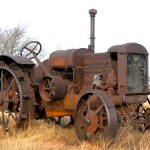
THIS TRACTOR’S HISTORY REFLECTS THE PAST CENTURY’S CORPORATE CULTURES AND HOW MISMANAGEMENT SERVES AS WARNING TODAY FROM OUR PAST

It has been a long time since someone asked, “Whatever happened to McCormick & Deering ?” I happened to notice an abandoned McC&D Tractor in Tumcumcari, NM and I was impressed with its condition and wondered what might have been the history of a piece of equipment which pulled its weight through the 20th Century to end up on this roadside in New Mexico.

Between the mid-1880s and 1902, a vicious battle known as “the Harvester Wars” was waged on America’s grain fields. The farm equipment manufacturer’s capacity to build harvesting machines far exceeded demand, so sales representatives of the two giants, McCormick Harvesting Machine Co. and Deering Harvester Co., along with their smaller rivals, tried every trick possible to sell their binders to reluctant farmers. The struggle became so intense that competing salesmen would not only bribe farmers to buy, but also allegedly sabotaged the competition’s machines and physically attacked people.
As the war dragged on, binder prices fell drastically and selling expenses grew to more than 40 percent of total sales. Something had to be done and, in 1902, a merger among the five largest companies was brokered by the J.P. Morgan banking firm. The McCormick, Deering and Milwaukee Harvester companies, Piano Mfg. Co., and Warder, Bushnell & Glessner (Champion harvesters) merged to become the mighty International Harvester Co. For many years after the merger, IHC sold two parallel lines of equipment, one named McCormick and one named Deering, each slightly different from the other, but wearing the IHC logo. This was deemed necessary since each line had its loyal customers, and there was usually both a McCormick and a Deering dealer in every farm community.
The U.S. government filed an antitrust action against IHC in 1912, and the suit dragged on until a consent decree was signed in 1918. One of the terms of the agreement called for IHC to have only one dealer in each town, meaning that the dual McCormick and Deering lines of equipment could no longer be maintained. Indeed, the expense of designing, building and supporting both lines of equipment had been a serious drag on the company, so in 1923 a new grain binder – one combining the best features of each of the older machines – was introduced and called the McCormick-Deering. All of IHC’s other farm implements soon followed suit, and the famous McCormick-Deering line was born. McCormick-Deering farm implements and Farmall tractors helped IHC become the giant of the industry. Its 1923 U.S. farm equipment sales of $150 million tripled those of second place Deere & Co. “Harvester is, of course, the greatest single agricultural enterprise in the world,” trumpeted Fortune magazine at the time.

However, even a corporate giant such as IHC wasn’t immune to the calamity of the Great Depression. By 1932, its U.S. sales fell 78 percent, and the price of its stock dropped to $10.37 from a 1929 peak of $142 per share. Tens of thousands of Harvester employees were laid off and remained so through most of the lean 1930s. The McCormick family had, starting as early as 1862, crushed several attempts at unionization by their own workers. In the late 1930s, though, the unions started organizing among Harvester’s workforce of 60,000. IHC management fought bitterly, but by 1945, most every worker was a union member. After VJ Day, Harvester started a round of diversification and acquisition that cost the company a fortune and diluted its focus. The old core business of farm equipment and trucks was joined by construction equipment and home refrigeration. Meanwhile, the attitude of IHC’s management was summed up by one longtime dealer: “They thought that whatever they built and painted red was going to sell.” Just three years later Deere green outsold Harvester red for the very first time.
 A combination of factors finally killed the International Harvester Co. These included the huge and expensive proliferation of truck models, and the stiff postwar competition in appliances. Also, several of IHC’s new crawler and farm tractor models were rushed into production without being thoroughly tested, and then broke down in the field. Obsolete factories were kept too long in service, and there were chronic and costly labor problems. All of these were reasons, and yet, the reason for all of these was poor management. Getting back to the original question, “Whatever happened to McCormick-Deering?” The name was used on farm implements until some time in 1948 or 1949, when Deering was dropped and McCormick alone was used. During the 1960s, the proud McCormick and Farmall names were replaced by International, the name Harvester’s farm machinery carried until the sale of the farm equipment division to Tenneco Inc. in 1984. It occurs to me you can reread this story and replace McCormick-Deering with Gannett and tractors with newspapers, and their mismanagement parallels the other.
Author Sam Moore has been interested in tractors, trucks and machinery ever since his years as a boy on a farm in western Pennsylvania. He’s been a collector of antique tractors for the past 11 years.
SOUTHWEST’S RURAL ECONOMY STRUGGLING TO SURVIVE
ANY EXIT OFF I-40 LEADS TO HARD TIMES…NOWHERE is it more telling-just how much America has frayed between the spaces–than between the spaces–TUMCUMCARI New Mexico lies between Amarillo Texas and Santa Rosa, NM or Albuquerque. All stops along the great way or Highway 40, the main EAST – WEST cooridor across AMERICA which offers an interesting cross section of the American Dream and how it has played out into new challenges and the loss of an American Way of Life. This roadside view was maturing in the South West Sun and had begun to melt into the Land of Enchantment, soon the summer glare will take it all. Til then it lies testament to another time, people’s dreams realized and un-realized but always free choices driven by the Great American Spirit to be Free and Succeed.

The town of Tucumcari itself got its start in 1901 as a tent city known first as “Ragtown” and later as “Six Shooter Siding” along the Chicago, Rock Island and Union Pacific Railroad. When the railroad turned the camp into a division point in 1908, the settlement was renamed Tucumcari after the nearby mountain. By 1910, Tucumcari was a major railroad center – complete with roundhouse, depot, and water tower. Not to mention more than 60 thriving businesses. The first businesses to open in 1902 were the Barnes and Rankin furniture store, the A. B. Simpson hardware, A. A. Blankenship’s livery barn, Pioneer Bakery, Arcade Restaurant, Waldorf-Astoria Hotel with rooms for $2 a day, the Owl Saloon, Weldon and Young Real Estate and Investments, Jackson and Foxworth Lumber Company, and the Exchange Bank. The birth of Route 66 in 1926 brought new travelers to Tucumcari by the carload. Wagon yards, livery stables, and blacksmith shops were soon replaced with gas stations, motor courts, gifts shops and cafes. Today, Tucumcari’s proximity to I-40 continues to attract travelers from all over the country.

<a href=" SPANISH TRANSLATIONS:
SOUTHWEST BORDER WARS or MEXICO: THE WAR NEXT DOOR
 ”
”
“PECK CANYON is heavily patrolled and the terrain rugged.”
Few saw that the US-MEXICO BORDER would tear apart families or tribes whose cultures and languages are threatened but the cities that sprang up on both sides were predictable the division created entrepreneurial opportunity which sprung from the law, culture and needs of society. The international border became a way of life, a geological oddity (like the Grand Canyon) right in their own backyard, if their property had backed up to a great viewpoint they would have set up a pay parking lot and required admission.
The fence or border brought traders who provided the needs of the locals, like Sasabe Merchantile sells both parlor and kitchen stoves all wood-burning and priced for a population where electricity and gas are a new world commodity. Until recently, places like the San Miguel Gate, (a strip of no man’s land) became a row of boxes and traders on Saturday mornings who tried to sell goods to folks who needed their products from either sides of the border.
Recently I spoke with a young man who grew up in the Peck Canyon corridor and he believed crossings may be down “but business was being done, and if a load needed to go, it went and arrived intact! Business has been conducted through Peck Canyon since the day when Geronimo used those foothills’s perfect cover as he made tracks for the border. In our last posting, a local deer hunter said, “all border traffic was being funneled into Peck Canyon” much of this because of the high-tech sensing equipment elsewhere and the high profiles of the National Guard and additional manpower to the Border Patrol.
Unique to Peck Canyon, is the mixing of wilderness and residential, its close proximity to dense high
desert terrain and I-19, which is next to the large Border Patrol Checkpoint on I-19. I thought it would be quite easy for drug cartels to own several houses along I-19 where folks could move north from one house to another, for $5000 a head, many things are possible, like tunnels. Locals can think of four or five houses that might fit that description or have, from time to time. Likewise, the bandits who prey on crossers and smugglers alike, they probably live right there and know the terrain like the back of their hand and could be watching TV while border patrol searches.
Maybe, these Border businessmen started out young as mules! Perhaps, in the beginning they carried marijuana on their backs into the US, for $200 a pound, forty pounds equals $8000, 50 pounds or $10000, whatever they could carry quickly. Once in, they drop their load in a remote spot and hotfoot back to Mexico. When they drop their packs a man on a hillside watches and carefully telephones “his crew” who he directs to the load and they bring it further north. For decades, people have stuffed their doors and wheel wells full with pounds of grass and more than 200 pounds might be stuffed into a single ride to travel north without a second look. Driver of a loaded car might make $2000 traveling between Rio Rico and Tucson where the keys are passed to new driver to take the car on into Phoenix. This practice limits anyone person having full knowledge of the network. Lots of stolen or borrowed cars end up abandoned in the desert and they are quickly stripped by yet other border entrepreneurial opportunity. Living on the border separates families and social responsibilities can collide with professional responsibilities may result in a phone call home where an agent tells his wife he is stopping for bread on the way home. That might mean he will not be on a certain mountain and that route will be open for cousin Jaime to bring his load through. Some people living on the line, say “it business!” and others, call it “family”. Anything is possible, here. If a load needs to go, it does so successfully!
Here are some links to recent articles on the Peck Canyon and its every growing violence and how the cartels are pushing back against Mexico and USA …
A Border Patrol swat team member was shot and killed Tuesday night in a gun battle with suspected bandits south of Tucson. Agent Brian A. Terry, 40, was killed when his team exchanged fire with a group of five people about 11 p.m. in a remote area west of Rio Rico, said the FBI. Four of the five suspected bandits were in custody Wednesday morning, including one man who was hospitalized with gunshot wounds. Border Patrol since “have buttoned down the Pena Blanca Lake area” covering all the squeeze points and by placing agents on quads and horseback into the interior they are looking for a fifth member of the group. The shooting occurred in a remote area near Forest Service Road 4197, west of Interstate 19, said Santa Cruz County Sheriff Tony Estrada. When deputies arrived at Peck Canyon Drive and Circulo Sombrero in Rio Rico, they found Terry dead of gunshot wounds, Estrada said. The remote area where the shooting occurred is an area frequently used by drug traffickers and people-smugglers.”All these canyons in Santa Cruz County are notorious for smuggling humans and drugs,” Estrada said. “Obviously, it is a very dangerous situation for anyone patrolling those remote areas, particularly for Border Patrol. There is always that threat.”Santa Cruz Sheriff’s Department was only serving in a support role, Estrada said. The FBI is handling the investigation.”Our thoughts and prayers are with the Terry family for their tragic loss,”
Border Patrol Agent Brian A. Terry was shot and killed Tuesday night in a fire fight with suspected bandits near Rio Rico, south of Tucson.


VIDEO: Mexico the War next Door…

Mexican Crime Reporter Speaks Out
BORDER BATTLEGROUND: ALL QUIET ON U.S. FRONTIER–GUARD DEFENDS QUAIL
NATIONAL GUARD OCCUPIES “NO MAN’S LAND”: CROSSING TARIFFS, SMUGGLERS AND ILLEGALS MOVIN ON….


Southern Arizona’s Altar Valley, once was a huge Spanish Land Grant, today it is a border battlefield between the Sinaloa cartel’s “Zetas and the Beltran-Leyva cartel” in 2006 the valley was closed to public entry because of incursions. Last week 30 National Guard lined the border making the southern region of the Buenos Aires Wildlife Refuge safe for bird-watchers and fans of the desert pronghorn. Jaime Molina has hunted deer in Fresnal Canyon which parallels the border for a dozen years, most of his adult life, in the past he says he would maybe see 150 crossers from his secret perch, this year Molina brought his new bride and together they got a three point rack but they haven’t seen any crossers, at all. “I’m told all the traffic is being funneled toward Peck Canyon”, he says referring to a canyon further east. This fence is headed that way and everyone is being pushed out of their familiar routes he says. The “fence” is the infamous “virtual fence” which has been plagued by costs overruns and millions of dollars, most recently, it was said it didn’t work and would not be extended.
ARIZONA’S EASTERN BORDER CLOSED FOR BUSINESS
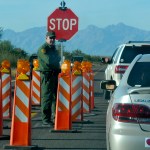


Anyone who yells, U.S. Government “DO YOUR JOB” protect ARIZONA from MEXICO just flat has never been to the border. Last week I drove halfway across Arizona driving along the border so I have seen, heard and observed the effort being expended to keep elements from the south crossing the border into the United States. It is quite impressive, the efficiency found in the Douglas District is amazing when you see they have an human eye on almost every inch 24/7, these folks sit quietly and watch from portable platforms in the flats near the border. Every mountaintop has been scraped flat and a homeland security trucks sits there seeking heat thermal signatures and flat sees everything that moves across the landscape. That truck doesn’t move until its replacement is in place. Cameras on towers observe favorite crossings and the border itself, is lighted each night at dusk until sunrise, much of the lighting are on poles but where needed, generators are brought in to fill in the gaps. Trucks just sit, watching their piece of the border and where some tracking is needed saddled horse teams or ATVs are trucked in, to initiate the search. Homeland Security is making a clean sweep of the US-MEXICO Border using bundled worn out truck tires to drag clean the soil at the end of each day, so the next morning, they know if anyone, or how many crossed and which way they went.
That is just what you can see. What you can’t see are all the noise sensors, the video cameras, the drone and helicopter over flights and Aerostat, the Southern Arizona mystery of the cold war now made relevant by an invasion on its doorstep. In the NACO Sector, there are a 1000 people assigned there alone and as you move into forest and army land, the presence becomes less in your face and more implied. My last blog on the Border with the National Guard, showed how electronic-monitoring monitors the entire landscape, keeping US turf safe from the hordes from the south. This land from Montezuma Pass west to Nogales makes up the San Rafael Valley, and it probably the most user-friendly land to be crossed because it is treed, water occurs, less cactus more grass land, it is even cooler. West of Nogales is another story and one I will save for another blog. Arrests are down, people still try and some do get through and some are even rescued.
In year 2000, the US Border Patrol arrested 1.7 million, typically 97 per cent of those arrest comes from the 1,952-mile border with Mexico and the rest from Canada. Last year’s arrests were down 72 per cent to 463,000 made this year (down from 556,032 the previous 12 months) by the all-time high 20,500 agents who now backed up by 1200 National Guard troops. Those numbers reflect a 17 per cent drop in arrests this year reflecting the results of the heightened enforcement. Homeland Security Secretary Janet Napolitano said the weak economy also helps explain why fewer people are crossing the border illegally.
The Tethered Aerostat Radar System or TARS is a stationary platform for surveillance, capable of low-level aircraft and surface target detection over 200 nautical miles. The Fort Huachuca AZ deployment in 1986 was the second, today operational sites are located at Yuma and Fort Huachuca, Ariz.; Deming, N.M.; Marfa, Eagle Pass and Rio Grande City, Texas; Cudjoe Key, Fla.; and Lajas, Puerto Rico. They usually fly at 10,000 feet but are capable of altitudes of 15,000 with 25,000 feet of tether length.
KEEPING AN EYE ON MEXICO on the US BORDER with the NATIONAL GUARD


 “NATIONAL GUARD IN CAMOUFLAGE” />
In the past 24 Hours I have driven halfway across Arizona following the US-Mexico Border photographing “the Wall” and looking for the National Guard–reportedly there are 1200 guardsmen working in support of Homeland Security, half of those are watching cameras, the other half are in the field!
I’m climbing out of my Xterra and Chester jumps out to stretch after the long dusty, rocky, climb up Montezuma Pass to this scenic viewpoint where I scan the horizon miles distant deep into Mexico and Southern Arizona. “Can I pet your dog”? I turn and there is the National Guard marching right toward me, “Sure, Chester doesn’t mind,” drawing them in closer. In the parking lot, is a ford 450 with a funny looking gizmo spinning 360 and the windows are blacked out. “Are you with this I ask”? Naw, we’re bivouac up the hill keeping an eye on the border” I sure miss my golden”, he adds stroking Chester who is patiently putting up with the glib soldier. “we’re 4-man teams, 24 hour shifts staying at Ft Huachuca 22 miles away when they aren’t sitting on a rock overlooking the US – Mexico Border. They scan the terrain, looking for UIA’s (undocumented illegal aliens) or smugglers, if they see something, they call the Border Patrol. How good are these guys coming in I ask, “Extremely good”, he retorts three times in succession. “I saw ll guys slipping past 1800 meters beneath me, called in BP and had my binocs on them in a draw, watched them the whole time, maybe they heard us but I directed BP in and they had slipped away, “they are there-I saw them”, nope says BP, “not anymore”. “They are extremely good”, he repeats, “another team saw 38 crossing”, they know we are here “we’re just a deterrent”, he adds. “We’ll be here as long as the politicans want us here.” “They are paying me $5,000 a month to sit on this rock and watch Mexico”, we can stay as long as they want.
The gizmo on the Ford 450 is still spinning and I ask, does it scan the entire valley and point to a distant ridge 5-6 miles away and ask if that ridge is in play. “Absolutely, he says, “it’s like in Preditor”, he says referring to the scifi flick where the alien has heat-seeking thermal signature vision. These guys (Homeland Security) get a lot of training how to read thermal signatures, how to avoid cows, rocks heating up! We (the guard outpost) have a hand-held thermal binco says the guardsman. That thing, (the gizmo on the 450) is 3 and a half times stronger than ours. “Can you see faces I ask” “Kinda, he says but it is the preditor-thing, they are kinda hard to make out.” Anyway, we gotta go. Needed a puppy-fix we gonna get coffee. “Can I checkout your outpost?” Sure the guard says, it’s a public hiking trail. You will see the camouflage.
They’re gone and I stick Chester in the car and head up the rocky, exposed trail up to Coronado Peak a half mile to the summit. At the top, 6575’, there is a bench and shelter and the wind is just whipping anything in its path, down below on a hillside perch are two more guardsmen. I make several photos from a distance and finally I announced myself and a head pops out of the camo. “Mind if I checkout your outpost”, closing the distance between myself and the two dumb struck soldiers. “Well, we’re not really open to the public” one guardman offers. “Do I look like the public?,” I ask as I snap a few frames, the other guardsman busies himself with picking up two M-16 automatic rifles with clips engaged and moving them out of sight in the camo. The other guard man, flustered, turns toward Mexico and looks through his bincos and I get my photo. The wind is still flaying in gusts, under the camo are packs, two cots, a water jug–pretty Spartan I think. “Well, I can see you folks will be more comfortable if I wasn’t here…so I’ll just move along.” “THANK YOU”, both guard men say in unison. They were all perfect gentlemen.
FALL COLOR GRACES HIGH COUNTRY
 From Flagstaff to the North Rim of the Grand Canyon the color shift has begun, first with the Aspen, so prominent now-days because it gets the first foothold after forest fires and followed in the Flagstaff Walnut Canyon area with yellowing Oaks. While tempid temperatures have quieted the shift, it is advancing slowly and may yet reach an ultimate peak. However Northern Arizona is forecast for showers and frequently downpours and accompanying winds knock off the final coat. Southern Arizona is still several weeks off, on an average I find, that the final weekend of October is usually the best to get out and look around. Watch out for the deer hunters, they show up in great numbers at that time, and frequently take all the campsites.
TWISTERS DAMAGE PATH ACROSS ARIZONA LEAVES BELLEMONT FEELING LUCKY
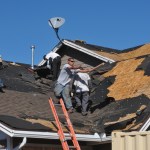
 “You should have been here Friday, the place looked like a tornado hit it!” My friend Joe Powell has a firm grip on the obvious and continues. “You should have been here Saturday and seen those 500 Latter Day Saint Volunteers who swooped into the devastated Flagstaff Meadows subdivision to help several of their own church members and their neighbors. Today is Tuesday and last Wednesday at least one tornado dropped from the sky and swept right down Bellemont Springs Drive blowing out all the windows and garage doors and hitting four homes at the end of the street head on and ripped off their roofs. No one was seriously injured, more 200 homes were damaged, forty were uninhabitable. Today Bellemont Springs is choked with repair trucks, dumpsters, insurance adjusters and the American Red Cross and security guards keep an eye on everyone and everything. On the other side of I-40 ten miles west of Flagstaff, Arizona on a rail line running through the Navajo Army Depot 30 Santa Fe railroad cars were derailed and rolled off the tracks. The hundred mile an hour winds also tossed idling semi trucks on their sides today work crews are trying to repair the rail bed and to right some of the derailment. “Not a soul was injured” insisted Powell, a Williams resident
 who is helping out with residents tearing out the bad and replacing the good. Joe’s not really for hire, he just does it to salvage some supplies to build a storage shelter at home. Someone gave him a banged up BBQ, he says he will fix it and give it to a friend, today I’m his friend and he takes me around the corner of a home he is working on to see the 12′ boat foot jammed into the gable of the home. “Isn’t that remarkable!”, we both mouth in unison. “These folks should get down on their knees and give thanks” says Joe. Minutes before the first tornado in Bellemont touched down, Jeff Cox was standing in his garage, his children nestled in bed. Rain and hail pounded hard against the windows and a fierce wind made it look like houses were swaying.Then Cox heard a deafening sound and ducked beneath a trailer when the tornado struck, it tore off the roof of nearly his entire home and throwing it into the nearby forest. The Cox home was at the end of Bellemont Springs Drive and the tornado went right through it and exploded the four homes surrounding it. In the driveway of ground zero lies a “Camping World” sign in fair condition but almost two miles from its perch on the other side of i-40 where the RV business suffered huge losses as much of the inventory was slam banged onto the stores’ parking lot and swept into a pile, the business was not open today. This storm continued into Nevada leaving record rainfall and into California bring heavy snow in the High Sierra. Tornados are rare in Arizona and while the state averages four twisters a year rarely do they all come at once.




 SOUTHWEST PHOTO JOURNAL