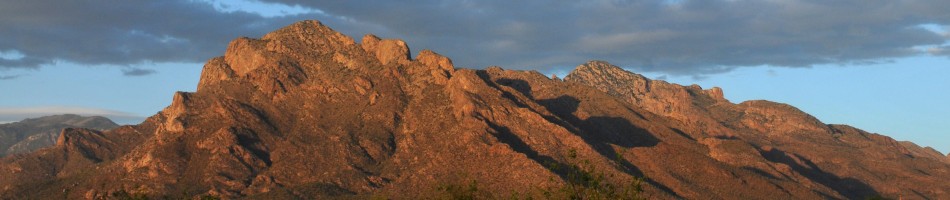
BORDER SECURITY FACT or FICTION ? MORE BOOTS ON THE BORDER NOW THAN EVER BEFORE ! SOME CALL FOR MILITIA, MARSHALL LAW TO STOP THE INVASION !
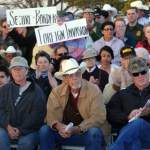

Following the shooting death of Robert Krentz along the US-Mexico Border residents ask government to protect their families, friends and homes.
IS AMERICA’S BORDER BROKEN?
US-Mexico Border Security in the 1970s was the key in Father Lambert Frembling’s pocket, it opened Mexico from the US and it opened the US from Mexico, it was the typical swinging gate for which US Customs had given him a key to the lock so he could shuttle between his flock as he held mass, funerals, baptisms and wedding in the small Tohono Oodham villages and outlaying chapels. Some of these small chapels were first started by Padre Kino or the early Spanish but today many are on Tohono O’odham Land that spans both sides of the US-Mexico Border.

Spent his life ministering to the Tohono O’odham on both sides of the US-Mexico Border.

The Tethered Aerostat Radar uses the aerostat as a stationary airborne platform for surveillance.
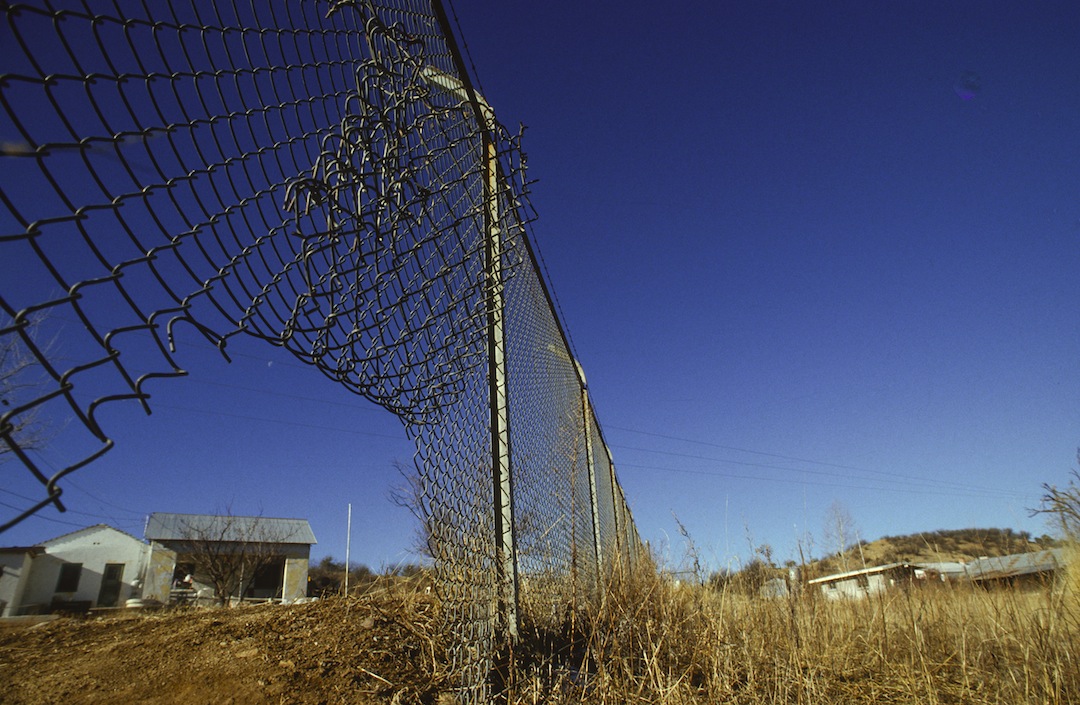
The Lochiel Arizona crossing was closed in 1983 due to budget retraints.

Vehicles with visas or Sonoran plates could access the area east of Nogales without going to Nogales first.
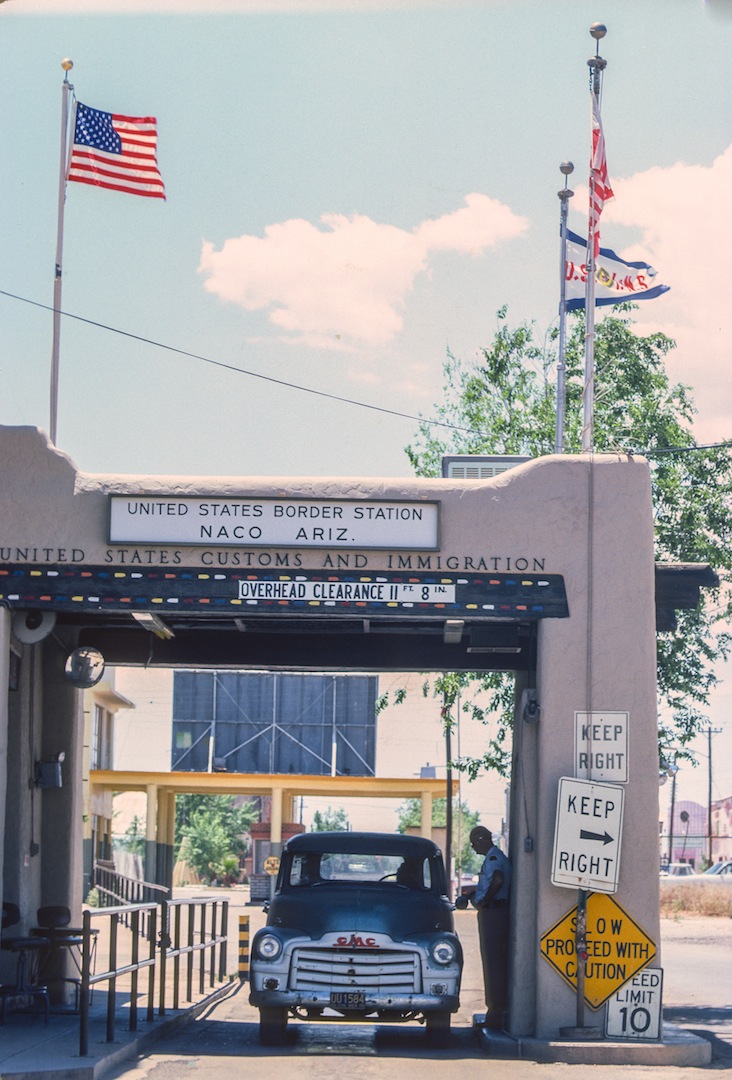
For decades the Naco, Az gate was this low tech relic of the 20th Century, since the National Border Industrial Complex has become fully engaged, billions of dollars have changed everything about the US-Mexico Border. At the new Naco Border Patrol Station numerous agents watch monitors showing folks in the darken rooms who and what is hanging out on the Border. If you drive past one, be friendly and wave.
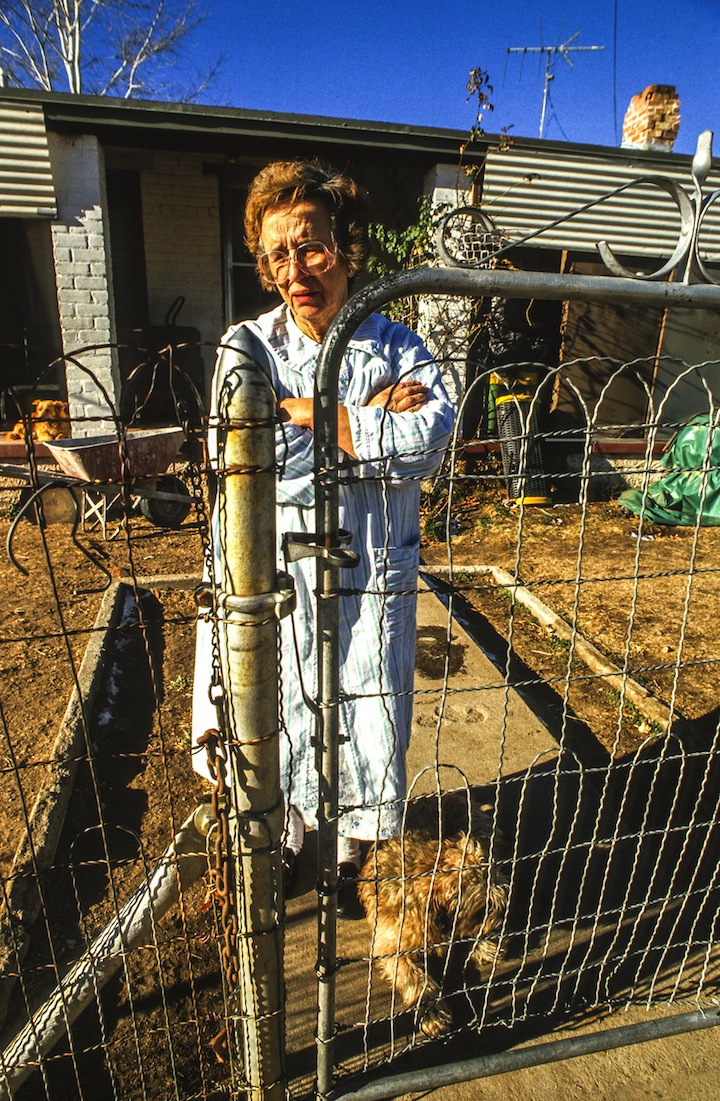
The De La Ossa pioneer family settled on the US-Mexico Border from Spain and for generations they have ranched on both sides of the fence.
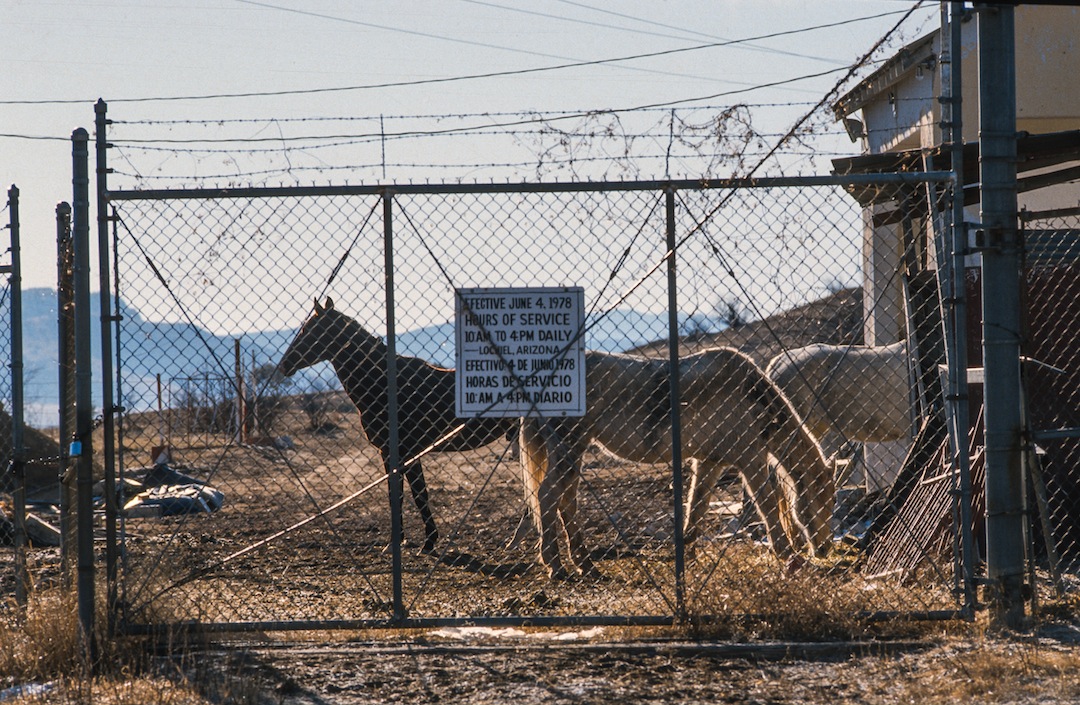
East of Nogales, AZ the Lochiel Gate was open from 10am to 4pm daily during the 1970-80’s allowing residents of Santa Cruz (headwaters of the river) Sonora access to the US and hospitals without going to Nogales first and then crossing.
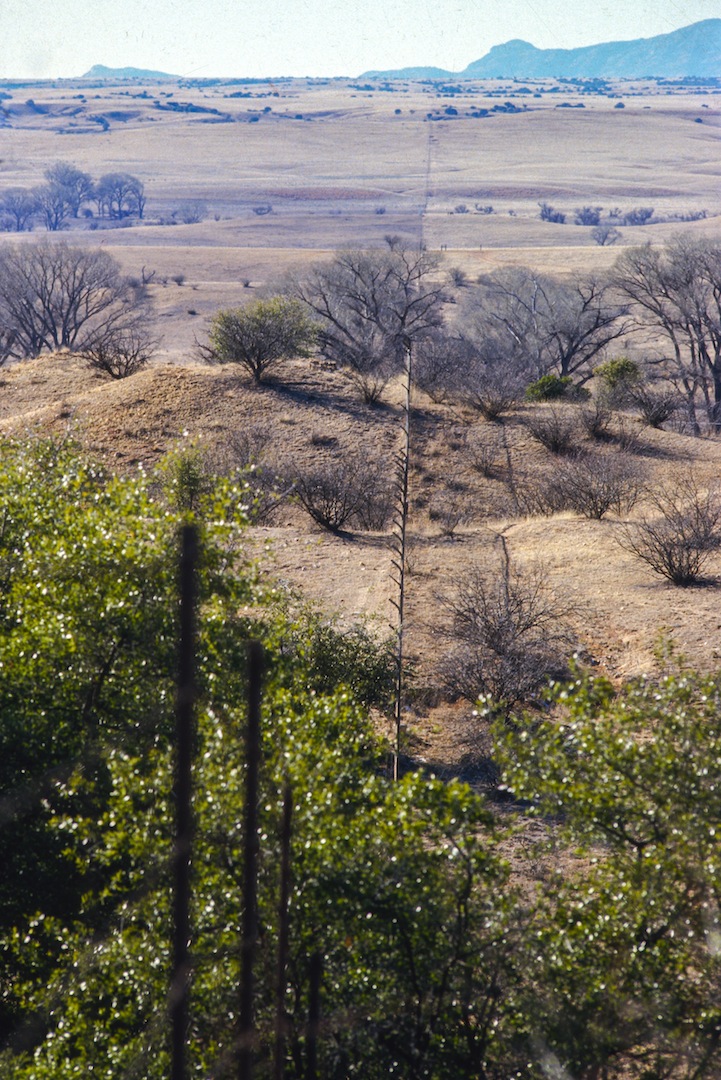
MEXICO-US BORDER FENCE runs east from Lochiel and served as a geological border and each evening this fence was often cut and penetrated at will by smugglers, mules (men carrying backpacks of contraband) and coyotes (guides who escort undocumented crossers and either deliver their cargo or dump them in the desert.
 But in recent years Mexican Drug Cartels have militarized their approach to smuggling by hiring ex-military elite, who have trained load bearing drug smugglers to walk with a shotgun backing them up to negotiate any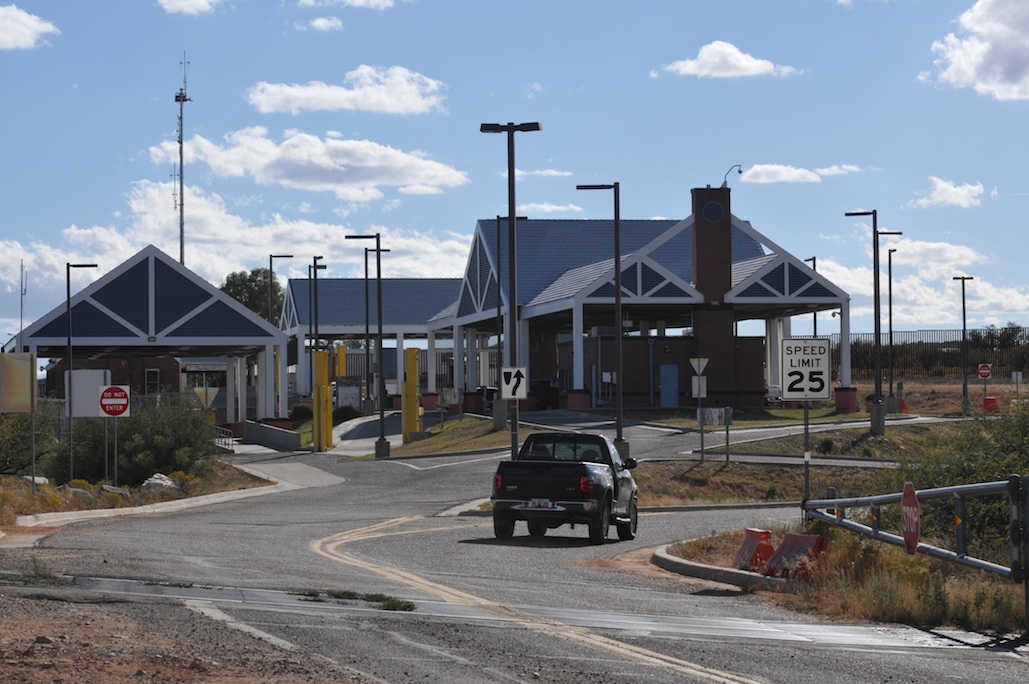
First time I crossed at the Sasabe, I drove past the small shack on the US side and as I approached the Mexican one-room entry post I heard gun shots. Ahead of me standing in the entry lane my Mexican border agent was target-practicing while on duty. But as I approached he holstered his pistol and reloaded as I departed. On the US side, the small shack is now this lovely compound with all the 21st century Customs technology.

The US National Guard takes a forward operating position on Coronado Peak to Monitor smuggling routes to the east and illegal immigration toward the west. “They know we are here, says one Guard member, “we’re just a deterrent !” “They pay me $5000 a month to sit on a rock, for that kinda money I can do that all year-long.”
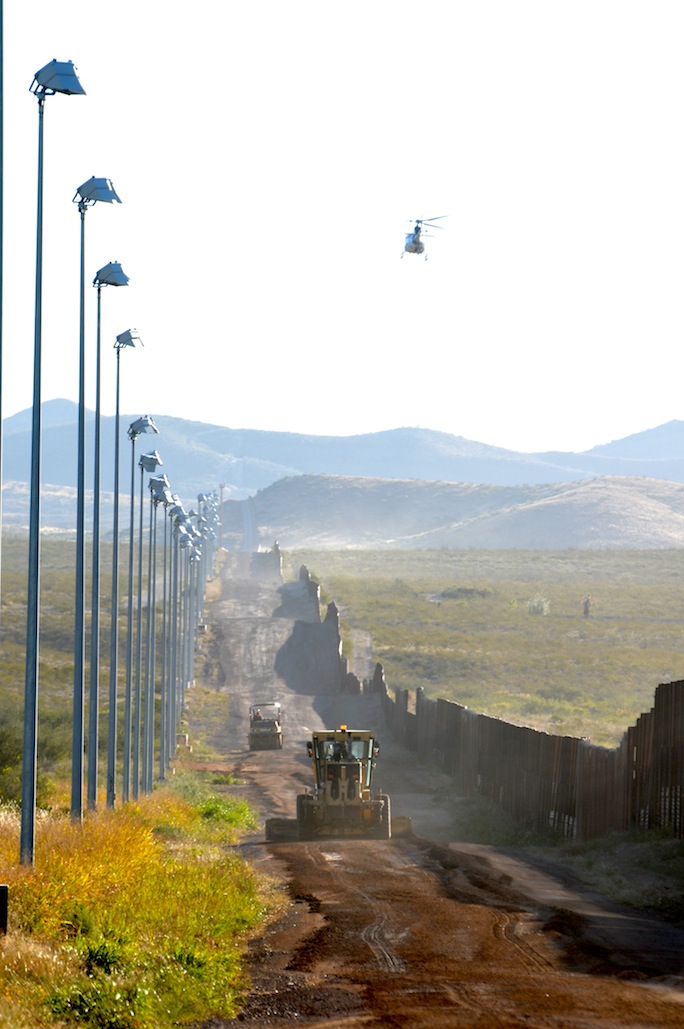
COPTERS, DRONES, SENSORS, RADAR PATROL THE LINE AS BULLDOZERS SCRAP THE BORDER CLEAN

This virtual fence watches more than 50 miles east and west of Sasabe, AZ

Tucson’s Tom Miller has written about Life along the U.S. Border for more than 30 years. Miller, a veteran of the underground press of the 1960s, has appeared in Smithsonian, The New Yorker, LIFE, The New York Times, Natural History, and many other publications. He wrote the introduction to Best Travel Writing – 2005, and has led educational tours through Cuba for the National Geographic Society and other organizations. His collection of some eighty versions of “La Bamba” led to his Rhino Records release, “The Best of La Bamba.” His book On the Border has been optioned by Productvision for a theatrical film.
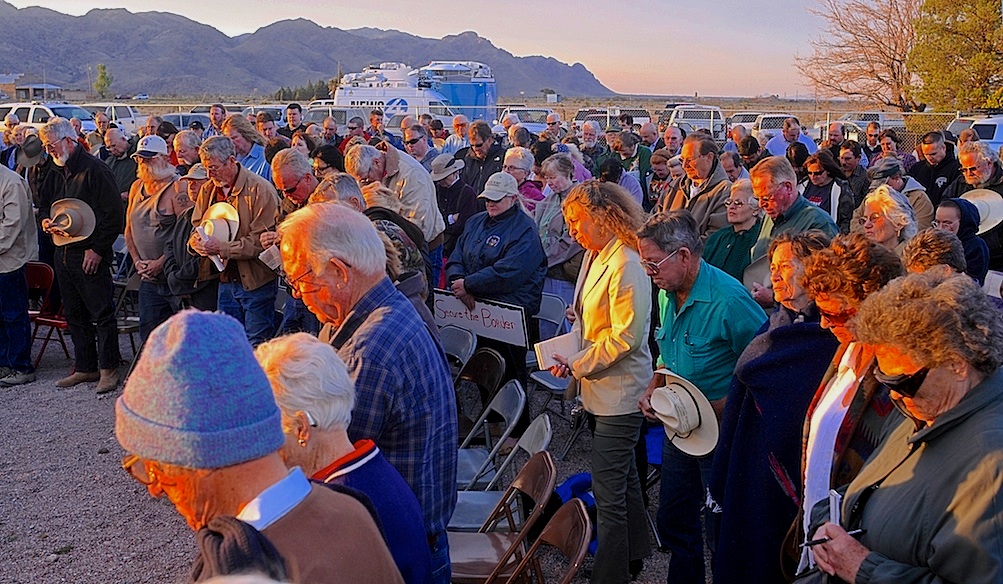
After the shooting ranchers and residents of the four corners region of Southeast Arizona, Southwest New Mexico, and the Mexican States of Sonora and Chichuahua meet at the Apache, Arizona one room school house after Congress women Gabby Giffords brought in media from Tucson, Phoenix and the New York Times to hear the needs and concerns of these folk living on the Border. Before the meeting, everyone bowed their heads and paid tribute to their dead friend and fellow rancher Robert Krentz, who like themselves, had tried to make the best of this difficult situation and Krentz and his dog died trying.

Many residents complained to the Border Patrol that they had called and called, reported and reported and no one ever came. Congress Women Gabbie Giffords (far right) brought in media from Tucson and Phoenix “what good is Homeland Security if no one ever shows up when you need them”? Customs vehicles now carry this phone number 1-877-USBP-HELP painted on the back of all vehicles.
On Saturday, March 27th, 2010 the body of Robert Krentz, a longtime rancher, was found on his property near the border with Mexico on Saturday, March 27, 2010. Krentz and his dog were gunned down shortly after he reported spotting someone who appeared to be in trouble.
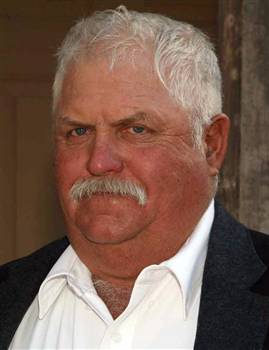
ROBERT KRENTZ
Today smugglers have moved off the flats and into the rugged mountain ranges where smugglers now carry their large backpacks and the crossers have moved further west onto the Tohono Oodham Reservation where the desert is less hospitable and where many unprepared for the desert have perished. Homeland Security has now deported more people this year than any year in the past decade. Homeland detained 212,000 in 2010, 120,000 in 2011 and less than 100,000 is expected to be picked up and detained in 2012. Death from failed summer crossing have dropped from 212 in July, 2010, 138 were reported in 2011 and in 2012 the numbers continues to drop but the proportion of those dying trying to cross into the U.S. continue to increase because of the increased difficulty. Border deaths were sparse throughout the 1990s. But in 2000, the numbers jumped drastically, increased border enforcement in California has moved migration routes east into some of Arizona’s most remote and inhospitable terrain. Unusually hot weather, even by Arizona standards, also may be contributing to the large number of deaths this year. Some migrants try to time their journeys to the summer monsoon season with its cooling rains, Kat Rodriguez told the Huffington Post. Rodriguez works with the human rights group Coalicion de Derechos Humanos who supply water stations in the desert to keep crossers alive who lack enough water to survive their journey. “The border experience 10 years ago is completely different than now,” Rodriguez said. (Today) “It’s brutal and ruthless.”
The 182 bodies of illegal border crossers recovered in fiscal year 2011 from New Mexico to Yuma County (the area within the Border Patrol’s Tucson Sector) are the fewest since fiscal 2002 when 147 bodies were found, indicates the Arizona Daily Star’s border death database.

WATER STATIONS are a political hot potato along the US-Mexico Borderlands but volunteers backing up southwest humanitarian groups walk a fine line helping out undocumented crossers and some have been arrested for their troubles. photo by Francisco Medina
Conservative critics of the water stations maintained by Tucson-based Coalicion de Derechos Humanos say the water stations enable “successful crossings” instead of “unsuccessful border crossings” where crossers are either picked up or turn themselves in to avoid death, or die in the desert. Conservatives say knowing the water is there encourage crossers to attempt the journey and without water stations–fewer people would attempt to cross the border–their deaths are their fault for trying and a deterrent to others attempting the trip. Some say many who cross have no idea of what lies before them, many are from the jungles of southern Mexico and South America, and have never seen a desert, let alone, crossed one.

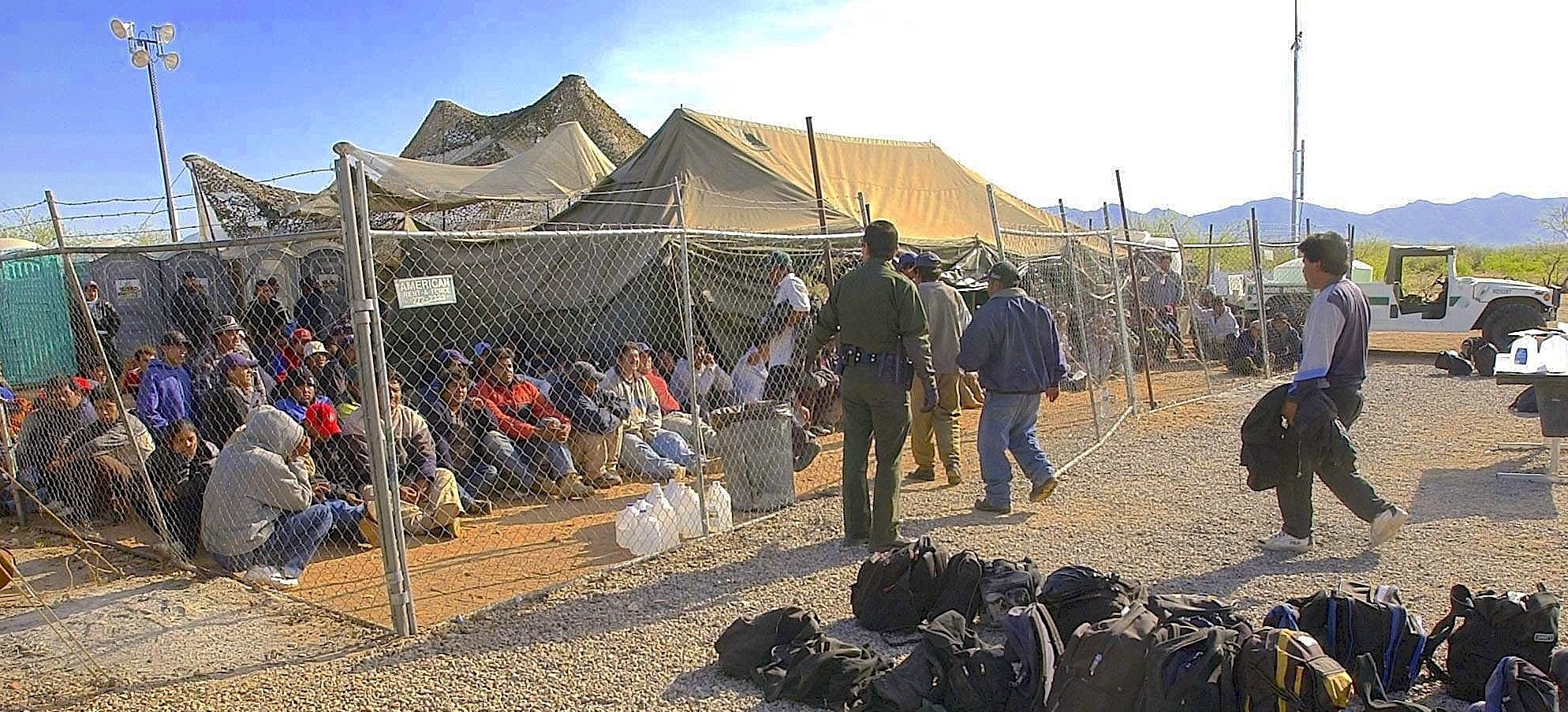
Customs helicopter tracked these crossers, called in ground support and all where taken to holding pins where they await buses to take them back to the border.

Three Border Patrol agents guide 78 illegal immigrants through the desert near Arivaca after they were found when helicopter pilots followed fresh tire tracks to trees in wash where they were hiding. PHOTOS BY GARY GAYNOR
As the U.S. Customs and Border Protection continues to secure the border, the number of border crossings has declined dramatically in the last five years, the number of deaths has not decreased at the same pace. Human rights organizations say the increased militarization of the U.S.-Mexico border and the absence of government policy addressing the motivations that prompt migrants to cross, despite the dangers. “We never thought that we’d be in the business of helping to identify remains like in a war zone, and here we are,” said Isabel Garcia, co-chair and founder of the Coalicion de Derechos Humanos.  While the precise number of individuals crossing the U.S.-Mexico border without authorization is impossible to tally, Border Patrol’s apprehensions and death data offer the most accurate picture available. Each year the Border Patrol reports the number of bodies found along the Southwest border and the number of migrants that agents bring into custody. In 2011, 327,577 migrants attempted to cross the border illegally, down from 858,638 in 2007 — a nearly 62 percent drop. A close look at the numbers reveals that illegal border traffic has slowed and deaths have slightly declined, but the proportion of people dying in an attempt to cross has continued to rise. With no official record-keeping system, the exact number of illegal border crossers who died along Arizona’s stretch of U.S.-Mexican border will never be known. In the summer of 2004, the Arizona Daily Star in Tucson started compiling border deaths recorded by Pima, Cochise and Yuma County medical examiners in an effort to present an accurate tally of the numbers of people who die coming into the United States illegally through Southern Arizona. The Pima County Medical Examiner’s Office handles bodies found in Santa Cruz and Pinal Counties as well.
To report somebody who is missing who tried crossing the border through Arizona or for help trying to locate them, contact:
• Pima County Medical Examiner’s Office: 520-243-8600
• Mexican Consulate Call Center: 1-877-632-6678
• Coalición de Derechos Humanos: 520-770-1373
• National Missing and Unidentified Persons System website: http://www.namus.gov

This new wall was suck almost 10′ under ground to deter tunneling. With two months following its completion. Customs found two tunnels to parking spots on the US side, the driver of a car with a false bottom would park and go to lunch and when he returned. He had a fresh load of contraband for the drive home.

Traffic awaits their turn at customs at the DeConcini Border Crossing…
Even after he said it twice, Arizona Senator Lori Klein still insists “Joe the Plumber”– a.k.a. Sam Wurzelbacher — was “joking” about shooting people who illegally cross the U.S./Mexico border.”Put troops on the border, start shootin’;
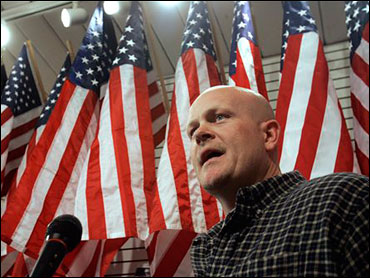
Sam Wurzelbacher, aka Joe the Plumber

McCain has a 10 Point Plan to secure the southern Border…
 “With hundreds of thousands of people illegally crossing the border every year and record drug smuggling and violence, shouldn’t the government be working to completely secure the border? Our plan is a straightforward approach that will actually achieve a secure border.”
Senators McCain and Kyl’s Enhanced Ten Point Border Security Action Plan:
1) Deploy up to 6,000 National Guard troops to the United States-Mexico border.
2) Deploy 5,000 additional Border Patrol agents to the United States-Mexico border by 2016 and Offer Hardship Duty Pay to Border Patrol agents assigned to rural, high-trafficked areas. Provides funding for 500 more customs inspectors for the sw border.
3) Provide increased funding for Operation Streamline. A costly initiative aimed at criminally prosecuting and imprisoning every immigrant who crosses the U.S.-Mexico border unlawfully.
4) Provide increased funding for the Southwest Border Prosecutors Initiative. (Public Law 108-447) $30,000,000 is for the Southwest Border Prosecutor Initiative to reimburse State, county, parish, tribal, or municipal governments only for costs associated with the prosecution of criminal cases declined by local United States Attorneys offices.
5) Provide increased funding for Operation Stonegarden. “Operation Stonegarden grants direct critical funding to state, local and tribal law enforcement operations across the country,” The 2009 allocations reflects President Obama’s increased emphasis on the Southwest border in response to cartel violence along the U.S.-Mexico border. Based on greater risk, heavy cross-border traffic and border-related threat intelligence, nearly 76 percent of the $60 million Operation Stonegarden funds will go to Arizona, California, New Mexico and Texas—up from 59 percent in fiscal year 2008.
6) Construct double-layer fencing at needed locations along the United States-Mexico border and replace outdated and ineffective landing-mat fencing along the southwest border.
7) Increase the number of mobile and other surveillance systems and Unmanned Aerial Vehicles (UAVs) along the United States-Mexico border. Send additional fixed-wing aircraft and helicopters to the United States-Mexico border.
8) Provide funding for vital radio communications and interoperability between Customs and Border Patrol and state, local, and tribal law enforcement.
9) Provide funding for additional Border Patrol stations along the southwest border and explore the creation of an additional Border Patrol sector in Arizona. Create six more permanent Border Patrol Forward Operating Bases and upgrade existing bases.
10) Complete construction of the planned permanent checkpoint in Arizona. Deploy additional temporary roving checkpoints and increase horse patrols throughout the Tucson Sector.
All traffic from the US-Mexico Frontier is funneled through road check points scattered all over Southern Arizona. New roads has been graded parallel to the Border so Homeland Security is able to access the entire region rapidly.
THIS CONTROVERSIAL I-19 CHECK POINT HAS BEEN A SORE POINT WITH LOCAL RESIDENTS
DOUGLAS BORDER WALL
This new wall was installed in Nogales on the Arizona and Sonora line.
To help the country out the conservative left has tried to raise enough money to build a second border wall to backstop the present wall. One hysterical conservative fund initially raised $265,00 for the second wall, but six months later money for the project has dried up and the existing funds will not construct one mile of border wall. Still advocates say start the construction and more money will begin to flow in to preserve our democracy. The new wall just installed this year in Nogales is designed to halt a 10 ton truck going 40 mph. But it fails to keep out people who can quickly scale the fence, some fall and break bones but many more find a way over the wall. Every night border fence is cut and repaired the next day, critics say Mexican smugglers are able to cut the fence at its base bend it flat and use it as a ramp for trucks to enter the U.S., all in five minutes. The wall will not stop people unless you watch it and if you watch it–you don’t need a wall. One utube video shows two girls climbing the wall in less than 18 seconds! Is this really worth $4 million a mile ?
Presidential candidate Mitt Romney’s plans didn’t take notice of what’s already been done along the U.S-Mexico, including record-high staffing levels along the border and the failure of a Bush-era virtual-fence plan. Today the Border Patrol has more than 18,500 agents working on the southern border. In the year budget ending last September, agents apprehended about 340,000 illegal immigrants, the fewest in nearly 40 years – an average of 18 apprehensions per agent. The decrease in apprehensions has been linked to a weak economy producing fewer jobs in the U.S. and to more law-enforcement agents and technology being deployed along the border. Under the Bush administration, the government built hundreds of miles of fencing along the Mexican border. A planned virtual fence was also started, but was scrapped by the Obama administration in 2010 after the project was deemed a failure. About 53 miles of virtual fencing is in place near Sasabe, Az, at a cost of about $1 Billion. An exit-verification system has been sought since after the Sept. 11, 2001, terrorist attacks, but efforts to build one have been repeatedly stymied, most often because of the projected costs. Earlier this year, John Cohen, deputy counter terrorism coordinator for the Homeland Security Department, told a congressional panel that the agency was finalizing plans for a biometric data system to track who leaves the country and when. He didn’t give any details. Arizona’s unsuccessful Democratic candidate for Governor however does have some very specific ideas how best to secure the border…
“YOU WANT A CLOSED BORDER, HERE’S HOW BY FORMER ARIZONA ATTORNEY GENERAL TERRY GODDARD…
If the United States wants effective border security and not just a political punching bag, where symbolism trumps common sense, then more effective law‐enforcement measures must be taken. By attacking money laundering and making bi‐national criminal investigation and prosecution of the cartel bosses a priority, the border can be made significantly more secure. In the process, the mayhem in Mexico and the smuggling of drugs and people into the United States will be reduced. There must be a unified focus. All agencies must get on the same page to succeed. State and local law enforcement, with the coordinated efforts of all relevant federal agencies, can win this.</a>
<a href=”https://southwestphotojournal.com/wp-content/uploads/2012/10/terry-goddard.jpg”>
The United States’ southern border today bristles with technology and manpower designed to catch illegal immigrants and drug smugglers. Since 1986, the government has spent hundreds of billions of dollars on fences, aircraft, detention centers and agents. But even as federal budgets shrink and illegal immigration ebbs, experts say that there’s no end in sight for the growth of the border-industrial complex. A growing investment on the border stocked with equipment like Blackhawk helicopters — hundreds of aircraft fly daily missions — much of the southern border has grown into an industrial complex that is fed by the government and supplied by defense contractors and construction companies. The infrastructure includes a border fence that in some places has been built and rebuilt several times. And up to 25 miles north of the border, towers, sensors and permanent checkpoints spread across the landscape.
The government spends an estimated $5 million each day to house detainees awaiting deportation. All this takes manpower. Roughly 80,000 federal employees work in immigration enforcement and Homeland Security Secretary Janet Napolitano…believes it is safe to say that there has been more money, manpower, infrastructure technology, invested in the border protection mission in the last three years than ever before.
Hernan Lopez, a U.S. Border Patrol camera monitor watching our border with Mexico. Photo by Tricia McInroy
Janet Napolitano

Raul Grijalva

Politicans turned out to shake hands on Labor Day in Eloy, Az after the parade through downtown. The controversial Sheriff of Pinal County Paul Babeu shook hands with his constituents asking each for their vote. Babeu has recently drawn attention and criticism for his use of military equipment for a slush fund and was just told to return the equipment …
<a href=”http://www.statesman.com/news/news/opinion/longley-industry-of-border-security-creates-extra-/nRjsP/” title=”NATIONAL BORDER INDUSTRIAL COMPLEX” target=”_blank”>During the past 40 years, a multi-billion-dollar border industrial complex has sprouted up, bearing a striking resemblance to the military industrial complex that President Dwight Eisenhower warned about in 1960. These large institutions have a vested interest in short circuiting immigration reform and absorbing huge quantities of national security funds. What are the foundations of the complex? An obvious one is the private sector writes Kyle Longley, a history professor at Arizona State University
and the author of four books.
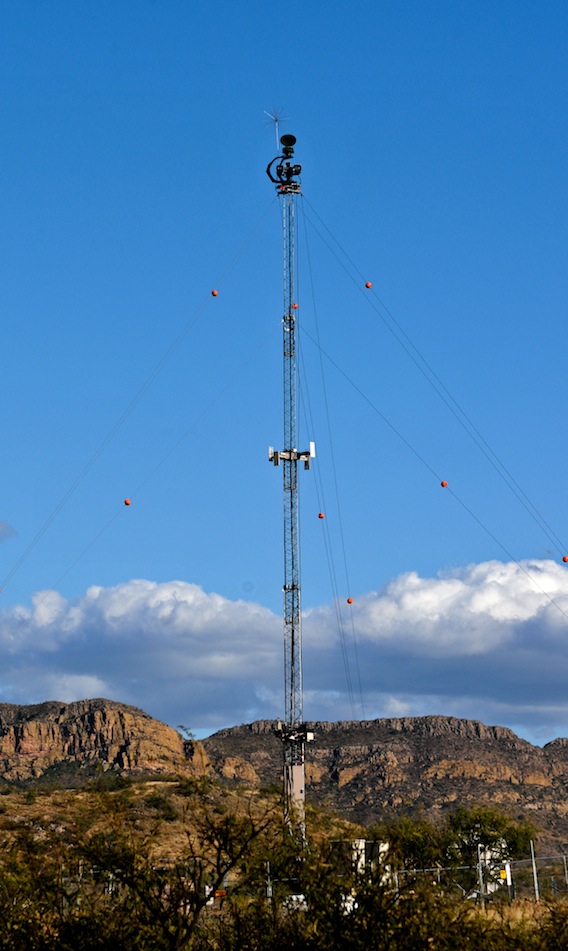
SASABE VIRTUAL FENCE
Many businesses long dependent on military spending have expanded into border security. The efforts of Boeing to build a high-tech fence along the border provide one example. It spent $1 billion of a proposed $8 billion budget before Homeland Security pulled the contract after Boeing produced only 53 miles of a flawed virtual fence. Not all businesses have defense industry ties. In fact, one of the biggest beneficiaries remains the private prison system. Huge companies, including Corrections Corporation and GEO Group, incarcerate large numbers of illegal immigrants for the government. Understanding the potential, the company’s lobbyists have backed hardline security-first leaders, such as Arizona Gov. Jan Brewer, who championed the Senate Bill 1070 immigration law. Many others in the private sector benefit, from airlines that rent planes to ICE to deport immigrants, to the local business people who provide food and gas to Border Patrol agents. It is a lucrative industry that ensures private businesses employ armies of lobbyists to push their agendas.

Lots of vehicles need lots of gas…

NICHOLAUS IVIE
The NICHOLAS IVIE, the U.S. Border Patrol agent killed in a shooting in Southern Arizona apparently opened fire on two fellow agents thinking they were armed smugglers and was killed when they returned fire, the head of the Border Patrol agents union said. The two sets of agents approached an area where a sensor had been activated early Tuesday from different directions and encountered each other in an area of heavy brush, National Border Patrol Council President George McCubbin told the Associated Press in Phoenix.”It’s happened and it’s a horrible tragedy for the agents involved and their families and the agency,” McCubbin said. “We can come up with some reasons as to how this happened, but that doesn’t fix anything. All we can do is send prayers to the families and all the agents involved that somehow they can find some peace with this someday.”Ivie’s death marked the first fatal shooting of an agent since a deadly 2010 firefight with Mexican bandits that killed U.S. Border Patrol Agent Brian Terry in December 2010 and spawned congressional probes of a botched government gun-smuggling investigation.
<a href=”http://channel.nationalgeographic.com/channel/videos/ultralight-drug-drop/embed/” title=”DRUG DROP” target=”_blank”>CLICK HERE TO SEE ULTRA-LIGHT AIRPLANE DROP HIS LOAD OF DRUGS…

Congress women Gabby Giffords shortly before being shot a a townhall meeting in Tucson Arizona, the Tucson lawmaker passed legislation making ultralight flights over the US-Mexico Border illegal. This new law handed local law enforcement a new weapon against illegal drug smuggling for border bound law enforcement agencies.
Just as the Bush administration launched the “global war against terrorism” and the wars in Iraq and Afghanistan in a burst of misguided patriotism, the administration also thrust us into a new era of “homeland” and border security with little reflection about costs and consequences. Without a clear and steady focus on the actual security threats, “homeland” and border security have devolved into wars against immigrants and drugs. Instead of prioritizing intelligence and interagency communication – the failures of which made 9/11 possible – the Bush administration, and now the Obama administration, have mounted security-rationalized crackdowns on the border and in the interior of the “homeland.”
As a result, the criminal justice system is overwhelmed, our prisons are crowded with immigrants and the flagging “war on drugs” has been given new life at home and abroad. Absent necessary strategic reflection and reform, the rush to achieve border security has bred dangerous insecurities about immigration and the integrity of our border.
Tightened control has made illegal crossings more difficult and more expensive. It has also turned what were previously routine, nonviolent crossings into dangerous undertakings that regularly involve dealings with criminal organizations. An indirect and certainly unintended consequence of the US border security buildup has been the increasingly violent competition between criminal organizations and gangs as they both struggle to maintain markets and trafficking corridors. Despite the border security buildups and $100 billion spent along the southwestern border, no terrorists or terrorist weapons have been seized. DHS does point out, however, that every year it regularly apprehends illegal border crossers from countries designated as state sponsors of terrorism. Those apprehended are mostly from Cuba, with single digit numbers from Iran, Syria, Sudan, Somalia, Pakistan, Afghanistan and Yemen. Border security hawks point to these arrests of citizens from “special interest countries” as evidence that the “broken border” keeps Americans vulnerable and that the border should be completely sealed.
Ten years after the federal government undertook a new commitment to domestic and border security, the nation deserves to know what the tens of millions of dollars spent on securing the southwestern border have accomplished. Before more tax dollars are dedicated to border security, we need new policy frameworks for immigration and illegal drugs that disaggregate these issues from homeland and national security.
The post-9/11 imperative of securing “the homeland” set off a widely played game of one-upmanship that has had Washington, border politicians and sheriffs, political activists and vigilantes competing to be regarded as the most serious and hawkish on border security. The emotions and concerns unleashed by the 9/11 attacks exacerbated the long-running practice of using the border security issue to further an array of political agendas – immigration crackdowns, border pork-barrel projects, drug wars, states’ rights and even liberal immigration reform.

BORDER PATROL AGENTS PICKUP LOCALS CROSSING OVER IN NOGALES AND RETURN THEM TO MEXICO
‘WHAT DOES A SECURE BORDER LOOK LIKE’ …. 2013 VIEW OF THE US-MEXICAN BORDER…CLICK HERE
US BORDER PATROL AGENT SHOOTS 14 YEAR OLD ROCK THROWER…CLICK HERE
UPDATE: MEXICAN DRUG WAR TURNS THE CORNER
ABANDONED BY SMUGGLERS, FORTUNE SMILES ON CROSSERS, BUT NOT ALWAYS
SONOYTA OVER RUN BY CRIMINALS, ARMY AND POLICE TAKE IT BACK
STAR ARTICLE DETAILS SONOYTA INVASION…CLICK HERE
US CONSULATE WARNS EXPATS IN ROCKY POINT
Nicholas Ivie, a 30-year-old father of two, was shot and killed in the sparse desert in SE ARIZONA
2013 BORDER APPREHENSIONS LOWEST IN ALMOST TWO DECADES….CLICK HERE
SOUTHWESTPHOTOBANK.COM PHOTO COLLECTION/GALLERIES ON THE US-MEXICO BORDER…CLICK HERE


<a href=" SPANISH TRANSLATIONS:
CONFEDERATES SCARE OFF YANKEES PICACHO PEAK PARK SALUTES 150th ANNIVERSARY OF ARIZONA VICTORY
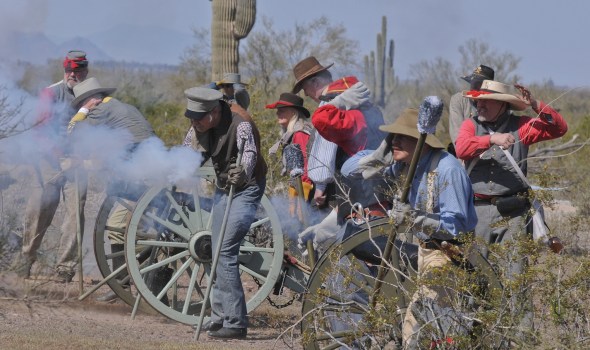
Johnny Rebs teeth rattle from the firing of a 6 pound gun during the 150 Anniversary of the Skirmish at Picacho Peak.

FORT HUACUHUA's historic and ceremonial regiment empty their pistols before turning their horses and beating a hasty retreat from advancing Confederates.

Visiting spectators at the wire, many re-enactors, like Robert Guyton, enjoy sharing their knowledge of the Civil War with the hundreds of spectators.
Great crowds turned out for the Civil War in the South West to watch more than 200 re-enactors battle out the great Civil War engagements of the South West. Two were fought in New Mexico, Valverde and Glorieta Pass, is often called the Gettsyburg of the West. The third battle, Picacho Peak is fought near the actual battle spot, just across I-10, lies the unmarked grave of a Union trooper who died, buried where he fell at the skirmish known as the Battle of Picacho Peak. Today hundreds turned out to relive those days of the the Confederate Territory of Arizona, and the 150th Anniversary is on everyone mind. “This is a rare thing,”! “A 150th anniversary”! says VJ Audegis and Annette who have been coming for 12 years to this contest between the blue and grey. “This is a really special year”, “this anniversary preceded by the statehood celebration has made it a very exciting year” say Baldy Cervantes and his thirteen year old son Elvis. Both had attended the Civil War in the South West Weekend before and wanted to become re-enactors so they both joined on the spot.

Gaining battlefield experience in 2012, next year, both will be able to bare arms in the battle, firing against the Yankees and be promoted to corporals.
Both father and son are reveling in the anniversary this April 15, the 150th year, of that chance encounter at Picacho Peak, called the most western battle of the Civil War. This summer Cervantes and Elvis are taking off three weeks and driving back to Gettsyburg for the 150th anniversary and re-enactment, a four day event that will see more boots on the ground this July, than has trampled those grounds since the original battle when 133,000 men battled and died in the most desperate fight of the Civil War. Cervantes is proud of his Arizona roots and his Hispanic culture, so when the recruiter mentioned the First Texas were made up of a number of Texacans, and their reenacted force was lily white now. “They needed us”, he said, “We fit right in”.
“We know that few people understand what was happening during the Civil War in the Southwest and these battles offer the public a glimpse into history and how the battles were fought,” says Rob Young, Picacho Peak State Park Manager. “This is also a popular camping park for RVers because it is just off the highway and surrounding Sonoran Desert habitat is so unusual, especially when there are magnificent poppies.” The Mexican Poppy were looking good about three weeks ago but warm days and hot wind frazzled this year’s crop into a less than an average display with pockets of opportunity if you catch them at the right place, at the right time, that spot won’t be Picacho Peak this year.

Lots of color, some clashing, but rebels were just that. Able to rebel against conventional uniforms and able to pursue their own look on the battlefield.
Today Confederate hats are flying out the tent door and Gerald Durbin, owner of the Coon River merchantile, can hardly keep up with the line at cash out. Confederate hats out sell Union all day long. Pausing for a breathe, between checkouts of hardtack, hats of blue and gray, uniforms, flags and dresses he reasons the Johnny Reb look allows variety enough to let its owner change his persona, “those Yankee troops never change”, he explained. “Like cookie-cutters, everyone looks just alike.” Fifteen year old Taylor Horrid, chose the Confederate side and dressed in period clothes to came with his uncle. He was having fun learning about the Civil War.

Moving troops skillfully was artfully demonstrated by the officers and the troops ability to follow commands.
For Taylor, learning how to load, fire, clean a black powder musket has been great and military drilling is something he learned and now loves. He looks forward to learning more about the United States and its history.
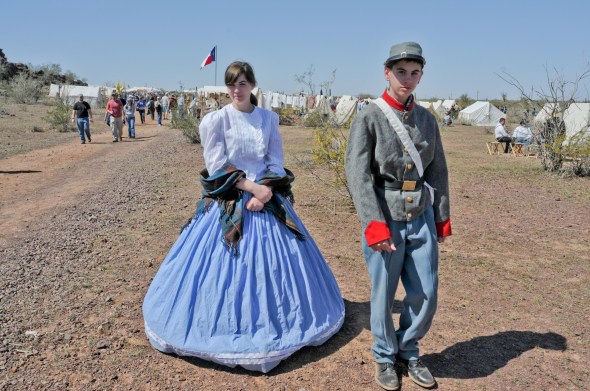
Seventeen year old Heather Jones, Mesa accompanied by her Johnny Reb brother, fourteen year old Bryson both have shared their love for history with their friends, "It's fun to be part of something that made our country great".

California re-enactors hung together at camp and enjoyed the desert setting.

Back at camp, Larry Hammack (left) and Robert Guyton pose for a filmless image
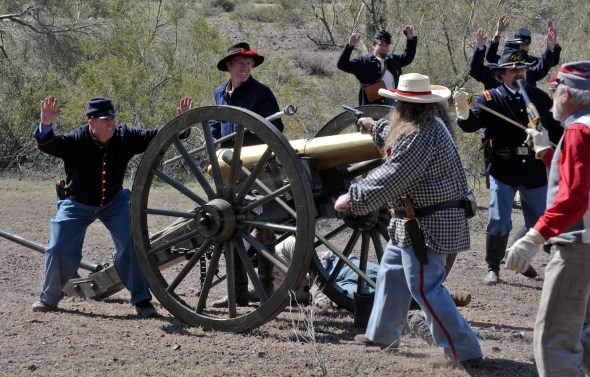
Rebels overrun the Union artillery taking over the cannon and turning it on their owners firing grapeshot till the North left the battlefield.
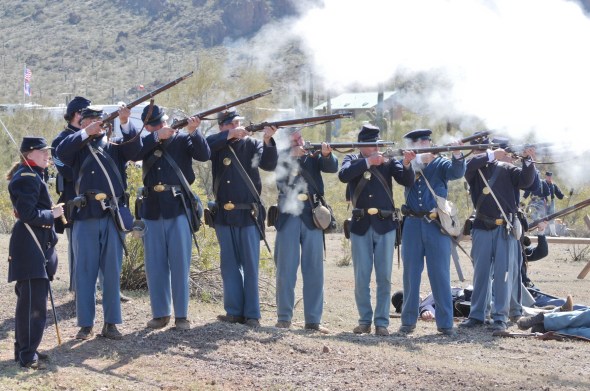
Heavy musket firing with black powder, was grimy and dirty work and after the 6th round, many found it difficult to ramrod the shot or simply clean the barrel.

"Members of the storied 4th Cavalry Regiment, one of the most famous and most decorated regiments in the US Army. Ft Huacuhua was in the middle of the Apache Indian War"
Since 1855, the 4th Cavalry has continuously served the United States of America in the Indian Wars, the Civil War, the Philippine Insurrection, World War II, Vietnam and the Gulf War. Today the 4th Cavalry is a historic and ceremonial regiment stationed at Fort Huachuca and its Troopers are active duty and retired military who care for their horses and drill weekly.

Rod Preuss USA (Ret.) Executive Officer of the storied 4th Cavalry Regiment Ceremonial Unit ...
SLIDE SHOW FROM 150TH ANNIVERSARY OF THE CIVIL WAR IN THE SOUTHWEST CLICK HERE
SLIDE SHOW OF PICTURES FROM EARLIER YEARS OF PICACHO PEAK RE-ENACTMENTS CLICK HERE …

<a href=" SPANISH TRANSLATIONS:
SOUTHWEST BORDER WARS or MEXICO: THE WAR NEXT DOOR
 ”
”
“PECK CANYON is heavily patrolled and the terrain rugged.”
Few saw that the US-MEXICO BORDER would tear apart families or tribes whose cultures and languages are threatened but the cities that sprang up on both sides were predictable the division created entrepreneurial opportunity which sprung from the law, culture and needs of society. The international border became a way of life, a geological oddity (like the Grand Canyon) right in their own backyard, if their property had backed up to a great viewpoint they would have set up a pay parking lot and required admission.
The fence or border brought traders who provided the needs of the locals, like Sasabe Merchantile sells both parlor and kitchen stoves all wood-burning and priced for a population where electricity and gas are a new world commodity. Until recently, places like the San Miguel Gate, (a strip of no man’s land) became a row of boxes and traders on Saturday mornings who tried to sell goods to folks who needed their products from either sides of the border.
Recently I spoke with a young man who grew up in the Peck Canyon corridor and he believed crossings may be down “but business was being done, and if a load needed to go, it went and arrived intact! Business has been conducted through Peck Canyon since the day when Geronimo used those foothills’s perfect cover as he made tracks for the border. In our last posting, a local deer hunter said, “all border traffic was being funneled into Peck Canyon” much of this because of the high-tech sensing equipment elsewhere and the high profiles of the National Guard and additional manpower to the Border Patrol.
Unique to Peck Canyon, is the mixing of wilderness and residential, its close proximity to dense high
desert terrain and I-19, which is next to the large Border Patrol Checkpoint on I-19. I thought it would be quite easy for drug cartels to own several houses along I-19 where folks could move north from one house to another, for $5000 a head, many things are possible, like tunnels. Locals can think of four or five houses that might fit that description or have, from time to time. Likewise, the bandits who prey on crossers and smugglers alike, they probably live right there and know the terrain like the back of their hand and could be watching TV while border patrol searches.
Maybe, these Border businessmen started out young as mules! Perhaps, in the beginning they carried marijuana on their backs into the US, for $200 a pound, forty pounds equals $8000, 50 pounds or $10000, whatever they could carry quickly. Once in, they drop their load in a remote spot and hotfoot back to Mexico. When they drop their packs a man on a hillside watches and carefully telephones “his crew” who he directs to the load and they bring it further north. For decades, people have stuffed their doors and wheel wells full with pounds of grass and more than 200 pounds might be stuffed into a single ride to travel north without a second look. Driver of a loaded car might make $2000 traveling between Rio Rico and Tucson where the keys are passed to new driver to take the car on into Phoenix. This practice limits anyone person having full knowledge of the network. Lots of stolen or borrowed cars end up abandoned in the desert and they are quickly stripped by yet other border entrepreneurial opportunity. Living on the border separates families and social responsibilities can collide with professional responsibilities may result in a phone call home where an agent tells his wife he is stopping for bread on the way home. That might mean he will not be on a certain mountain and that route will be open for cousin Jaime to bring his load through. Some people living on the line, say “it business!” and others, call it “family”. Anything is possible, here. If a load needs to go, it does so successfully!
Here are some links to recent articles on the Peck Canyon and its every growing violence and how the cartels are pushing back against Mexico and USA …
A Border Patrol swat team member was shot and killed Tuesday night in a gun battle with suspected bandits south of Tucson. Agent Brian A. Terry, 40, was killed when his team exchanged fire with a group of five people about 11 p.m. in a remote area west of Rio Rico, said the FBI. Four of the five suspected bandits were in custody Wednesday morning, including one man who was hospitalized with gunshot wounds. Border Patrol since “have buttoned down the Pena Blanca Lake area” covering all the squeeze points and by placing agents on quads and horseback into the interior they are looking for a fifth member of the group. The shooting occurred in a remote area near Forest Service Road 4197, west of Interstate 19, said Santa Cruz County Sheriff Tony Estrada. When deputies arrived at Peck Canyon Drive and Circulo Sombrero in Rio Rico, they found Terry dead of gunshot wounds, Estrada said. The remote area where the shooting occurred is an area frequently used by drug traffickers and people-smugglers.”All these canyons in Santa Cruz County are notorious for smuggling humans and drugs,” Estrada said. “Obviously, it is a very dangerous situation for anyone patrolling those remote areas, particularly for Border Patrol. There is always that threat.”Santa Cruz Sheriff’s Department was only serving in a support role, Estrada said. The FBI is handling the investigation.”Our thoughts and prayers are with the Terry family for their tragic loss,”
Border Patrol Agent Brian A. Terry was shot and killed Tuesday night in a fire fight with suspected bandits near Rio Rico, south of Tucson.


VIDEO: Mexico the War next Door…

Mexican Crime Reporter Speaks Out
RARE TWISTERS SLAM NORTHERN ARIZONA

 Last Wednesday four or more Tornados slammed into Northern Arizona while I was driving from Tucson to the North Rim of the Grand Canyon, I had left Tucson 6am and was just 30 miles from Flagstaff when I heard a radio severe weather warning advising everyone to be on the lookout for funnel clouds until 11am. Around noon, another twister was reported off 1-17 about where I heard the first reports. Apparently around 5:30 am two f1 tornados hit Bellemont, Az with more than a 100 mph winds ripping off roofs, rolling semis trying to sit out the storm and then derailed a freight train, damaging 200 homes before moving north toward Flagstaff. This tornado or another later dropped suddenly into the forest west of Flagstaff cutting a mile-long path through the forest, across AzHwy 180 and eventually mowing down 250-300 fir and aspens. Many of these trees were 40′-50′ in height, some were topped, others snapped at the base, even more were pulled from the ground–roots and all. While there were no serious injuries most folks in this neck of woods won’t soon forget the Day of the Tornados.
TUCSON’S FIRST DAY OF AUTUMN


Preparing for flight on the PINAL PIONEER PARKWAY Thursday Morning ten TURKEY BUZZARDS warmed and dried their wings against the Morning Sun near the entrance to the FALCON VALLEY RANCH on AZ HWY 79 nine miles north of Oracle Junction. These area has been recognized as a key spot for raptor viewing, even an osprey has nested nearby, the Turkey Buzzards are an added bonus. The Turkey Vulture is common in the United States, its keen sense of smell is vital for finding carrion, contrary to popular belief, this bird enjoys plant matter as well. The Turkey Vulture soars above the ground for most of the day, searching for food with its excellent eyesight and highly developed sense of smell. Extremely non-confrontational, the Turkey vulture will not feed on live prey, an occasional habit of its cousin the black vulture. Turkey Vultures, like these, are often seen along roadsides, cleaning up roadkill. The turkey vulture is one of the most skilled gliders among the North American birds. It migrates across the continents with minimal energy output. Vultures launch themselves from their perches only after the morning air has warmed. Then, they circle upward, searching for pockets of rising warm air, or thermals. Once they have secured a thermal, they allow it to carry them upward in rising circles. When they reach the top of the thermal, they dive across the sky at speeds near 60 miles per hour, losing altitude until they reach another thermal. All this is done without the necessity to flap. In fact, the turkey vulture can glide for over 6 hours at a time without flapping a wing! …
BARREL CACTUS TIME

Landscape photography requires the photographer to have a link with the land, he must be attuned to the weather, the time of year, the movements of the moon and sun, blooms and fall-all things natural, but often out of sight and out of mind, not something city-dwellers easily track. Therefore the challenge, Ansel Adams described the landscape photograph as often the source of great hope and often the source of severe disappointment, it’s hard to keep it all together and be there when great things happen, unfold and become a lasting digital moment. That doesn’t mean that untold numbers of photographers won’t strive to accomplish what Ansel Adams did, with every breath they take. His record selling “Moonrise Hernandez New Mexico” was one of those “drove into the ditch, threw up the tripod, slammed in a film holder into his camera, pulled the slide, guessed the exposure, made the exposure, light faded. Then he pulled a light meter and made his readings and developed according. Hernandez New Mexico print sold recently for $609,600, more recently, the Adam’s photo “Winter Storm clearing” has sold for $722,000.00 bypassing all other Adam’s photos for a price paid. I asked Ansel about “Winter Storm clearing” once he said that he often visited that view and some times there was a photo but often nothing and he drove on. So luck, has a lot to do with Ansel Adams “luck” but his diligence and tenacity always the deciding factor, he was out there working and checking out ideas that may bear fruit, but maybe not today, keep checking. Years ago I decided that Landscape work needed total devotion and tried to devise ways of improving my chances, without living in the desert the rest of the year. A few tricks that help, the moon calendar on this website’s blog roll, tells you when the full moon will present itself, it also shows you the dark of the moon, for night shots. The AZ Highways scenic drive and monthly event calender gives you ideas of pretty drives that can dove-tail with up-coming events like the Fort Verde Days October 8 thru 10, lots of living history, drilling, posing for tourists. Maybe enroute or on the way home you decide to visit wet Beaver Creek, the road travels across several one-lane bridges and a country boarding school to the V-Bar-V Heritage Site, where after a short half-mile hike, visitors can see more than 1,300 petroglyphs depicting everything from snakes to humans with walking sticks. A nice diversion, breaks up a long drive and a good thing to shoot mid-day and gives you some variety and more bang for your buck.<!–
SW SPRINGPK WeisI have a habit of picking up rocks along the way and over the years I find myself with a huge rock garden and in the nooks and crannies of these rock, cactus adorn and bloom annually right in my backyard. Frequently cactus blooms at home fill in the blanks when I need a particular bloom but better still it keeps me in touch with the desert and when I notice the blooms in my garden I realize things are heating up out in the Sonoran Desert and I might do well to take a look.

WATCH YOUR STEP !


UPDATE: New signs unlike the sign above have replaced the one below and some say its because of the election and the need to show greater control of the border. The Pinal Sheriff said it was all politics but the sign below was placed in an area where he held a four day smuggling sting in northwest Pima/southwest Pinal to justify his request for a million-day anti-smuggling team. Investigative leads have brought in outside agencies to investigate a Pinal Deputy’s shooting allegedly tracking smugglers. Governor Candidate Jan Brewer stood in front of a sign like below and told Washington to “do its job” ranting about “heads in the desert” and some might say that all could be called politics. “I’m 80 miles away from the border and only 30 miles away from Arizona’s capital. This is an outrage. Washington says our border is as safe as it’s ever been. Does this look safe to you?” she asked. Still reports say Americans must take care driving Sonora in 2010 and to stick to the main roads or join organized tours who do business there regularly….end of update…
There was time when I would throw my camping gear in the car and take off and camp where ever the wind blew me.
Today I find myself questioning whether or not camping along the US-Mexico Border is as safe as it once was. I find myself considering whether a person alone carrying expensive camera gear is as safe as I once always thought. The Robert Krenz shooting in the SouthEast corner of Arizona says no. Shit happens, people say, until it happens to them. I have always known that crossers were honest hard working people crossing into Arizona’s Sonoran Desert are not the problem. I have seen dozens and know they simply wish to fade in the texture of the desert and reappear close to their goal and awaiting friends and family. God Bless them—I wish them well.
Having said all that, I still find myself thinking twice about venturing out and carefully considering my destination. I used to drive the border road between Nogales and the Coronado National Monument south of Sierra Vista, I frequently camped along it, heard occasionally things going bump in the night but never had a problem. I often camped in the riparian region called Sycamore Canyon west of I-19 along the Ruby Road south of the fantastic Tumacacori Highlands, no more.
The picture above was taken at the west end of Avra Valley Road–west of Marana–north of the Tucson Mountain chain but south of the magnificent Silverbell Range. That opening leads into the Tohono Oodham Reservation which is frequently used by smugglers. Violence in Mexico trinkles down to the little guy, the mules, the folks carrying the loads and if they lose their cargo, they too may lose and so, in the days of trickle-down economics, so may you. Daylight brings some safety and fewer issues arise with the sun but with nightfall, so comes Trouble. And everyone knows “Trouble rides a fast horse”, so be smart and safe. Get an early start home by dark, always carry spare water in case you find someone in trouble, but take care not to place yourself and loved ones in a compromised situation.

UPDATE: Two Mexican immigrants have been found shot to death in Pinal County 500 yards from a migrant camp, each with a single AK-47 round, the shootings occurred an area known as Antelope Pass, not far from where a Pinal County Sheriff Deputy was shot by smugglers five weeks earlier. One of the victims may have reported the shootings with a cellphone prior to dying from his injuries, when helped arrived, both were dead. A rifle was found with the victims and question whether or not, the victims were out were hunting or perhaps had been smuggling themselves.
FURTHER UPDATE: The Arizona DPS reports "militia groups" operating in the open desert with the intent to deter smuggling and capture illegal crossers. Many different points of view are represented in these groups and care should be taken around any group of heavily armed individuals. Pinal County Sheriff Paul Babeu blasted the federal government during an Oct. 10 tea-party rally in Tucson for putting up the signs in English “instead of in Spanish, facing south, saying, ‘Stay out.’ “
THE COLORADO RIVER IS 2013’s “MOST ENDANGERED RIVER” ARE WATER BANKS AND RATIONING, OUR FUTURE?
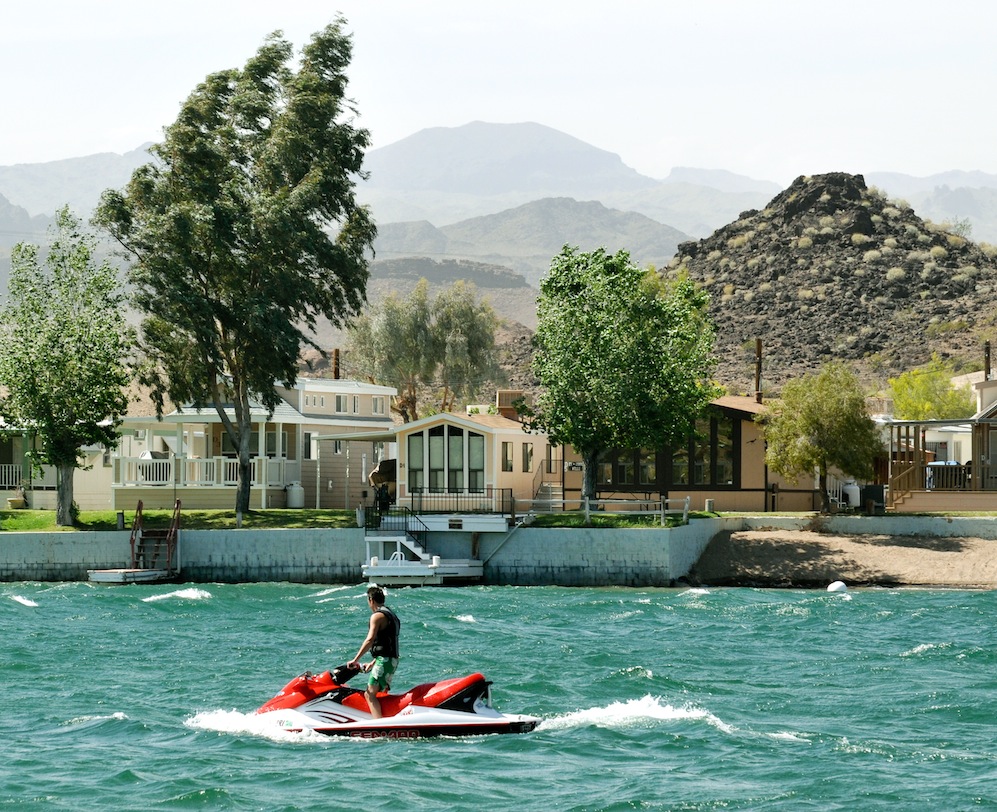
WILL THIS POPULAR ARIZONA, CALIFORNIA AND NEVADA PLAY GROUND RUN DRY?

THE CAP IN TAKES WATER BENEATH HOOVER DAM.
What happens next year? “Maybe we’ll have a wet year”, seems to the extent of the plan, it’s a lot like me buying lottery tickets for my retirement, its proactive, optimistic but nothing to take to the bank.
I visited the New York Times, the editorial page of the Salt Lake Tribune, the Las Vegas Headlight-Sun, the Los Angeles Times and the Arizona Republic to see how each spun the story about Lake Mead facing shortages. Perhaps the best story I found was a gardening column for the LA Times, complaining that they were getting mixed signals whether or not they should put in lawns. The Vegas spin was more sobering when you realize Sin City gets 90 percent of its drinking water from Mead. Vegas has two large siphons attached to the lake and a third under construction, they are scared–by the end of the year one siphon may be above Mead’s water level and worthless. The new siphon runs through the bottom of the lake and will be able to literally suck Lake Mead dry. Nobody believes that will happen-but the new siphon is nearing completion in spite of setbacks. The Southern Nevada Water Authority has begun pursuing permits necessary to build a $3.5 billion, 300-mile pipeline to shuttle water from the mountains in northern Nevada, many question the plan.
Southern California believes every time a sprinkler is turned on, choices are being made between lawns and their fisheries and still-no one believes anything will change until the courts start ordering changes. Already California water companies are trying to linkup with snow melt from the Northern High Sierra, just in case, they say. Lake Mead’s reservoirs have reached 1087 feet for the first time since 1956 when the lake dropped ten feet in order to fill Lake Powell. These twin reservoirs will require years of snow melt and runoff to make up the deficit and tree ring dating data frankly doesn’t support that optimism, it does suggest the droughts since 1990 frankly are nothing out of the ordinary and things could get worse. Utah has a $2billion “pie-in-the-sky” pipe line planned to bring more water from Lake Powell…water that might not be there. Kinda of reminds me of the Hohokam, all we really find of them are the water canals they built to bring water to the desert and therefore brought life itself.
In Phoenix, the Arizona Republic reports Lake Mead water levels determine drought status on the river under a set of guidelines adopted in 2007 by the seven Colorado River states: Arizona, California, Nevada, Utah, Wyoming, Colorado and New Mexico. If the lake reaches the first drought trigger, measured at an elevation of 1,075 feet above sea level, water deliveries below Lake Mead are reduced by a little more than 10 percent. Additional cutbacks would occur if the lake continued to drop. For Arizona, the stakes are high. Arizona absorbs 96 percent of any water rationing on the river under a decades-old agreement that ensured construction of the 336-mile CAP Canal. Nevada absorbs the other 4 percent under a separate deal with Arizona. Although rationing would affect some users on the river in western Arizona, most of the cuts would come from the canal, whose annual flow of 1.5 million acre-feet would be reduced in stages. (An acre-foot is 325,851 gallons, enough to serve two average families for one year.)
Farmers and users of excess water, such as underground-storage programs, would be affected first. It’s unlikely cities and business in Phoenix and Tucson would lose any water in the earliest stages.

IN SAN LUIS BAJA NORTE MEXICO THE RIVER IS DRY LESS THAN TEN MILES SOUTH OF THE BORDER
“It’s a clear warning,” said Tim Barnett, a scientist and Lake Mead expert from the Scripps Institution of Oceanography who sounded the alarm in 2008 that Mead had a 50% chance of running dry by 2021. “The thing that’s astounding to me is the head-in-the-sand attitude of the bureaucrats that we’ve talked to.” “The water situation in Southern California is serious,” he added, “But I don’t think it’s dire yet. Six months or a year from now, we might not be using ‘serious.’ ‘We might be using dire'”.
During the last decade the Southwest has loss snow pack, vegetation and endured serial wildfires and increased temperature and all the while the region has grown faster than any other part of the US. Study after study predict that climate change will reduce the banked snow pack from 6 to 45 percent over the next half century. Every year more water is drained than deposited with an annual deficit of 1.6 million acre-feet, still without a “full-fledged crisis” most folks won’t do anything. In Las Vegas, for instance”, the “Cash for Grass” program pays homeowners $1-per-square-foot to convert to desert landscaping.
In 2007 the Feds mandated an agreement between the seven US states sharing the rivers flow. The lowest reduction cuts deliveries by 333,000 acre-feet, about half of what Las Angeles consumes in a year. Should the lake’s surface fall another 12 feet to 1075 feet below sea level or about 33 percent capacity. some say this will happen next year. When the 28.5-million-acre-foot reservoir’s surface hits 1,050 feet, or about 26 percent capacity, deliveries get slashed by 417,000 acre-feet, Las Vegas shuts down one of its two intakes and Hoover Dam’s massive turbines lose the hydraulic pressure needed to generate electricity. The maximum cutback of 500,000 acre-feet kicks in when Mead surfaces hits 1,025 foot, or about 20 percent capacity.

YUMA WATER USERS
The mighty Colorado carries the lifeblood of the Southwest. It services the water needs of an area the size of France, in which live 40 million people. In its natural state, the river poured 15.7 million acre-feet of water into the Gulf of California each year. Today, twelve years of drought have reduced the flow to about 12 million acre-feet, and human demand siphons off every bit of it; at its mouth, the riverbed is nothing but dust.
The U.S. intelligence community understands what is happening, according to one report released last year, the global need for water will exceed the global supply of “current sustainable water supplies” by 40 percent by the year 2030…
OFF TO A GOOD START
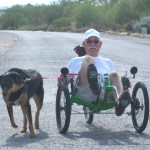
Every morning about an hour before sunrise Chester and I head out for our walk. Its quiet and the coolest it’s going to be for the rest of the day. Now days the humidity has dropped our walk down to about 2 miles but it takes about the same time due to Chester’s slowing pace–the monsoon humidity really heats things up quickly and he slows.
Regardless, it’s the act of doing, being there, getting the exercise, awaking to the day on the walk, watching the sun flirt with the rim of Pusch Ridge and finally getting home just as the sun peaks over the ridge and into my valley. Things are going to get hot and its time to head for the house, maybe some quick yard work and then slaving away on the computer. It is the morning walk that gets the blood pumping, allows for meditation and mapping out the day and assures we’re up and ready for the morning.
Many of my neighbors, meet me out there everyday–same time and same place and we always reflect on the weather and in Tucson, that makes for a short conversation.
Maybe another month, perhaps five weeks, and our best weather of the year will be upon us and our walks become blessed and full of anticipation. I should be able to sleep-in a bit and have less pressure to beat the sun. Chester is always excited about our early start and it his joy and how he savors and relish his morning outing that fuels my walking the most and why I don’t sleep in when I would rather crawl slowly from the bed. In the final exam, my doctor and vet, both believe the morning jaunt does us both a lot of good and when it comes to my doc, anything I can do to make him happy is important, he finds so little. And I owe all of it to Chester, my faithful walking companion.<img src="http:// ” alt=”walkingthedawg3512.jpg” />
ORO VALLEY : Land Stewards or Land Sharks ?

For more than 35 years I have lived on the West side of the Catalina Mountain Range so admittedly I love it as much as I do the air I breathe. Too often in those years I felt the land being developed there was treated secondary to the construction and the natural beauty that brought you, me and the developers was being lost. All that having been said, “beauty is all in the eye of the beholder”, would be the political stalemate we see in all such cases.
So when I complain I can’t see the Mountains, from what is arguably the best vantage afforded anyone driving north on Oracle, because someone built a wall. That seems like a obvious complaint and such a outrageous affront it amazes me no one has blown it up or knocked it down or asked that it be moved. I did my own informal survey and my banker said she was usually so busy driving, she hadn’t noticed the wall that outrages me every time I drive by. My eye doctor had heard lots of complaints and some of them thought it was an affront, many others, thought it, silly.
You wouldn’t find it silly, if you paid big money for a lot and a new home and went out on the patio to enjoy your exclusive view and couldn’t hear the birds singing because of road noise made worse by the echo of the CDO wash. You might not also see the silliness of bulldozers carving out those expensive home plots tearing up the beauty that GOD himself carved and nestled on our west slope. So the wall keeps you from seeing stuff you might not like seeing and therefore heads off complaints and bitching because out of sight–out of mind.
Catalina State Park was born by a land swap that made Sun City Rancho Vistoso possible and gave Oro Valley, the chance to become the next Scottsdale, rather than the tennis court it was for two decades. In those days Big Horn Sheep lived on Pusch Ridge and watched us carefully as our noise and light pollution grew and the growth pushed out. The sheep gave up grazing on the golf course behind the Sheraton and have now gone all together. The only rams to be found there today are the Oro Valley mascots with which they have decorated their environs so they might revel in the days when these wild animals once walked this land. I heard two women talking at a Oro Valley event, one women from Saddlebrook was going on and on about the wildlife that her community enjoys and the Oro Valley women said how she so wished she lived where she could enjoy the desert….




 SOUTHWEST PHOTO JOURNAL