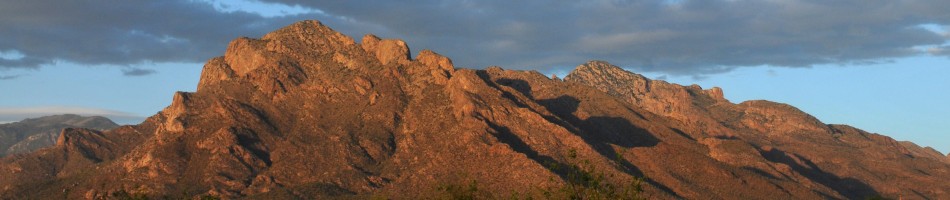
RARE TWISTERS SLAM NORTHERN ARIZONA

 Last Wednesday four or more Tornados slammed into Northern Arizona while I was driving from Tucson to the North Rim of the Grand Canyon, I had left Tucson 6am and was just 30 miles from Flagstaff when I heard a radio severe weather warning advising everyone to be on the lookout for funnel clouds until 11am. Around noon, another twister was reported off 1-17 about where I heard the first reports. Apparently around 5:30 am two f1 tornados hit Bellemont, Az with more than a 100 mph winds ripping off roofs, rolling semis trying to sit out the storm and then derailed a freight train, damaging 200 homes before moving north toward Flagstaff. This tornado or another later dropped suddenly into the forest west of Flagstaff cutting a mile-long path through the forest, across AzHwy 180 and eventually mowing down 250-300 fir and aspens. Many of these trees were 40′-50′ in height, some were topped, others snapped at the base, even more were pulled from the ground–roots and all. While there were no serious injuries most folks in this neck of woods won’t soon forget the Day of the Tornados.
A GRAND CANYON VIEW: WILL FIST FIGHTS BREAK OUT! WHERE HAS THE LOVE GONE ?
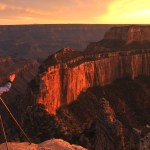
 Sunset at Cape Royal on the North Rim of the Grand Canyon is a meeting place for serious-minded photographers, it is the place and the time to be there. So as the sun sinks, lens men from all over the world begin to show up, lineup and watch the ski and imagine the possibilities. “Looks like it might be really special tonight”, says a photographer with an Australian accent as he eyes the break in the clouds at the horizon and the band of clouds above it–excitement builds and photographers work one angle and move on, cameras play musical chairs as the light plays across the landscape. On my rock, four photographers trade place and war stories, everyone is having a really good time, it is a creative moment and the possibilities endless. “Hey, you’re not going to stay in that spot, are you?” questions another photographer on a different rock, to one photographer on my rock. “Yes”, I believe I will” he retorts. “I’ve been lining up this shot for an hour” yells the questioning shooter from his distant perspective to the newly arrived photographer who has set up his tripod to shoot south when everyone else is shooting west into the sun. The new photog unravels a bit and complains “its my second night at the canyon, and I’m tired of folks bitching at me. The conversation turns dark, the light continues to peak and soon the cameramen know–the new guy is not moving and the distant rock guy is going to come over and stand in front of him, he promises, steam appears at both sites. Meanwhile, everyone else is wondering if this will escalate into punches being thrown, at the moment it could go either way, but as the sun sinks behind the ridge and night advances–photographers deal with the limitations of the moment and little more is said. “I thought those two were going to slug it out”, said a NPS park ranger at the scene but “in civies”, if I had entered the dispute–I would have pulled the new guy off this perch on the edge of the rock. The fella on the distant rock, was on solid ground, but the other was in harms way even if he didn’t think so”, the ranger said. Since 1860 more than 600 people have fallen into the canyon averaging 4-5 a year, last month a 18 year old French photographer fell 75 feet and survived, in 2007 the youngest fatality, a four year old rolled off the Mather Point viewpoint, as had the Frenchman, so it happens with some regularity. It is sad that a grand moment like that had to deteriorate into such a scene I think to myself as I walk back to my Xterra. I experienced a similar scene at Delicate Arch in Central Utah at Arches National Monument, a few years earlier at another sunset, there another mass gathering for the religious experience of watching the sunset set on a rock so remarkable that every Utah license plate carries a photo of Delicate Arch for the all the world to see. As today, photographers line up and wait for the sunset, most taking care to stay out of the view of the other cameras, and then as the light finally reaches its peak, a obtuse individual walks into everyone’s view stands under the arch, looks up and makes a picture. Everyone waits, each chews his lip and expects the photog who now has the photo, to leave, she doesn’t–she pauses to enjoy the moment and then it begins “get outta there” yells one and then another, the offending photographer begins to make the case for her doing whatever she wants–wrong tact I think–as I and everyone else literally yells her off the mountain. To be fair, that evening there had been no light, the sun was hidden in the clouds–still folks made the uphill three mile hike on the possibility–then the sun popped out at the last moment rewarding dozens of photographers who had traveled amazing distances to be there for this moment. So then when someone defies their investment with such obtuse behavior, it seems, understandingly she was granted a temporary pass, but then crossed a bridge too far when she failed to quickly retreat, the chorale response from dozens of photographers was deafening and in fact, lacking in tact. Desperate people can say almost anything when pushed–and pushed they were. Every park incident incident reflects a microcosm of the real world where we all find difficult and dysfunctional people every day–some can be reasoned with and others will do it their way– the hell with everyone else… “where has the love gone” you ask! Love indeed, love of US Parks is peaking, toss in the competitive creative pursuit of digital landscape photography and folks may drive 500 miles in a day to make sunset on a distant rock which builds expectations for a photographers with only this chance to get the photo. One such photographer a day earlier had arrived from Michigan, on his first night he raced to Cape Royal for the legendary sunset, and arrived three minutes too late, he had seen the view from the trail but pushed on to the viewpoint instead of grabbing what would be his only opportunity. He freely admitted he should have grabbed the moment instead of rushing on ahead for the perspective he thought would be better. Tonight’s classless late arrival had rushed up late and settled into what he thought was his picture and blocked the shot of a photographer who had done the same a hour earlier without him being an element–the closed minded and late photographer–fought for and kept his precious angle and never moved out for any thing else. All the other photographers on my rock had worked that angle and moved on. “I didn’t think his picture was very good anyway” said the ranger “he had no foreground” but still he stayed, to assert his rights and screw the other shooter who had given him shit. I often find that serendipity can be a photographer’s best friend, the best pictures come from where we don’t expect, and we need to be open to all the possibilities–in other words–sure lineup your best photo, track it and work it and make it if you can but look around, over your shoulder, up and down but be flexible and your pictures will improve.
Remember, the age old photographic adage, “F8–be there!”

BLOGGING vs THE POWER of UTUBE

So you were born to blog! Sharing with all the world your innermost thoughts, feelings and in my case, rants! Back up! Setting up a wordpress.com site has been a real experience, a positive experience, for one thing, they are free. Secondly, they really work well and therefore the pressure is on you–the blogger–to produce content someone wants to see or visit. Technically speaking, running web sites boil down to
the amount of space you have available to you, particularly when video, photographs, slideshows are involved. One video can easily add up to a gigabyte, slow to load and play, enter utube which allows you to upload your video to their servers and then link it back to your site without any
cost in space to you. They give you a nice looking player and it looks good. But once the viewer enjoys your video on your site–they are left on utube and they steal your traffic … that said. What traffic you might ask. WordPress sites have great search engine visability, for one reason because they are all linked and you can search all their content or WordPress will link you with related topics on other sites and bring you some readers. My videos have had a marginal affect on my site, however on utube, the Apache project, will soon enjoy its 1000th playing largely from Apache in Arizona and New Mexico but now has been found globally and is enjoying almost 25 hits a day on utube, my other videos, Dia de Muertos in Nogales, Son is second with much fewer hits, fifty eight views since mid-August, and my multi-media slideshow of the Day of the Dead Procession, my best I believe, has had fewer than forty views, inspite of all my spiffy digital sound capture overlaid with the video. Stumbleupon is another tool, if you get a good posting–Stumbleupon might bring you ten viewing in a good day, your content, and its interest to your reader will determine the degree. I recently sent my Shamanism post to Stumbleupon and found the mystery of the super natural brought in almost nine hits from the outside. Either way, it is hard to match the power and speed of the huge servers of utube but as you blog, your archives gives you depth, and slowly builds your daily viewings. SOUTHWESTPHOTOBANK.COM and SOUTHWEST PHOTO JOURNAL are new and designed to promote each other by sucking in the search engines and finding new views and ultimately customers.
I can see from my stats page, readership is up, the curious are visiting–but I still am amazed by the success of my videos on utube and the total lack of interest in them on site. Obviously, the content needs improvement, and the right story will bring more visibility, so SWPB will continue to be topical and current and strive to reach you across multiple platforms. You can help by coming back and checking in.
Hey, if nothing else, the Tucson Weather Report on my page with its 10-day outlook is the BEST REPORT in Town. Weather in Tucson tomorrow! HOT and SUNNY … See, who would have seen that coming.
TUCSON’S DAYoftheDEAD PROCESSION
NOGALES, SON DIA de MUERTOS
TUCSON’S FIRST DAY OF AUTUMN


Preparing for flight on the PINAL PIONEER PARKWAY Thursday Morning ten TURKEY BUZZARDS warmed and dried their wings against the Morning Sun near the entrance to the FALCON VALLEY RANCH on AZ HWY 79 nine miles north of Oracle Junction. These area has been recognized as a key spot for raptor viewing, even an osprey has nested nearby, the Turkey Buzzards are an added bonus. The Turkey Vulture is common in the United States, its keen sense of smell is vital for finding carrion, contrary to popular belief, this bird enjoys plant matter as well. The Turkey Vulture soars above the ground for most of the day, searching for food with its excellent eyesight and highly developed sense of smell. Extremely non-confrontational, the Turkey vulture will not feed on live prey, an occasional habit of its cousin the black vulture. Turkey Vultures, like these, are often seen along roadsides, cleaning up roadkill. The turkey vulture is one of the most skilled gliders among the North American birds. It migrates across the continents with minimal energy output. Vultures launch themselves from their perches only after the morning air has warmed. Then, they circle upward, searching for pockets of rising warm air, or thermals. Once they have secured a thermal, they allow it to carry them upward in rising circles. When they reach the top of the thermal, they dive across the sky at speeds near 60 miles per hour, losing altitude until they reach another thermal. All this is done without the necessity to flap. In fact, the turkey vulture can glide for over 6 hours at a time without flapping a wing! …
PUSCH RIDGES’S MANY MOODS: CROWN JEWEL of the SANTA CATALINA MOUNTAIN RANGE
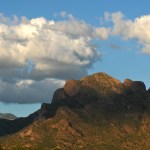
PUSCH RIDGE DRESSES UP THE ENTIRE NORTHWEST SIDE OF TUCSON AND MAKES IT THE FASHIONABLE SIDE OF TOWN. I’m closing out my 4th decade in TUCSON and most of that time I have lived in one spot in the shadow of PUSCH RIDGE. Early on, I set up a ladder and never moved it, eventually the vines grew over the ladder and now it can never move but nightly I will find myself on my roof watching the interplay of lite and color as both bounce off PUSCH RIDGE. It can be particularly rewarding this time of the year when clouds appear and give the sky contrast and color at sunset, the storms and lightening add a completely different component, each photographer has to decide how much of that he can handle. I frankly get off the roof when the sky is crackling, the tree in my front yard was recently reduced to a hedge by an explosive lightening strike. So take my advise, keep your head down and find a good, solid plastic tripod. Today I am posting a new slide show on SouthWestPhotoBank.Com which will show a portion of my collection of my PUSCH RIDGE Collection and hope you find them fun in the real-time of a slideshow and remember in actuality each reflects a day, or 24 hours, in changing weather and time spent. I have driven all over the AMERICAN SOUTHWEST and BAJA and few places I have visited have had the class and beauty that PUSCH RIDGE lends TUCSON. Its always fun when driving in, after a long trip, to finally spy my view of the ridge and finally know, I’M HOME ! There is PUSCH RIDGE to prove it. HOPE YOU ENJOY…
BARREL CACTUS TIME

Landscape photography requires the photographer to have a link with the land, he must be attuned to the weather, the time of year, the movements of the moon and sun, blooms and fall-all things natural, but often out of sight and out of mind, not something city-dwellers easily track. Therefore the challenge, Ansel Adams described the landscape photograph as often the source of great hope and often the source of severe disappointment, it’s hard to keep it all together and be there when great things happen, unfold and become a lasting digital moment. That doesn’t mean that untold numbers of photographers won’t strive to accomplish what Ansel Adams did, with every breath they take. His record selling “Moonrise Hernandez New Mexico” was one of those “drove into the ditch, threw up the tripod, slammed in a film holder into his camera, pulled the slide, guessed the exposure, made the exposure, light faded. Then he pulled a light meter and made his readings and developed according. Hernandez New Mexico print sold recently for $609,600, more recently, the Adam’s photo “Winter Storm clearing” has sold for $722,000.00 bypassing all other Adam’s photos for a price paid. I asked Ansel about “Winter Storm clearing” once he said that he often visited that view and some times there was a photo but often nothing and he drove on. So luck, has a lot to do with Ansel Adams “luck” but his diligence and tenacity always the deciding factor, he was out there working and checking out ideas that may bear fruit, but maybe not today, keep checking. Years ago I decided that Landscape work needed total devotion and tried to devise ways of improving my chances, without living in the desert the rest of the year. A few tricks that help, the moon calendar on this website’s blog roll, tells you when the full moon will present itself, it also shows you the dark of the moon, for night shots. The AZ Highways scenic drive and monthly event calender gives you ideas of pretty drives that can dove-tail with up-coming events like the Fort Verde Days October 8 thru 10, lots of living history, drilling, posing for tourists. Maybe enroute or on the way home you decide to visit wet Beaver Creek, the road travels across several one-lane bridges and a country boarding school to the V-Bar-V Heritage Site, where after a short half-mile hike, visitors can see more than 1,300 petroglyphs depicting everything from snakes to humans with walking sticks. A nice diversion, breaks up a long drive and a good thing to shoot mid-day and gives you some variety and more bang for your buck.<!–
SW SPRINGPK WeisI have a habit of picking up rocks along the way and over the years I find myself with a huge rock garden and in the nooks and crannies of these rock, cactus adorn and bloom annually right in my backyard. Frequently cactus blooms at home fill in the blanks when I need a particular bloom but better still it keeps me in touch with the desert and when I notice the blooms in my garden I realize things are heating up out in the Sonoran Desert and I might do well to take a look.

SHAMANISM: Crack in the Rock divides US from our Spiritual Side
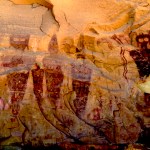
Rock art in North America is found deep into Mexico north into Utah-it can be quite old, in central Arizona it begins before Christ and around 1000 AD rock arts takes on human shapes. North to New Mexico’s Chaco Canyon, a rock wall has a series of lines in a single panel said to mark the summer equinox, a sun dagger is said to mark the coming and going of summer. Elsewhere in Chaco’s back country is a panel said to depict a 10th century Super Nova seen in the sky. Graphic shapes or counting seems to be one media but art does become more expressive, but nowhere is the javelina or wild-pig and mountain lion depicted in stone. They migrated late into our area only within the past two hundred years. This flute-playing Mountain Goat carved in rock is found at SAND ISLAND IN BLUFF UTAH in the midst of the NAVAJO Nation but is a remnant of the ANASAZI prehistoric culture. This isolated view represents perhaps 18 inches by maybe 30 inches sliced from a rock art panel on a 150’ cliff beside the San Juan River. Most of that 150 foot cliff is rock art, this is simply a paragraph.
It appeared to me as very cool having a Mountain Goat playing the flute, like Kokopelli, so I pulled this in with a 300mm lens and thought no more about it until one day when I visited Edgar Perry, a White Mountain Apache Medicine Man and described the panel to him from memory.
Is there a crack between the two groups of sheep? he asked. Yes, I said. “That line represent the real world (topside) and the supernatural world (beneath),” he said. Topside you see two sheep walking on all fours beneath the crack you see two sheep — one standing on two legs and playing a flute and the other on all fours with a bird (raven) appearing from its head the Navajos call this, skinwalkers or shape–shifting. The Medicine Man points out the White Sheep becoming a black Raven characterizes the battle between good and bad, right and wrong. Imagine if that much meaning can be taken from a fraction of the entire panel, imagine what else, we could learn everywhere.
WATCH YOUR STEP !


UPDATE: New signs unlike the sign above have replaced the one below and some say its because of the election and the need to show greater control of the border. The Pinal Sheriff said it was all politics but the sign below was placed in an area where he held a four day smuggling sting in northwest Pima/southwest Pinal to justify his request for a million-day anti-smuggling team. Investigative leads have brought in outside agencies to investigate a Pinal Deputy’s shooting allegedly tracking smugglers. Governor Candidate Jan Brewer stood in front of a sign like below and told Washington to “do its job” ranting about “heads in the desert” and some might say that all could be called politics. “I’m 80 miles away from the border and only 30 miles away from Arizona’s capital. This is an outrage. Washington says our border is as safe as it’s ever been. Does this look safe to you?” she asked. Still reports say Americans must take care driving Sonora in 2010 and to stick to the main roads or join organized tours who do business there regularly….end of update…
There was time when I would throw my camping gear in the car and take off and camp where ever the wind blew me.
Today I find myself questioning whether or not camping along the US-Mexico Border is as safe as it once was. I find myself considering whether a person alone carrying expensive camera gear is as safe as I once always thought. The Robert Krenz shooting in the SouthEast corner of Arizona says no. Shit happens, people say, until it happens to them. I have always known that crossers were honest hard working people crossing into Arizona’s Sonoran Desert are not the problem. I have seen dozens and know they simply wish to fade in the texture of the desert and reappear close to their goal and awaiting friends and family. God Bless them—I wish them well.
Having said all that, I still find myself thinking twice about venturing out and carefully considering my destination. I used to drive the border road between Nogales and the Coronado National Monument south of Sierra Vista, I frequently camped along it, heard occasionally things going bump in the night but never had a problem. I often camped in the riparian region called Sycamore Canyon west of I-19 along the Ruby Road south of the fantastic Tumacacori Highlands, no more.
The picture above was taken at the west end of Avra Valley Road–west of Marana–north of the Tucson Mountain chain but south of the magnificent Silverbell Range. That opening leads into the Tohono Oodham Reservation which is frequently used by smugglers. Violence in Mexico trinkles down to the little guy, the mules, the folks carrying the loads and if they lose their cargo, they too may lose and so, in the days of trickle-down economics, so may you. Daylight brings some safety and fewer issues arise with the sun but with nightfall, so comes Trouble. And everyone knows “Trouble rides a fast horse”, so be smart and safe. Get an early start home by dark, always carry spare water in case you find someone in trouble, but take care not to place yourself and loved ones in a compromised situation.

UPDATE: Two Mexican immigrants have been found shot to death in Pinal County 500 yards from a migrant camp, each with a single AK-47 round, the shootings occurred an area known as Antelope Pass, not far from where a Pinal County Sheriff Deputy was shot by smugglers five weeks earlier. One of the victims may have reported the shootings with a cellphone prior to dying from his injuries, when helped arrived, both were dead. A rifle was found with the victims and question whether or not, the victims were out were hunting or perhaps had been smuggling themselves.
FURTHER UPDATE: The Arizona DPS reports "militia groups" operating in the open desert with the intent to deter smuggling and capture illegal crossers. Many different points of view are represented in these groups and care should be taken around any group of heavily armed individuals. Pinal County Sheriff Paul Babeu blasted the federal government during an Oct. 10 tea-party rally in Tucson for putting up the signs in English “instead of in Spanish, facing south, saying, ‘Stay out.’ “
THE COLORADO RIVER IS 2013’s “MOST ENDANGERED RIVER” ARE WATER BANKS AND RATIONING, OUR FUTURE?
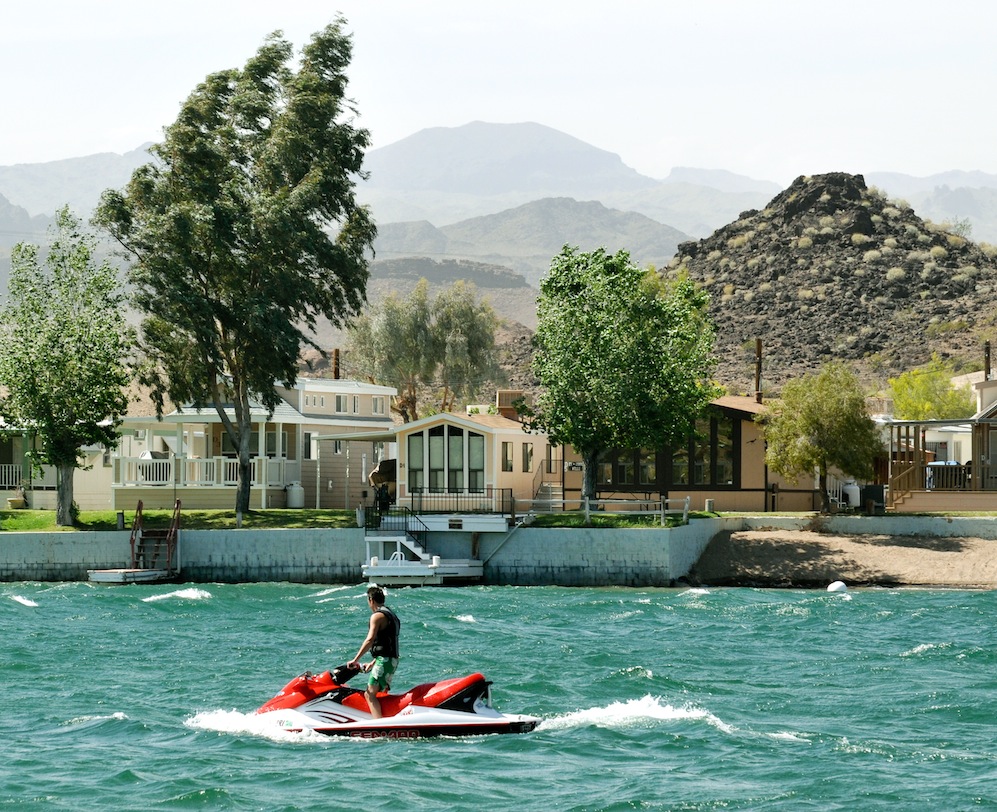
WILL THIS POPULAR ARIZONA, CALIFORNIA AND NEVADA PLAY GROUND RUN DRY?

THE CAP IN TAKES WATER BENEATH HOOVER DAM.
What happens next year? “Maybe we’ll have a wet year”, seems to the extent of the plan, it’s a lot like me buying lottery tickets for my retirement, its proactive, optimistic but nothing to take to the bank.
I visited the New York Times, the editorial page of the Salt Lake Tribune, the Las Vegas Headlight-Sun, the Los Angeles Times and the Arizona Republic to see how each spun the story about Lake Mead facing shortages. Perhaps the best story I found was a gardening column for the LA Times, complaining that they were getting mixed signals whether or not they should put in lawns. The Vegas spin was more sobering when you realize Sin City gets 90 percent of its drinking water from Mead. Vegas has two large siphons attached to the lake and a third under construction, they are scared–by the end of the year one siphon may be above Mead’s water level and worthless. The new siphon runs through the bottom of the lake and will be able to literally suck Lake Mead dry. Nobody believes that will happen-but the new siphon is nearing completion in spite of setbacks. The Southern Nevada Water Authority has begun pursuing permits necessary to build a $3.5 billion, 300-mile pipeline to shuttle water from the mountains in northern Nevada, many question the plan.
Southern California believes every time a sprinkler is turned on, choices are being made between lawns and their fisheries and still-no one believes anything will change until the courts start ordering changes. Already California water companies are trying to linkup with snow melt from the Northern High Sierra, just in case, they say. Lake Mead’s reservoirs have reached 1087 feet for the first time since 1956 when the lake dropped ten feet in order to fill Lake Powell. These twin reservoirs will require years of snow melt and runoff to make up the deficit and tree ring dating data frankly doesn’t support that optimism, it does suggest the droughts since 1990 frankly are nothing out of the ordinary and things could get worse. Utah has a $2billion “pie-in-the-sky” pipe line planned to bring more water from Lake Powell…water that might not be there. Kinda of reminds me of the Hohokam, all we really find of them are the water canals they built to bring water to the desert and therefore brought life itself.
In Phoenix, the Arizona Republic reports Lake Mead water levels determine drought status on the river under a set of guidelines adopted in 2007 by the seven Colorado River states: Arizona, California, Nevada, Utah, Wyoming, Colorado and New Mexico. If the lake reaches the first drought trigger, measured at an elevation of 1,075 feet above sea level, water deliveries below Lake Mead are reduced by a little more than 10 percent. Additional cutbacks would occur if the lake continued to drop. For Arizona, the stakes are high. Arizona absorbs 96 percent of any water rationing on the river under a decades-old agreement that ensured construction of the 336-mile CAP Canal. Nevada absorbs the other 4 percent under a separate deal with Arizona. Although rationing would affect some users on the river in western Arizona, most of the cuts would come from the canal, whose annual flow of 1.5 million acre-feet would be reduced in stages. (An acre-foot is 325,851 gallons, enough to serve two average families for one year.)
Farmers and users of excess water, such as underground-storage programs, would be affected first. It’s unlikely cities and business in Phoenix and Tucson would lose any water in the earliest stages.

IN SAN LUIS BAJA NORTE MEXICO THE RIVER IS DRY LESS THAN TEN MILES SOUTH OF THE BORDER
“It’s a clear warning,” said Tim Barnett, a scientist and Lake Mead expert from the Scripps Institution of Oceanography who sounded the alarm in 2008 that Mead had a 50% chance of running dry by 2021. “The thing that’s astounding to me is the head-in-the-sand attitude of the bureaucrats that we’ve talked to.” “The water situation in Southern California is serious,” he added, “But I don’t think it’s dire yet. Six months or a year from now, we might not be using ‘serious.’ ‘We might be using dire'”.
During the last decade the Southwest has loss snow pack, vegetation and endured serial wildfires and increased temperature and all the while the region has grown faster than any other part of the US. Study after study predict that climate change will reduce the banked snow pack from 6 to 45 percent over the next half century. Every year more water is drained than deposited with an annual deficit of 1.6 million acre-feet, still without a “full-fledged crisis” most folks won’t do anything. In Las Vegas, for instance”, the “Cash for Grass” program pays homeowners $1-per-square-foot to convert to desert landscaping.
In 2007 the Feds mandated an agreement between the seven US states sharing the rivers flow. The lowest reduction cuts deliveries by 333,000 acre-feet, about half of what Las Angeles consumes in a year. Should the lake’s surface fall another 12 feet to 1075 feet below sea level or about 33 percent capacity. some say this will happen next year. When the 28.5-million-acre-foot reservoir’s surface hits 1,050 feet, or about 26 percent capacity, deliveries get slashed by 417,000 acre-feet, Las Vegas shuts down one of its two intakes and Hoover Dam’s massive turbines lose the hydraulic pressure needed to generate electricity. The maximum cutback of 500,000 acre-feet kicks in when Mead surfaces hits 1,025 foot, or about 20 percent capacity.

YUMA WATER USERS
The mighty Colorado carries the lifeblood of the Southwest. It services the water needs of an area the size of France, in which live 40 million people. In its natural state, the river poured 15.7 million acre-feet of water into the Gulf of California each year. Today, twelve years of drought have reduced the flow to about 12 million acre-feet, and human demand siphons off every bit of it; at its mouth, the riverbed is nothing but dust.
The U.S. intelligence community understands what is happening, according to one report released last year, the global need for water will exceed the global supply of “current sustainable water supplies” by 40 percent by the year 2030…
SUENO THE HARRIS HAWK

HAWKS are meat eating machines and they are the homeowners friend, pack rats are a favorite meal says Kathie Schroeder a Arizona Wildlife rehabilatator who raised Sueno the Harris Hawk from birth. The State and Federally licensed wildlife advocate says her Hawk prefers “Jackrabbit” when they can get it, but occasionally, a Yorkie or Daschund, will do in a pinch. Schroeder says the birds live and feed in family groups and often one will land to flush out a jackrabbitt from a bush so the others can nail it with their razor-sharp talons. She said a UA study showed 75% of the annual birth may die through electrocution, so Tucson and Electric Power Company, has developed a Raptor Protection Program which reacts when customers report raptors nesting or perching near energized wires. Hawks mate for life says Schroeder but infidelities have been reported but if lucky, a hawk, may live twelve years. Schroeder said the Oro Valley Country Club grounds is a big feeding place for raptors and several nests have been reported around Oracle Junction and further north along the Pinal Parkway others reports a golden eagle has been seen in the Pima Canyon area. The Horned Owl is the only real predator of the Harris Hawk, she says, owls do not build nests and will often land there, eat the Harris Hawk’s young and leave their young in the newly vacated nests. The Harris Hawk is said to often return the favor, resettling the nest and starting over after snacking on baby Horned Owls. To report nesting raptors near energized wire call 623-7711<img src=" ” alt=”schroederwsueno” />
OFF TO A GOOD START
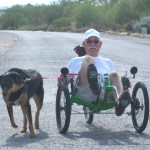
Every morning about an hour before sunrise Chester and I head out for our walk. Its quiet and the coolest it’s going to be for the rest of the day. Now days the humidity has dropped our walk down to about 2 miles but it takes about the same time due to Chester’s slowing pace–the monsoon humidity really heats things up quickly and he slows.
Regardless, it’s the act of doing, being there, getting the exercise, awaking to the day on the walk, watching the sun flirt with the rim of Pusch Ridge and finally getting home just as the sun peaks over the ridge and into my valley. Things are going to get hot and its time to head for the house, maybe some quick yard work and then slaving away on the computer. It is the morning walk that gets the blood pumping, allows for meditation and mapping out the day and assures we’re up and ready for the morning.
Many of my neighbors, meet me out there everyday–same time and same place and we always reflect on the weather and in Tucson, that makes for a short conversation.
Maybe another month, perhaps five weeks, and our best weather of the year will be upon us and our walks become blessed and full of anticipation. I should be able to sleep-in a bit and have less pressure to beat the sun. Chester is always excited about our early start and it his joy and how he savors and relish his morning outing that fuels my walking the most and why I don’t sleep in when I would rather crawl slowly from the bed. In the final exam, my doctor and vet, both believe the morning jaunt does us both a lot of good and when it comes to my doc, anything I can do to make him happy is important, he finds so little. And I owe all of it to Chester, my faithful walking companion.<img src="http:// ” alt=”walkingthedawg3512.jpg” />
SOUTHWEST DROUGHT ENDS LIFE 700 YEARS AGO … WILL TUCSON be the next CHACO
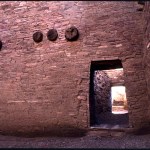
WATER is always a emotional topic in the Southwest United States. Talk of water rights and who owns the rights to Green Valley’s CAP allotment, can they sell it and who can use the Central Arizona Project will always be big news and the fights will just get bigger and more important as time goes by. The new CAP spur being built to Green Valley is said allow the new ROSEMONT MINE access to all the water they will need but what about LOS ANGELES and LAS VEGAS, I thought these U.S. cities got whatever water that was left over and wasn’t sent south to MEXICO and we owe MEXICO water by TREATY. Shall we assume since the mine will not have to pump ground water that its construction on the slopes of the Santa Rita Range is now a slam dunk. Better get used to the idea says Congresswomen Gabbie Giffords. According to Giffords, there has never been a Copper Mine not allowed to be built in ARIZONA because of the 1872 Mining Law, a law written, passed and enacted long before Global Warming

Abandoned due to drought which made farming impossible, fuel scarce and building supplies 50 miles away.




 SOUTHWEST PHOTO JOURNAL